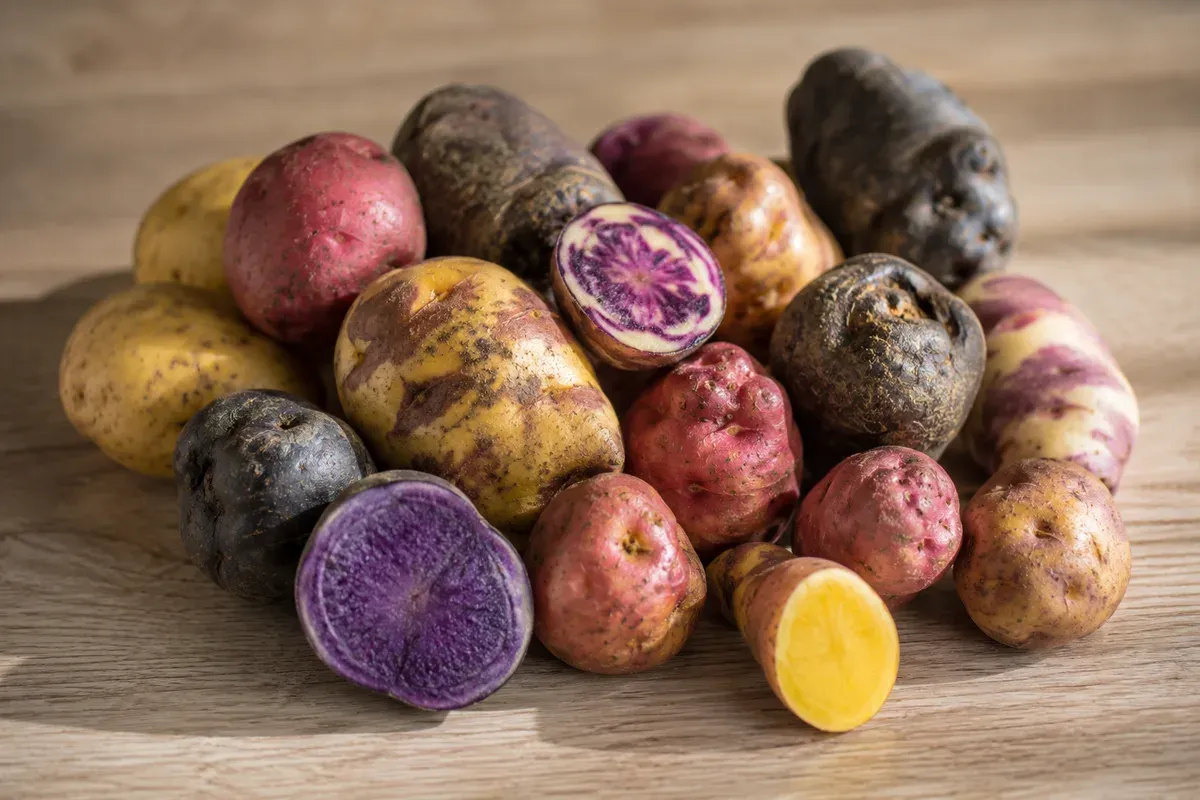
The potato was domesticated on the shores of Lake Titicaca somewhere between seven and ten thousand years ago, and Peru never stopped breeding it: the country is home to thousands of native varieties — Peru's International Potato Center safeguards over four thousand in its collection — in colors from butter-yellow to violet to ink-black, in shapes from golf ball to llama hoof, with names like puma maki (puma's paw) and yawar huayco (river of blood). A highland market stall is a geology display you can cook. We live in the middle of this abundance, and this guide is our attempt to make it useful rather than just impressive: which potato families actually matter at the stove, what each does best, and what to buy abroad when the market only knows four kinds.
Walk through our market on any morning and the potato section is its own little country: open sacks of papa amarilla, huayro, peruanita and the dark pigmented ones, sold by the kilo for less than you'd believe, the sellers calling "llévese, casero" — take some, casero — as you pass. That word runs both ways: she is your casera, the vendor you have bought from for years, and you are her casero right back. It is a small thing, and it tells you most of what you need to know about how a Peruvian market works. My family buys amarilla for huancaína and causa, huayro for the week's stews because it drinks the broth, and a handful of the purple ones whenever they look good — just to boil in their skins and eat with cheese. Nobody here learns potatoes from a book; you learn them one sack at a time.
The grammar of potatoes: floury vs. waxy
Cut through the thousands of varieties and the kitchen question is always the same one: how much dry matter does the potato carry? Floury (harinosa) potatoes are high in starch and low in water — they mash silkily, absorb sauces, and collapse into soups to thicken them. Waxy (cerosa) potatoes hold their shape through boiling — they're the ones for stews, salads and any dish where the potato must survive intact. Every potato in this guide, and every potato in your supermarket, lives somewhere on that line. Learn the line and you can improvise across continents.
The five names worth knowing
- Papa amarilla. The queen. Deep golden flesh, floury and almost buttery on its own — the obligatory potato for causa and huancaína, and the one Peruvians abroad miss like a relative. Closest substitute: Yukon Gold, which is genuinely good, just less intense.
- Papa huayro. The stew specialist of the central highlands — elongated, reddish-purple skin, flesh that drinks broth like bread. Beloved in our region for exactly that thirst. Substitute: a red waxy potato, accepting you'll lose the absorbency.
- Papa peruanita. Small, bicolor (yellow splashed with pink), floury, and the classic boiling potato served simply with cheese or an ají sauce. Substitute: small Yukon Golds or yellow creamers.
- Papa negra / mariva. Dark-skinned, cream-fleshed, the dependable all-rounder of Lima kitchens — fries well, boils well, complains never. Substitute: any good all-purpose potato.
- Papas moradas y pigmentadas. The purple and red-fleshed natives, colored by the same anthocyanins as maíz morado. Earthy, dense, spectacular roasted or boiled in their skins. Abroad: Purple Majesty and similar varieties are direct descendants and widely sold.
In the Andes, "potato" is not an ingredient. It's a category of the universe, like weather.
Chuño: the potato that learned to wait
No guide from the highlands can skip chuño — the freeze-dried potato invented in the Andes millennia before the term existed. Small bitter potatoes are spread on the ground through freezing June nights, thawed by day, trodden to press out moisture, and dried until they turn light as cork and keep for years. Black chuño and its washed white sibling (moraya or tunta) are pantry staples up here, rehydrated into soups and stews with a flavor — mineral, faintly fermented — that no fresh potato has. Abroad it appears in Bolivian and Peruvian groceries; treat your first encounter as an education, not a substitution.
Where to buy Peruvian potatoes outside Peru
Three moves cover nearly everything. For golden floury dishes (causa, huancaína, mashes): Yukon Gold. For shape-holding jobs (stews, soups where the cube must survive, boiled sides for anticuchos): any red or fingerling waxy potato. For color and occasion: the purple varieties now common in good supermarkets. And when a farmers' market offers an heirloom you don't recognize — buy it, boil it in its skin, taste it with nothing. That's how every Peruvian learns potatoes, one variety at a time.
The simplest recipe in Peru: papas con queso
The highland way to actually taste a potato variety — and a complete lunch up here.
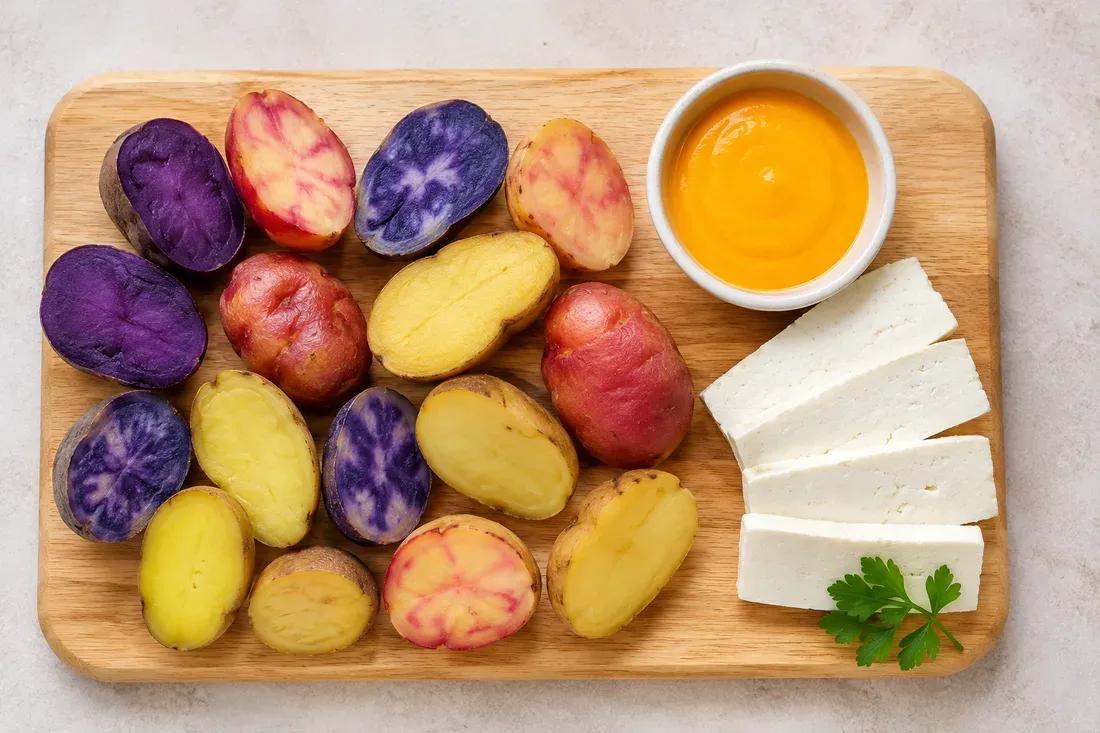
- 1 kg of the most interesting potatoes you can find, similar sizes, skins on
- 200 g queso fresco, in thick slices
- An ají sauce — even a quick blend of ají amarillo paste, a little oil, lime and salt
- Boil the potatoes in their skins in well-salted water until a knife slides in, 20–25 minutes.
- Drain and serve hot, whole, in the middle of the table with the cheese and the ají beside.
- Eat with your hands: peel as you go (or don't), a bite of potato, a bite of cheese, a swipe of ají. Repeat until the variety has explained itself.
Peruvian potato troubleshooting, from experience
Your "yellow potato" causa came out bland. Supermarket yellow ≠ papa amarilla; compensate with seasoning (more ají, more lime) rather than mourning the tuber.
The potatoes burst in the pot. A rolling boil tears waxy skins. Salted water at a gentle simmer, always.
Purple potatoes turned gray-blue when boiled peeled. The pigment bleeds; boil them in their skins (anthocyanins, same chemistry, same rule as keeping mazamorra vivid).
Where this guide points next
Every potato recipe on this site leans on these families: causa and huancaína on the golden flours, caldo and the stews on the shape-holders, and pachamanca on whatever the harvest brought. Master the line between floury and waxy, and the rest of Peruvian cooking stops asking you for varieties and starts asking you for judgment.

Junior Quintana learned to cook from his mother, Lina, in Junín, in the central Peruvian Andes — a kitchen where chicha morada simmered every Sunday and there were always native potatoes with cheese and choclo on the table. He started Andean Kitchen to share the food he grew up with, in English and without shortcuts: every recipe cooked and tested at home, where it's really made. His favorite dish is, and probably always will be, pachamanca. See how we cook, test and photograph.
Did you cook this?
Tell me how it went — including what did not work. I read every one, and with your permission I will put it on this page, with your first name, for whoever comes next.