About
Hi, I'm Junior — this is my kitchen.
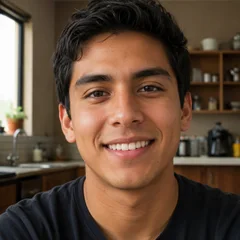
I'm Junior Quintana, and I cook and write Andean Kitchen from Junín, a highland region in the central Andes of Peru, at roughly 3,200 meters above sea level. That detail matters more than it sounds: water boils here at 89 °C, the potatoes come in colors most of the world has never seen, and the dishes I publish are the ones actually cooked in the homes around me — not adaptations of adaptations.
I learned to cook from my mother, Lina, in a kitchen where chicha morada simmered every Sunday and there were always native potatoes with cheese and choclo on the table. I started Andean Kitchen after one too many "authentic Peruvian recipes" online that called for ingredients no Peruvian kitchen has ever held, or skipped the steps that make a dish what it is. Our food has earned the world's attention; I think it also deserves to be explained accurately, in English, from inside the country where it's made.
Cooking at 3,200 meters
Altitude is not a detail I mention for color. Water here boils at about 89 °C instead of 100, and everything that depends on boiling changes with it. Dried beans and chickpeas take noticeably longer. Tough cuts need more time than a recipe written at sea level would tell you. A pressure cooker is not a shortcut in an Andean kitchen — it is standard equipment, and it is why so many highland stews assume you have one.
This cuts both ways, and it is worth saying plainly: if you are cooking at sea level, some of my simmering times will be longer than you need. Where it matters enough to change the result, I say so in the recipe. Where it does not, I leave it alone. I would rather tell you the pot is different than pretend every kitchen behaves the same.
How I work
Every recipe here follows the same process:
- Cooked at home, at least twice. Once the traditional way, and once testing the substitutions I recommend for readers cooking abroad.
- Honest about substitutes. When an ingredient is hard to find outside Peru, I say so and rank the realistic alternatives — including when there simply isn't a good one.
- Context included. A dish is also its history, its region and the occasion it's served at. I keep that part short, but I keep it.
What you'll find here
Recipes from the coast, the highlands and the jungle; guides to the Andean pantry (ají amarillo, native potatoes, quinoa, maíz morado and friends); and the occasional opinionated note about how Peruvian food gets represented abroad. New recipes go up every Tuesday and Friday. My own favorite is, and probably always will be, pachamanca.
There are more than 70 recipes published here so far. Every recipe on the site was cooked in this kitchen, and every picture shows that dish — never a stock image, never a dish someone else cooked. You can read exactly how I cook, test and photograph if you want the long version.
The words I keep, and why
The Quechua I grew up hearing is wanka, the variety spoken in Junín — not the Cusco Quechua that most of the internet quotes. They are not the same, and a Peruvian notices the difference immediately, the way an English speaker notices someone using a word they read but never heard.
So I keep the words. When a dish has a name in Quechua, or a technique has a name in Peruvian Spanish that English flattens into something duller, I use the real one and explain it the first time. There is a glossary of every term on the site, grouped by the language it came from — Quechua, Cantonese from the chifa kitchens, Tupi–Guaraní from east of the Andes, and one stray Arabic word that arrived by a very long road.
Peru has dozens of living languages. A dish from Puno and a dish from Ucayali do not speak the same one, and treating the whole country as monolingual is the fastest way to write about it inaccurately.
What I do not know
The highlands are home. The coast and the Amazon are not, and I do not pretend otherwise. When I publish a dish from Lambayeque or Iquitos, I say where I learned it and whether it was on my table growing up — usually it was not. I would rather write “I ate this properly for the first time as a guest in the north” than invent a childhood memory to sell a recipe.
The same applies to history. Some dishes have a documented origin. Plenty have three versions of it, all defended by serious people, and where that is the case I say the question is open instead of picking whichever story reads best.
A note on photos and ads
All the recipes, writing and food photography on this site are my own original work. Andean Kitchen may show advertising to help cover the cost of ingredients, hosting and the time it takes to test recipes properly. Ads will never influence which recipes I publish or what I say about them.
Questions, corrections, or a dish you'd like me to explain? Write to me — I read everything.