
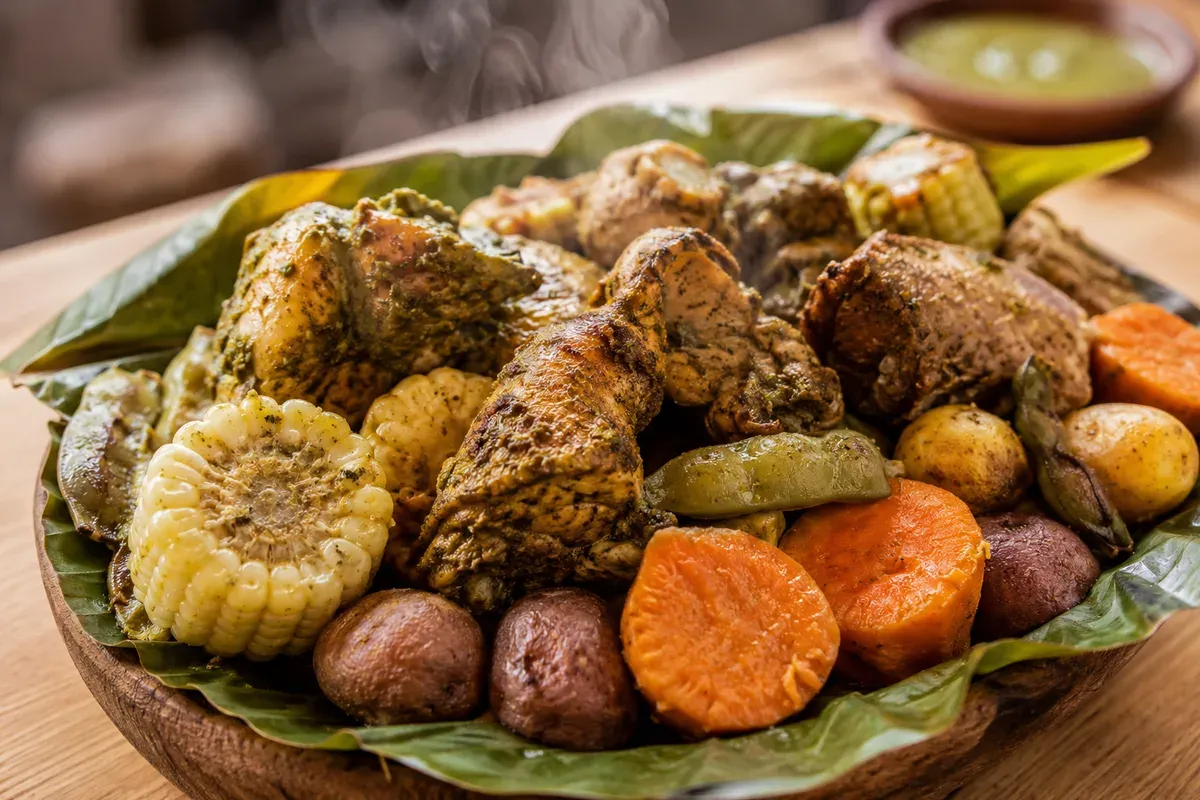
Pachamanca is not a recipe; it's an event with a menu. The word is Quechua — pacha, earth; manka, pot — and it means exactly what it says: the earth is the pot. A pit is dug, stones are heated in a wood fire until they're nearly glowing, and then an entire feast goes into the ground in layers — marinated meats, potatoes, sweet potatoes, fava beans, corn, humitas — covered with herbs, sacks and soil, and left to cook in the planet's own heat. An hour later the mound is opened like a gift in front of everyone, steam rolls out smelling of huacatay and roasted earth, and the eating begins. Here in Junín, where we write from, pachamanca isn't heritage-museum food: it's what happens when there's a harvest, a birthday, a roof to celebrate or a Sunday in the dry season with enough family in town.
This article does two honest jobs. First, it explains the real thing — how the earth oven actually works, what goes in, and why February through April is its season — because almost nothing accurate exists about it in English. Second, it gives a home adaptation for a normal oven that we'll defend as a tribute, not a replica: you cannot bake a planet, but you can borrow its logic.
Where we live, a pachamanca is still a reason to give up a whole Sunday. There is always one person — an uncle, a neighbor, the man everyone simply calls the maestro — whose authority over the stones is total, who has the pit dug and the fire going on the rocks while the rest of us are still arriving. Chicken, pork and lamb go under a green blanket of huacatay; the children haul the herbs, the adults stay out of the maestro's way. And when the mound is finally opened and the steam climbs out smelling of earth and huacatay, the whole table goes quiet for a second before anyone dares reach in. That hush is the dish.
How the earth oven works
The physics are elegant. Stones — volcanic or river stones that won't crack — are stacked over a hard wood fire for two or three hours until they hold tremendous heat. The pit is then assembled in strict order: hottest stones at the bottom, then the slowest-cooking layer (potatoes and sweet potatoes, directly against the stone), more stones, then the meats wrapped or interleaved with marinade, then the quick layer — fava beans in their pods, corn, humitas — then a blanket of aromatic herbs and clean sacks, and finally earth shoveled over everything until not a wisp of steam escapes. The seal is the technique: pachamanca is simultaneously baking, steaming and smoking, at falling temperature, for about an hour to ninety minutes.
Opening it is choreography in reverse and the social peak of the day. There is always one person — every town has them — whose authority over the pit is absolute, who reads the heat by hand and decrees the opening. Argue with the cook of a pachamanca and you will eat last.
Pacha, earth; manka, pot. The dish is named after its oven, and the oven is the planet.
The flavor signature: huacatay and chincho
If the earth is the oven, the herbs are the identity. The marinade — and the green blanket over the layers — is built on huacatay (black mint, a marigold relative with a flavor between mint, basil and something wilder) and its highland cousin chincho, harder to find but prized precisely for that. Blended with ají amarillo, ají panca (the dark chile from our anticuchos), garlic, vinegar and cumin, they make the red-green paste that stains the meats overnight. Abroad, jarred huacatay paste exists in Latin groceries and online; a fallback blend of mint, basil and a little cilantro gestures in the right direction without quite arriving — say so honestly to your guests and nobody will mind.
What goes in the ground
The classic load, region by region with local pride attached: chicken, pork and lamb (in Junín, often all three); potatoes in their skins — this is the dish where native varieties shine, cooked against the stone until their skins crisp like paper; camote (sweet potato); habas (fava beans) steamed inside their own pods; corn; and humitas, fresh-corn parcels that deserve their own article. Everything emerges tasting of itself plus smoke plus herbs plus mineral — a flavor that has no shortcut, which is the point of going to the trouble.
The home version: borrowing the logic
What the oven adaptation keeps: the overnight herb marinade, the strict layering (roots at the bottom where it's hottest, quick things on top), and above all the absolute seal — banana leaves or parchment plus a double crimp of foil, opened only at the table. What it loses: the stones' fierce initial heat and the smoke of the earth. The result is genuinely delicious — herb-steamed meats, potatoes perfumed through their skins — and it converts skeptics. Just never call it pachamanca in front of someone from the sierra without smiling.
The home recipe (oven "pachamanca")
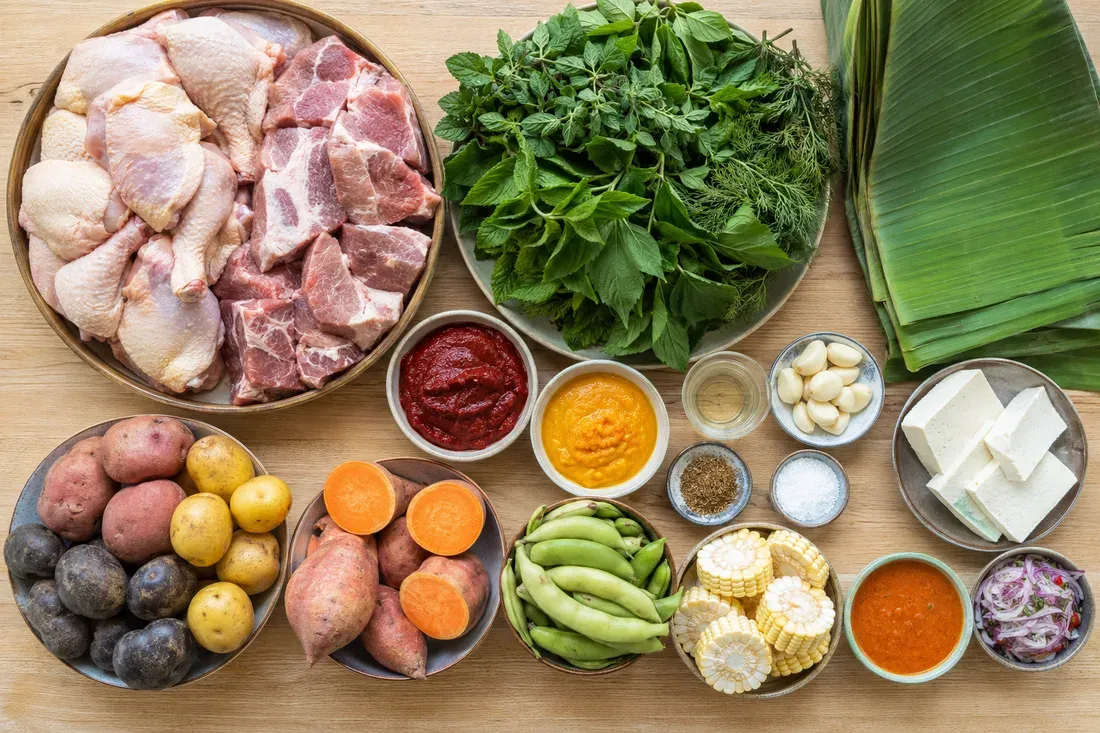
Ingredients
- 1 kg chicken legs and thighs, bone in · 1 kg pork shoulder in large pieces (add lamb if your table runs serrano)
- 100 g fresh huacatay leaves or 4 tbsp huacatay paste
- 50 g chincho if you can find it (or more huacatay) + a handful of mint and oregano
- 4 tbsp ají panca paste · 2 tbsp ají amarillo paste
- 6 garlic cloves · 4 tbsp vinegar · 1 tsp cumin · salt and pepper
- 1 kg mixed potatoes, scrubbed, skin on (the more varieties, the better)
- 2 sweet potatoes, halved · 500 g fava beans in their pods · 2 ears of corn in thick rounds
- Banana leaves (Latin/Asian groceries, frozen is fine) or parchment, plus heavy foil
- To serve: fresh cheese in slabs, ají sauce, salsa criolla
Method
- Marinade, the night before. Blend herbs, ají pastes, garlic, vinegar, cumin, salt and pepper into a thick paste. Massage into the meats, cover, refrigerate overnight. Reserve a few spoonfuls.
- Layer like the pit. Line your deepest roasting pan with banana leaves, edges overhanging. Bottom: potatoes and sweet potatoes. Middle: the meats with their marinade. Top: favas in their pods, corn rounds, the reserved marinade spooned over, more herbs if you have them.
- Seal like you mean it. Fold the leaves over, then a double layer of foil crimped to the pan's edges. The test: no steam escapes, ever. The seal is the dish.
- Bake blind. 180 °C, 2 hours, zero peeking — every peek costs you the steam that's doing the cooking. Rest 15 minutes, still sealed.
- Open at the table. This is non-negotiable theater: the unveiling, the steam, the smell, the applause. Serve heaped, with cheese, ají and criolla.
Troubleshooting, from experience
The potatoes were underdone. They strayed from the bottom, or the pieces were giants. Bottom layer, fist-sized maximum, always.
It came out soupy. The marinade carried too much liquid or the vegetables wept. Thicker paste next time — and the broth at the bottom, poured over rice, is not a flaw, it's a bonus the pit version never gives you.
It lacked the "earth" depth. Correct — that's the planet's share, and the honest limit of the adaptation. A pinch of smoked paprika in the marinade fakes a whisper of it. For the real thing: come to the sierra between February and April, when the harvest pachamancas start, and write to us first.
What to serve it with
Pachamanca is the whole meal by design; the additions are liquid and ritual. Chicha morada by the pitcher, chicha de jora where tradition runs deep (article coming), and afterwards — if anyone claims to have room — picarones, because a feast that began underground should end at the fryer.

Junior Quintana learned to cook from his mother, Lina, in Junín, in the central Peruvian Andes — a kitchen where chicha morada simmered every Sunday and there were always native potatoes with cheese and choclo on the table. He started Andean Kitchen to share the food he grew up with, in English and without shortcuts: every recipe cooked and tested at home, where it's really made. His favorite dish is, and probably always will be, pachamanca. See how we cook, test and photograph.
Did you cook this?
Tell me how it went — including what did not work. I read every one, and with your permission I will put it on this page, with your first name, for whoever comes next.