
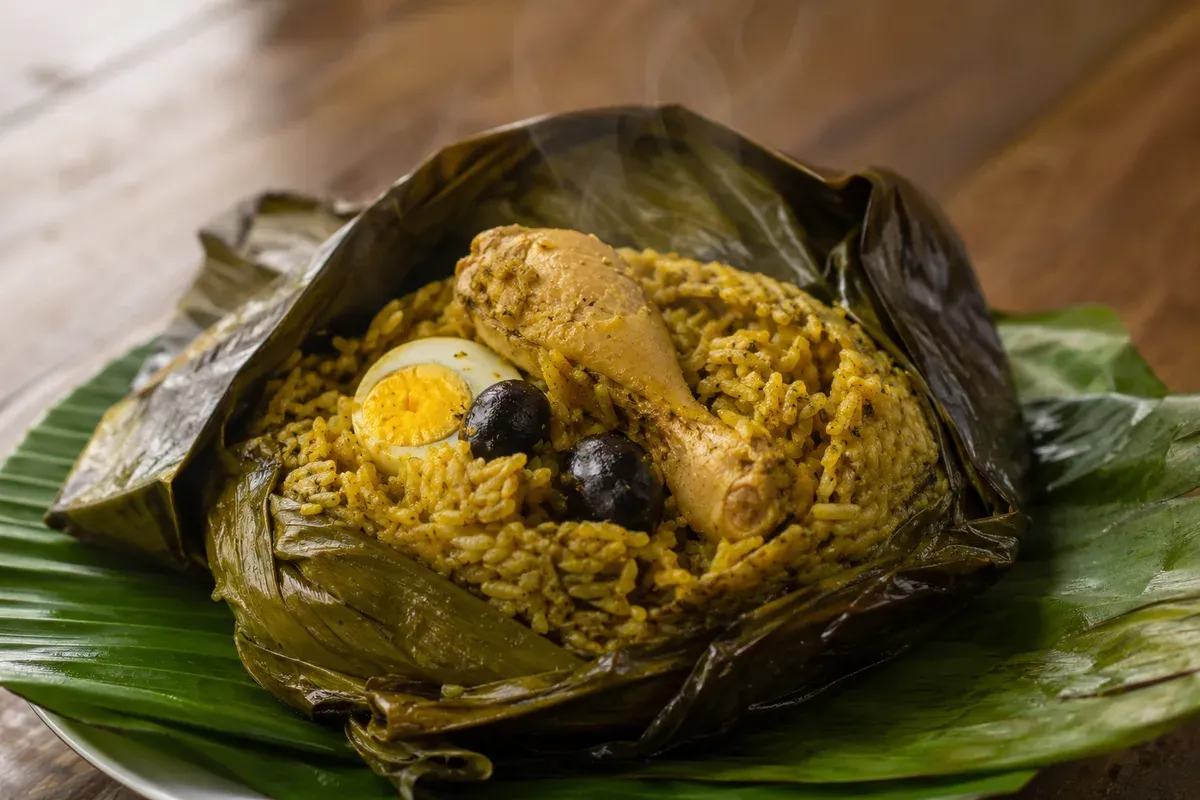
Every June 24th, the cities of the Peruvian Amazon stop for the Fiesta de San Juan, and the dish of the day — of the week, really — is the one named for the saint himself: juane, a dome of golden turmeric rice hiding a braised chicken thigh, half a boiled egg and a pair of olives, all wrapped in fragrant bijao leaves and steamed into a portable, self-contained feast. The shape, local tradition says with cheerful darkness, recalls the head of John the Baptist; the practicality is older than the story — a sealed leaf bundle is the jungle's original lunchbox, made to travel by canoe and keep for days in the heat.
For the home cook far from the selva, juane is the most rewarding kind of project dish: every component is simple, the assembly is genuinely fun, and the moment of unwrapping at the table — steam, perfume, the little surprise of egg and olive — is theater no plated dish can match. The one substitution everyone abroad makes is the leaf, and it's a good one: banana leaves (frozen at any Asian or Latin grocery) carry the spirit honorably, though bijao's particular grassy perfume remains the jungle's home-field advantage.
I didn't grow up anywhere near the Amazon, but juane still found its way to me. Junín reaches from our highlands all the way down into Selva Central — Satipo, Chanchamayo — the strip of jungle that borders the mountains, and every June the wrapped bundles start showing up in our markets, carried up still warm, leaves still damp. Buying one felt like the jungle had sent a package north. If your own family keeps a small chacra — Quechua for a family plot of land, the unit that still organizes a lot of rural Andean and Amazonian life — you already understand the instinct behind the wrapping: nothing travels better than food sealed in what grew around it.
The rice does the engineering
What holds a juane together isn't hope — it's egg. Beaten eggs folded through the warm seasoned rice set as the bundle steams, binding the dome so it unwraps intact instead of avalanching. The rice itself cooks in the chicken's braising liquid, stained gold with palillo (Peruvian turmeric — ordinary turmeric is the same plant family and the right call abroad) and seasoned with cumin and oregano. Cook it just barely done; it finishes inside the leaves, and overcooked rice plus steam equals a juane with the texture of regret.
A juane is judged at the unwrapping: the dome must hold, the steam must rise, and the egg must surprise exactly no one and delight everyone.
Wrapping without growing up in Tarapoto
Bijao or banana leaves both need softening first — passed quickly over a flame or dipped in hot water until they turn glossy and pliable instead of crackly. The fold: two leaves crossed shiny-side up, rice mounded in the center, the treasures nested in, more rice over, then the leaves gathered upward like a money bag and tied firmly with twine. Your first juane will look homemade. So does everyone's. By the third, your hands understand.
The recipe
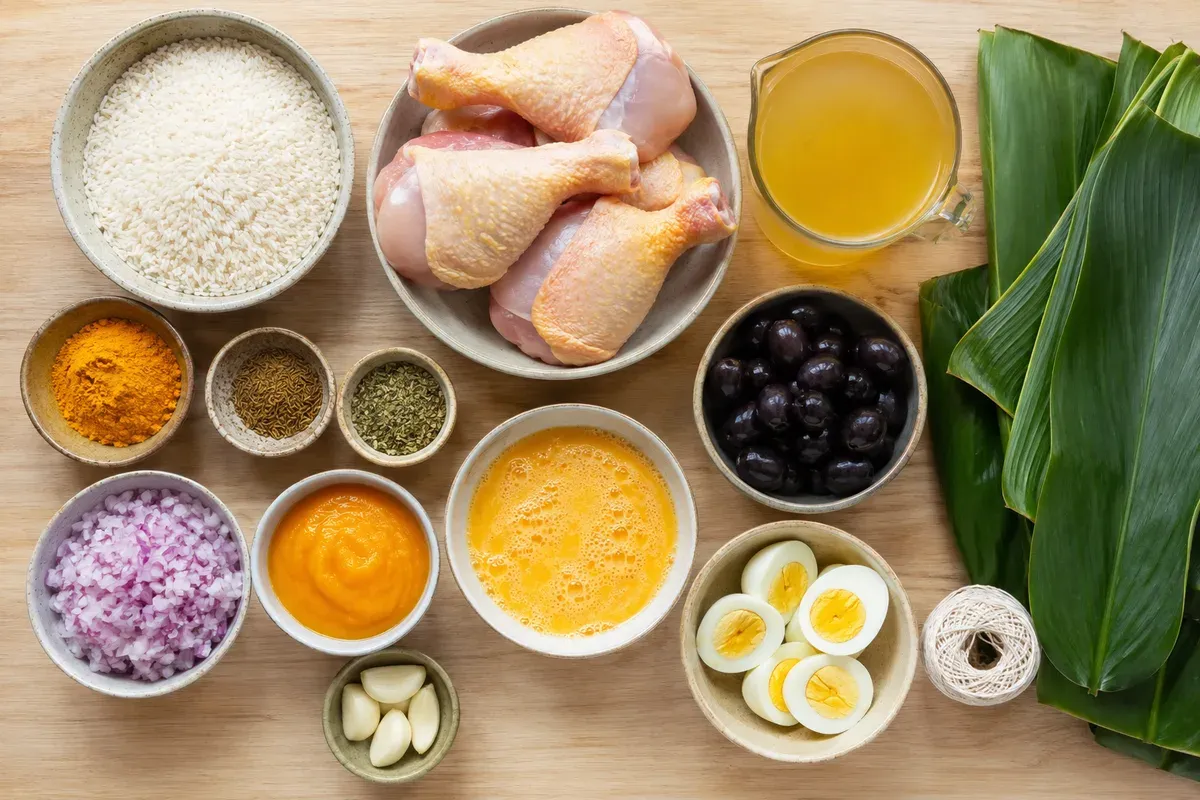
Ingredients
- 6 chicken thighs, bone-in
- 3 cups rice
- 2 tsp ground turmeric (palillo) · 1 tsp cumin · 1 tsp dried oregano
- 1 onion, diced · 4 garlic cloves, minced · 2 tbsp ají amarillo paste (optional, welcome)
- 4 eggs, lightly beaten · 3 hard-boiled eggs, halved
- 12 black olives
- ~4½ cups chicken broth (the braise provides most of it)
- 12+ banana or bijao leaf pieces (~30 cm), softened over a flame · kitchen twine
- Oil · salt · pepper
Method
- Braise the chicken. Brown the seasoned thighs; add half the aderezo (onion, garlic, spices, ají) and broth to cover. Simmer 25 minutes. Pull the chicken; strain and measure the liquid to 4½ cups, topping with broth.
- Golden rice. Cook the rice in that liquid with the remaining aderezo — absorption method, stopping at just-done. Cool 10 minutes.
- Bind. Fold the beaten eggs through the warm rice until evenly slicked.
- Assemble. Crossed leaves; a fat cup of rice; one thigh, half an egg, two olives nested in the middle; rice over to bury the treasure; leaves gathered and tied like a generous purse.
- Steam. Bundles in a big covered pot with 3–4 cm of water (a steamer basket helps; stacking is fine). 30–40 minutes at a steady simmer.
- Rest and unwrap 10 minutes, at the table, where the steam belongs to everyone.
Troubleshooting, from experience
The dome collapsed. Eggs skipped or rice too cool when they were folded in. Warm rice, honest eggs.
Mushy rice. It was fully cooked before steaming. Just-done is the law; the leaves finish the job.
The leaves tore. Not softened enough, or asked to do it alone. Flame them until glossy, and double-wrap without shame.
What to serve it with
On San Juan the juane rarely eats alone: a fierce little criolla with hot chile cuts the richness, chicha morada keeps the peace, and the spare juane in the fridge is tomorrow's prize — it reheats in its own leaves like it was designed to. It was.

Junior Quintana learned to cook from his mother, Lina, in Junín, in the central Peruvian Andes — a kitchen where chicha morada simmered every Sunday and there were always native potatoes with cheese and choclo on the table. He started Andean Kitchen to share the food he grew up with, in English and without shortcuts: every recipe cooked and tested at home, where it's really made. His favorite dish is, and probably always will be, pachamanca. See how we cook, test and photograph.
Did you cook this?
Tell me how it went — including what did not work. I read every one, and with your permission I will put it on this page, with your first name, for whoever comes next.