
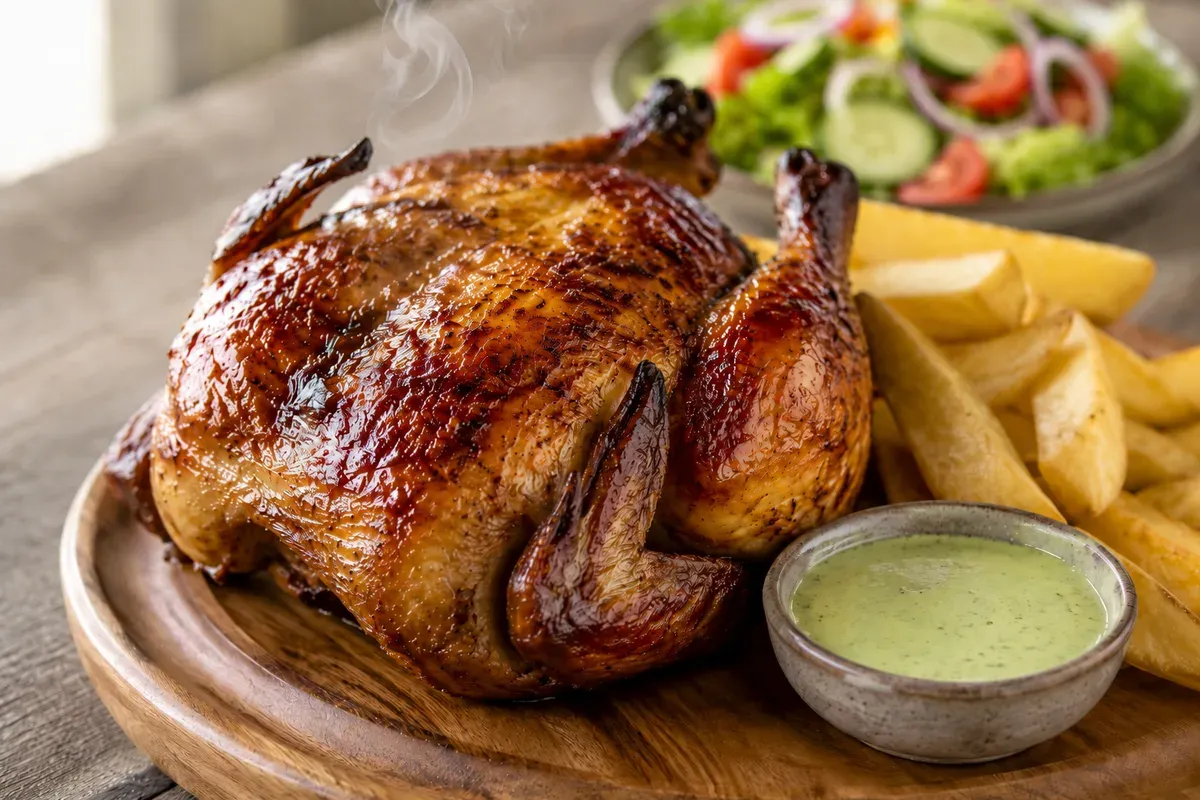
No dish unites Peru like pollo a la brasa. It has its own national day (the third Sunday of July), its own restaurant category — the pollería, with its glass-fronted rotisseries turning dozens of birds over wood and coals — and a place in the country's heart that statistics keep confirming: when Peruvians eat out, more often than not, this is what they're eating. The dish was born in the 1950s outside Lima, when Swiss immigrant Roger Schuler turned a farm's surplus chickens into a restaurant concept built around a custom rotisserie; the marinade Peruvianized fast, the wood smoke stayed, and seventy years later the smell of a pollería at 7 p.m. is the national clock striking dinner.
Let's be honest about the home version upfront: you don't have a wood-fired rotisserie, and we won't pretend an oven is one. What an oven can deliver, with the right marinade and method, is ninety percent of the experience — the lacquered mahogany skin, the smoke-adjacent depth of ají panca and cumin, the juicy interior — plus the two components that are fully replicable and absolutely non-negotiable: a mountain of fries and the creamy green ají sauce, without which pollo a la brasa is legally just roast chicken.
In my house a whole pollo a la brasa was never a solo purchase — it was a family production. Someone put in for the bird, someone else for the fries, and by the time the smell hit the street everyone already knew whose turn it was to go pick it up. We call that pooling money together hacer una vaca — literally "make a cow," Peru's all-purpose slang for chipping in as a group — and a whole chicken split five ways, with extra ají verde smuggled home in a used yogurt container, is one of the most Peruvian things a family can do on a Sunday. The papas alongside carry their own quiet history: the word travels straight from Quechua, the language that named the potato centuries before it ever met a fryer.
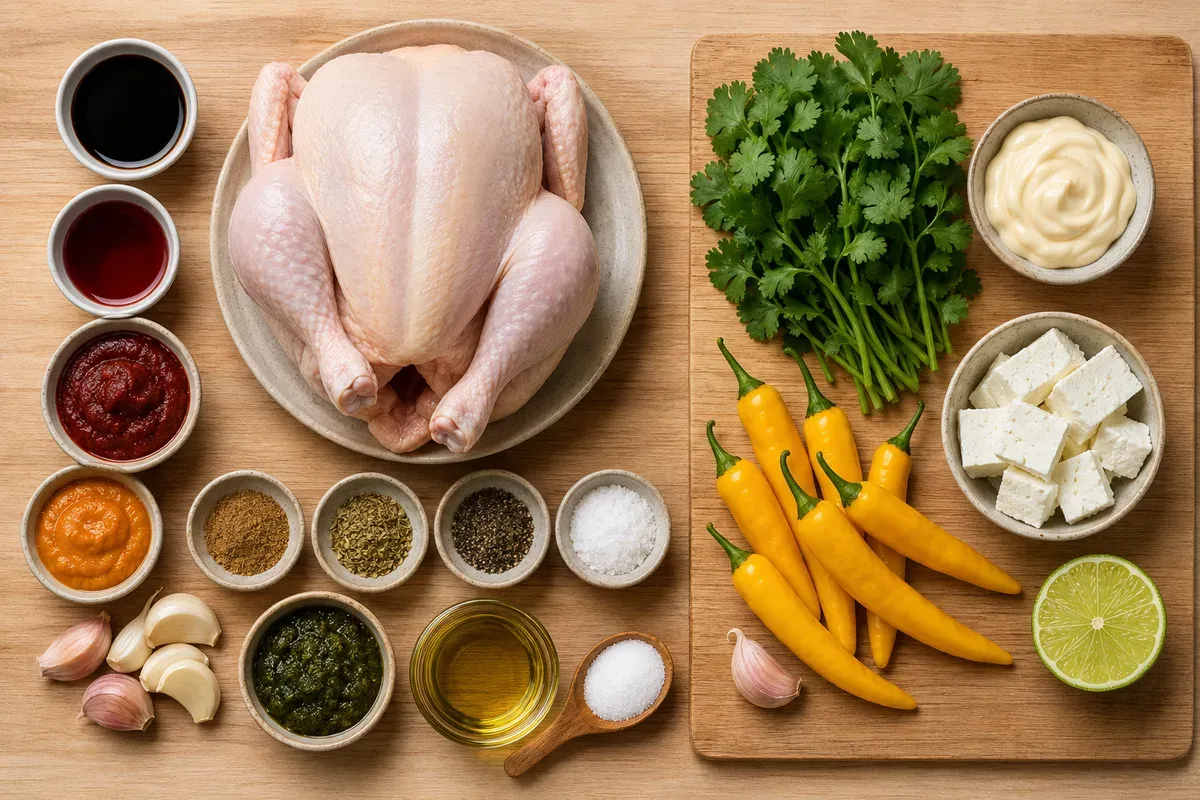
The marinade: where the depth lives
Pollería marinades are guarded like state secrets, but the home consensus is well mapped: soy sauce (the chifa fingerprint again — see lomo saltado's family history) for salt and umami, vinegar for tang and tenderness, ají panca for the dark red, faintly smoky base (the same chile that powers anticuchos), a touch of ají amarillo, and a firm hand with cumin, garlic, oregano and black pepper. Huacatay — Andean black mint — is the insiders' note; the paste is sold in jars at Latin groceries, and a little dried rosemary is the accepted home stand-in. A teaspoon of sugar helps the skin lacquer.
Two rules turn the marinade from coating into seasoning: it goes under the skin (loosen it gently from the breast and thighs with your fingers) as well as over, and it gets 12 to 24 hours in the fridge. The overnight wait is the single biggest gap between homemade attempts and the pollería; don't negotiate with it.
The rotisserie you can't replicate. The overnight marinade you can — and it's the half that matters most.
Ají verde: the sauce is half the dish
Every pollería table carries squeeze bottles of the creamy green sauce, and every Peruvian abroad has tried to reverse-engineer it. The home formula: fresh chile (ají amarillo if you have it, jalapeño works honestly), a big handful of cilantro, mayonnaise for the cream, a little queso fresco for body and tang, garlic, lime, salt — blended smooth and pale green. It goes on the chicken, the fries, the salad, and eventually on everything you eat for a week. The recipe below makes a generous cup; experienced households double it preemptively.
The recipe
Ingredients
- 1 whole chicken, 1.8–2 kg, patted very dry
- 4 tbsp soy sauce · 3 tbsp red wine vinegar
- 2 tbsp ají panca paste · 1 tbsp ají amarillo paste
- 5 garlic cloves, ground · 1 tbsp ground cumin · 1 tbsp dried oregano · 1 tsp black pepper · 1 tsp salt
- 1 tbsp huacatay paste, or 1 tsp dried rosemary
- 1 tbsp vegetable oil · 1 tsp sugar
Ají verde:
- 2 ají amarillo (cleaned) or 1 jalapeño · 1 cup cilantro leaves · ½ cup mayonnaise · 50 g queso fresco · 1 garlic clove · juice of ½ lime · salt
- To serve: thick-cut fries (real ones, fried or oven, but real) and a simple lettuce-tomato-cucumber salad
Method
- Marinate tonight for tomorrow. Blend all marinade ingredients to a paste. Loosen the skin over breast and thighs; rub paste under it, inside the cavity, and over everything. Into a bag or covered dish, fridge, 12–24 hours.
- Temper. Chicken out of the fridge 45 minutes before cooking. Oven to 200 °C, a rack set over a foil-lined tray (the drippings will be dramatic).
- Roast breast-up, no fussing. About 70 minutes for a 2 kg bird, rotating the tray once at the half. Done at deep mahogany and 74 °C in the thickest thigh. If the skin darkens too fast — the soy and sugar are eager — tent loosely with foil and keep going.
- Rest 10 minutes while you blend the ají verde smooth and fry the last batch of fries.
- Quarter and serve pollería-style: a quarter per person, fries underneath like they live there, salad for conscience, green sauce within everyone's reach. Eating with hands is not permitted; it's expected.
Troubleshooting, from experience
Skin burnt before the inside cooked. Oven too hot or rack too high. 200 °C, middle rack, foil tent on demand.
Flavor only skin-deep. The marinade stayed on top of the skin, or the overnight was skipped. Under the skin, twelve hours — the two rules, again, forever.
The green sauce is watery. Wet cilantro or thin mayo. Dry the leaves, and the queso fresco is your thickener — add more.
What to serve it with
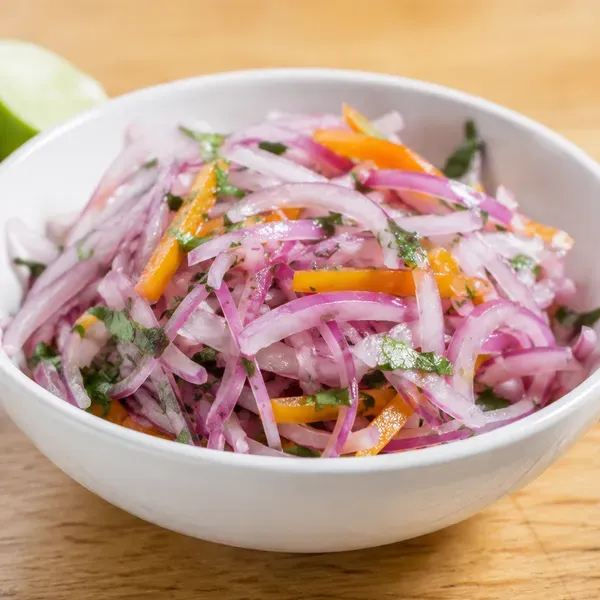
Fries and salad are the constitution; salsa criolla is a welcome amendment, and the pitcher of chicha morada completes what Peruvians simply call un cuarto con papas — the meal that ends arguments. Tomorrow, the leftover quarter becomes the filling of a pan con pollo that needs no recipe, only bread and the remaining ají verde, which you wisely doubled.

Junior Quintana learned to cook from his mother, Lina, in Junín, in the central Peruvian Andes — a kitchen where chicha morada simmered every Sunday and there were always native potatoes with cheese and choclo on the table. He started Andean Kitchen to share the food he grew up with, in English and without shortcuts: every recipe cooked and tested at home, where it's really made. His favorite dish is, and probably always will be, pachamanca. See how we cook, test and photograph.
Did you cook this?
Tell me how it went — including what did not work. I read every one, and with your permission I will put it on this page, with your first name, for whoever comes next.