
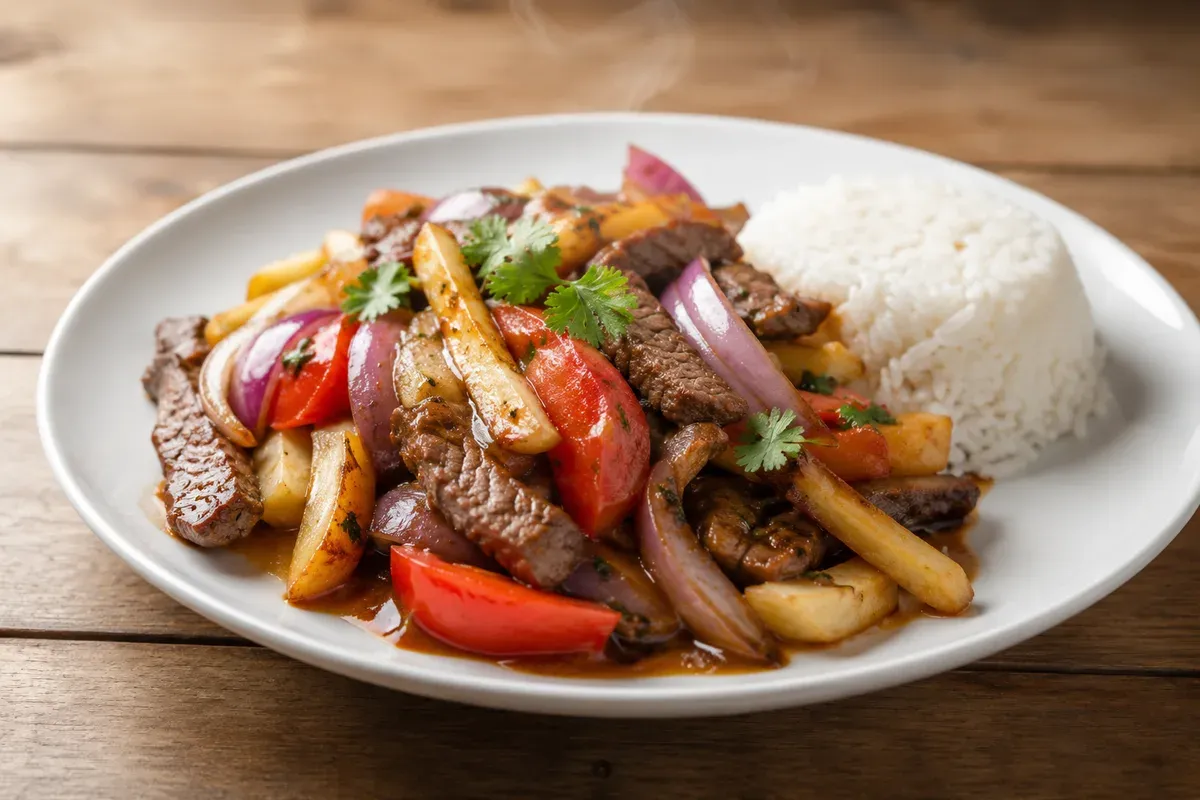
Lomo saltado is what happened when Cantonese wok technique met the Peruvian pantry, sometime in the late 1800s, in the chifa kitchens of Lima. A century and a half later it is arguably Peru's most beloved everyday dish — and one of the most consistently mangled recipes on the English-speaking internet. The errors are always the same: the pan is too cold, the soy sauce is treated like a marinade, and the fries are baked separately "to keep them crispy." All three miss the point.
This is the version cooked in Peruvian homes, including ours. It takes about 35 minutes, most of which is chopping. The actual cooking happens in under four — de una, we say, meaning in one go and no second chances — which is exactly why it goes wrong so often. You cannot fix lomo saltado mid-flight. You prepare everything, then you commit.
It's the dish we cook to prove the kitchen works — the one everyone in the house smells coming and nobody walks away from. We argue the details the way every Peruvian family does: how much vinegar, whether the tomato goes in at all, and the eternal fries-in-the-pan-or-on-the-side question (in the pan, always, no debate at our table). The one thing nobody argues about is the juguito — that dark sizzle of sauce pooling at the bottom of the plate is the entire reason rice was invented.
What makes it lomo saltado (and not just a stir-fry)
Three things separate the real dish from a generic beef stir-fry. First, the juguito: the dark, glossy pan sauce formed when soy sauce and vinegar hit screaming-hot metal and reduce on contact. It should pool at the bottom of the plate and soak into the rice. Second, the vegetables stay almost raw — the onion keeps its crunch, the tomato holds its shape. If your onion is translucent, the pan wasn't hot enough or it stayed in too long. Third, the fries go into the pan at the end, not beside it. Yes, they soften slightly where they touch the sauce. That contrast — crisp edge, sauce-soaked center — is the whole pleasure of the dish.
If your kitchen doesn't smell faintly of smoke when you're done, you cooked it too gently.
Choosing the beef outside Peru
In Peru, lomo means tenderloin, and for special occasions that's what's used. For a weeknight, sirloin (top sirloin or sirloin tip) gives you nearly the same result for half the price. What matters more than the cut is the slicing: strips about as thick as your finger, cut against the grain. Thin strips overcook in seconds and turn gray; thick strips stay rosy inside while charring outside.
Pat the beef completely dry before it touches the pan. Wet beef steams, and steamed beef is the saddest version of this dish.
The ají amarillo question
Fresh ají amarillo is ideal but hard to find outside Peru. The honest substitutes, in order of preference: frozen ají amarillo (many Latin American groceries carry it), jarred ají amarillo paste (one tablespoon replaces one chile), or — as a distant fallback — a yellow bell pepper plus a pinch of cayenne for heat. The bell pepper gives you the look but not the fruity, almost passion-fruit aroma that makes ají amarillo special. If you use the paste, add it with the garlic so it fries briefly and loses its raw edge.
The recipe
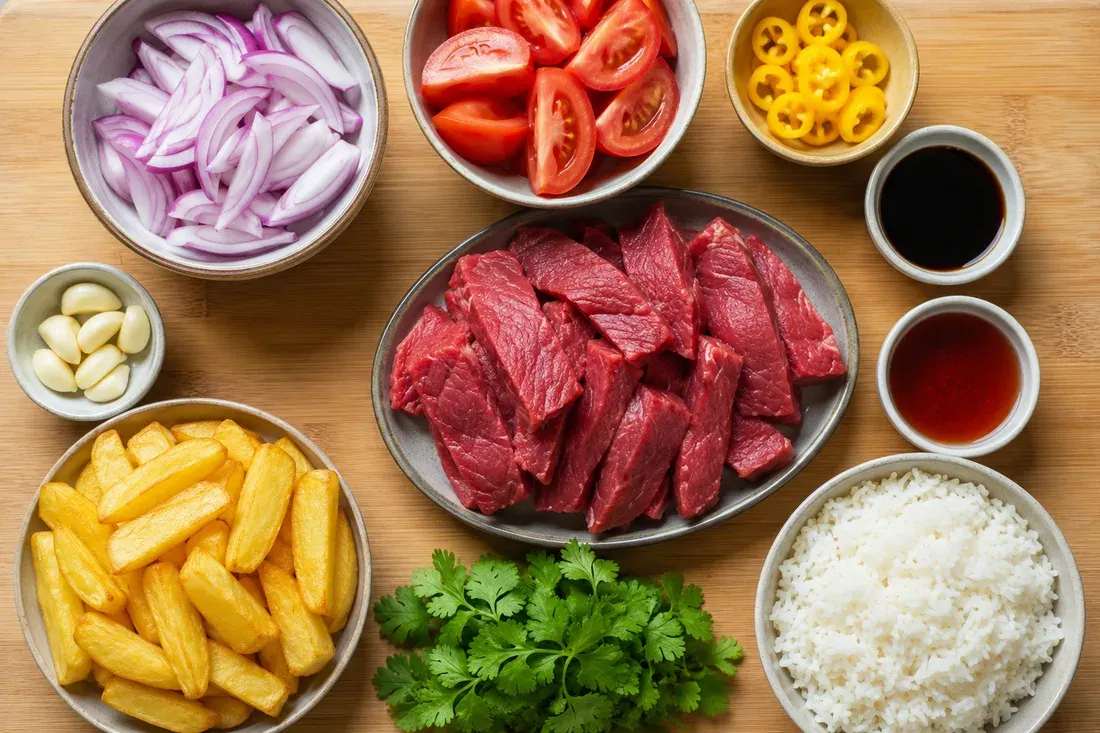
Ingredients
- 500 g (about 1 lb) beef tenderloin or sirloin, in thick strips
- 2 red onions, in thick wedges (root end intact so they hold together)
- 3 plum tomatoes, in wedges, seeds left in
- 1 fresh ají amarillo, seeded and sliced — or 1 tbsp ají amarillo paste
- 3 tbsp soy sauce
- 2 tbsp red wine vinegar
- 2 cloves garlic, minced
- 400 g thick-cut fries, freshly fried and kept hot
- A handful of cilantro leaves, roughly torn
- Vegetable oil, salt, freshly ground black pepper
- Cooked white rice, to serve
Method
- Set up first. Have everything chopped, measured and within arm's reach. Mix the soy sauce and vinegar in one small bowl. Once the pan is hot there is no time to look for anything.
- Heat the pan past comfortable. A wok or your widest skillet, empty, over the highest flame, until a drop of water skitters and vanishes instantly — about 3 minutes. Add 2 tbsp oil; it should shimmer and smoke lightly at once.
- Sear the beef in two batches. Season the strips with salt and pepper, lay them in a single layer, and leave them alone for 45 seconds before tossing. One minute total per batch — browned outside, pink inside. Move to a plate.
- Vegetables, fast. A touch more oil. Onion wedges first, 60 seconds, tossing twice. Then garlic, ají amarillo and tomato together for 60 more seconds. Everything should look glossy and barely cooked.
- The flame moment. Return the beef and its juices. Pour the soy-vinegar mix down the hot side of the pan — it should erupt in steam and sizzle. Toss for 30 seconds while it reduces into a glossy brown sauce.
- Finish off the heat. Kill the flame, fold in the hot fries and cilantro with two gentle turns, and plate immediately next to white rice. Spoon the juguito over the rice.
Troubleshooting, from experience
The beef released water and boiled. Either the pan wasn't hot enough, the batch was too big, or the meat was wet. All three are fixable next time; none is fixable mid-cook.
The sauce tastes flat. Almost always too little vinegar. The dish should have a clear acidic edge — that's what cuts through the beef fat and the fries. Add a teaspoon of vinegar at the end and toss once.
No wok, electric stove. Use your heaviest skillet (cast iron is perfect), preheat it twice as long as feels reasonable, and cook the beef in three batches instead of two. The dish forgives equipment; it does not forgive timidity.
What to serve it with
White rice is non-negotiable — the juguito needs somewhere to go. Beyond that, a glass of chicha morada is the classic pairing, and a simple salsa criolla (sliced red onion, lime, cilantro, a touch of ají) on the side brightens every bite. Leftovers, in the unlikely event of them, make an excellent sandwich on a crusty roll the next morning.

Junior Quintana learned to cook from his mother, Lina, in Junín, in the central Peruvian Andes — a kitchen where chicha morada simmered every Sunday and there were always native potatoes with cheese and choclo on the table. He started Andean Kitchen to share the food he grew up with, in English and without shortcuts: every recipe cooked and tested at home, where it's really made. His favorite dish is, and probably always will be, pachamanca. See how we cook, test and photograph.
Did you cook this?
Tell me how it went — including what did not work. I read every one, and with your permission I will put it on this page, with your first name, for whoever comes next.