
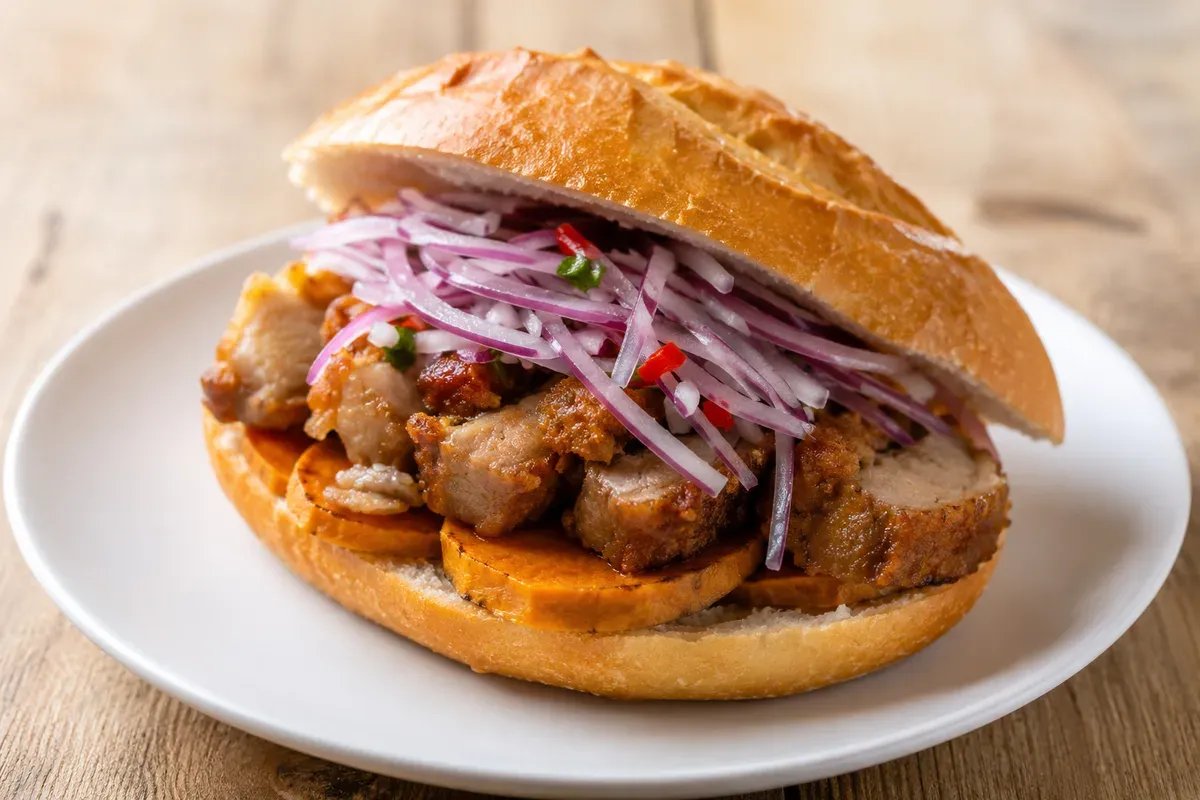
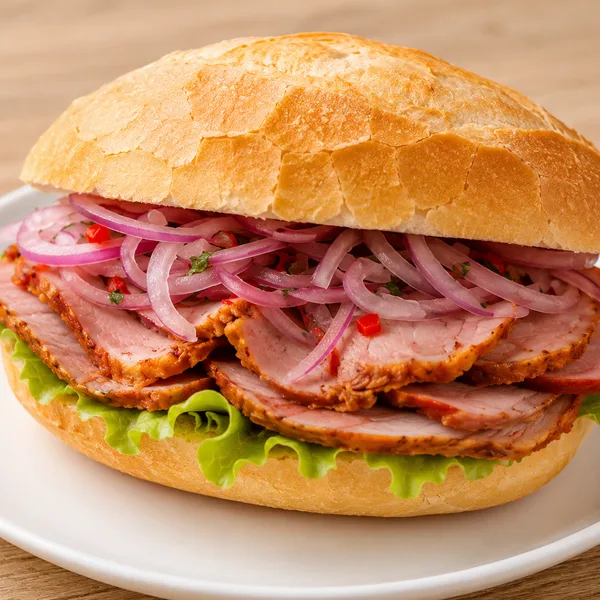
When international food rankings began crowning the world's best sandwiches, Peruvians were pleased but not surprised to see pan con chicharrón near the summit — the country had settled that question generations ago, every weekend, at every market stall with a vat of pork and a line of the faithful. The anatomy is four floors of intent: a crusty French roll; a slab of chicharrón — pork boiled tender, then fried crisp in its own rendered fat; a slice of fried sweet potato playing sweetness against the salt; and a rooftop garden of salsa criolla cutting through everything with lime and onion. Coffee or emoliente beside it, Sunday around it.
Ours came from the Sunday market by the bus stop, wrapped in paper still warm from the fryer, and the drink was always emoliente from the cart two stalls down — never coffee, at least not until I was old enough to be trusted with the thermos myself.
Boil, then fry: the chicharrón method
Peruvian chicharrón isn't deep-fried from raw — it's a two-act technique that needs no added oil at all. Act one: the pork simmers in seasoned water until tender, about an hour. Act two: the water is allowed to boil away entirely, the pork's own fat renders into the pot, and the meat fries in itself until every face is golden and crackling. One pot, no thermometer, and the fat that remains is the legally mandated medium for frying the sweet potato. It's the same self-sufficiency that makes tacacho's economy beautiful: the pig caters its own sandwich.
First the water cooks the pork. Then the pork cooks the pork. The cook mostly supervises.
The bread matters as much as the pork
This sandwich is built on pan francés — the Peruvian roll, crusty outside and airy inside, the same one every bakery pulls out at six in the morning. It is not a baguette and it is not a soft bun. It has to crack when you press it and then give way, because the whole architecture depends on the crust holding while the pork fat soaks the crumb.
Outside Peru, look for a bolillo at a Mexican bakery, a Portuguese roll, or a small ciabatta. What ruins it is anything soft and enriched — a brioche or a burger bun collapses into paste the moment the chicharrón lands on it.
The sweet potato is not a garnish
The slice of fried camote is doing structural work: it is the only sweet thing against a great deal of salt and fat, and without it the sandwich is heavy in a way you notice by the third bite. Use an orange or a purple-skinned sweet potato, cut it thick — a full centimeter — and boil it briefly before frying so the inside is cooked through by the time the outside colors.
Fry it in the fat the pork left behind. That is not nostalgia, it is the point: the fat carries the pork flavor into the one sweet element on the plate and ties the whole thing together.
The recipe
Ingredients
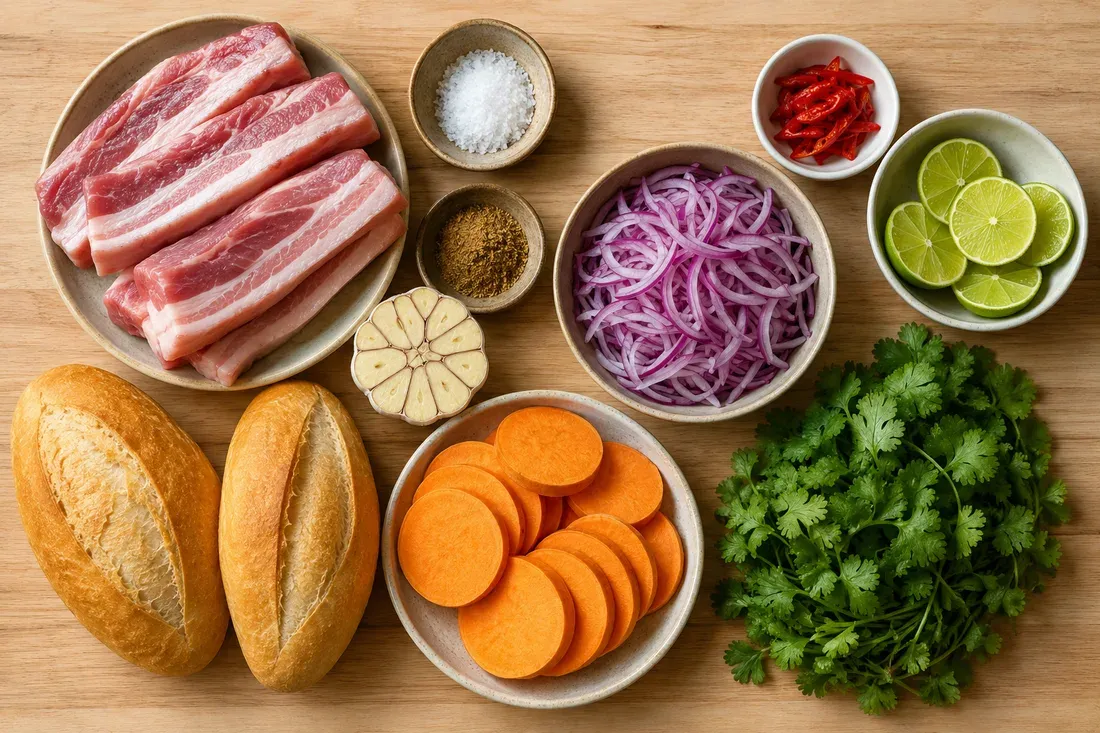
- 800 g pork belly or fatty shoulder, in thick slabs
- Water to cover · 1 head garlic, halved · 1 tbsp salt · 1 tsp cumin
- 1 large sweet potato, peeled, in 1 cm rounds
- 4 crusty French rolls, the kind that fight back a little
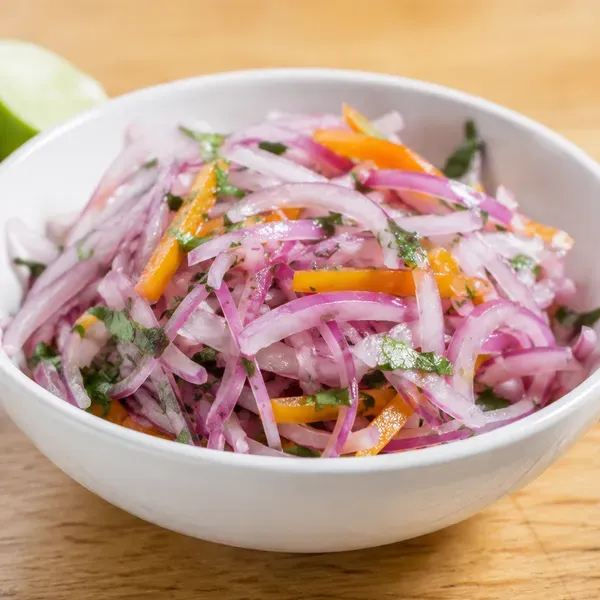
- Salsa criolla, freshly made: 1 red onion in fine julienne, lime, a little ají, cilantro, salt
- A little oil, only if the pork's own fat runs short
Method
- Act one. Pork, garlic, salt and cumin, water to cover; simmer ~1 hour until a fork slides in.
- The transition. Heat up slightly and let the water evaporate completely — you'll hear the pot's voice change from bubble to sizzle as the fat takes over.
- Act two. Fry the pork in its own fat, turning, until golden and crisp-edged everywhere, 10–15 minutes. Rest on a board.
- The sweet potato fries in the same gifted fat until tender and caramel-edged.
- Build: roll, sweet potato, thick slices of chicharrón, criolla piled with intent. Press gently. Serve while the contrast is loud.
Troubleshooting, from experience
The pork is crisp but dry. Too lean a cut. Belly or well-marbled shoulder — the fat is structural, not decorative.
It never crisped. The water hadn't fully evaporated, so it kept steaming. Patience at the transition; the sizzle announces act two.
The sandwich is heavy. Criolla was under-dosed. The onion-lime pile is the sandwich's suspension system; double it.
What to serve it with
Hot emoliente is the street pairing, coffee the home one, and a tamal beside it turns breakfast into the full Peruvian Sunday spread. Leftover chicharrón, chopped into tomorrow's chaufa, is the encore the pig deserves.
Questions people ask
Can I make chicharrón without a whole afternoon? The two stages are not negotiable but they are mostly unattended. An hour of simmering while you do something else, then fifteen minutes of attention while the water cooks away and the pork starts frying in its own fat. What you cannot do is skip the simmer and go straight to frying — the meat stays tough.
Which cut of pork? Belly or shoulder, with the fat on. The fat is not incidental — it is the frying medium for the second stage and for the sweet potato afterward. A lean cut leaves you with dry meat and an empty pot.
What bread should I use outside Peru? A crusty roll with an open crumb: bolillo, Portuguese roll, small ciabatta. Press it — it should crack. Anything soft or sweet turns to paste under the pork fat.
Is salsa criolla necessary? Yes. Red onion, lime and salt are the only acid on the sandwich, and without them the pork and the fried sweet potato sit heavy. It takes five minutes and no cooking, and it is what makes the whole thing eatable at nine in the morning.

Junior Quintana learned to cook from his mother, Lina, in Junín, in the central Peruvian Andes — a kitchen where chicha morada simmered every Sunday and there were always native potatoes with cheese and choclo on the table. He started Andean Kitchen to share the food he grew up with, in English and without shortcuts: every recipe cooked and tested at home, where it's really made. His favorite dish is, and probably always will be, pachamanca. See how we cook, test and photograph.
Did you cook this?
Tell me how it went — including what did not work. I read every one, and with your permission I will put it on this page, with your first name, for whoever comes next.