
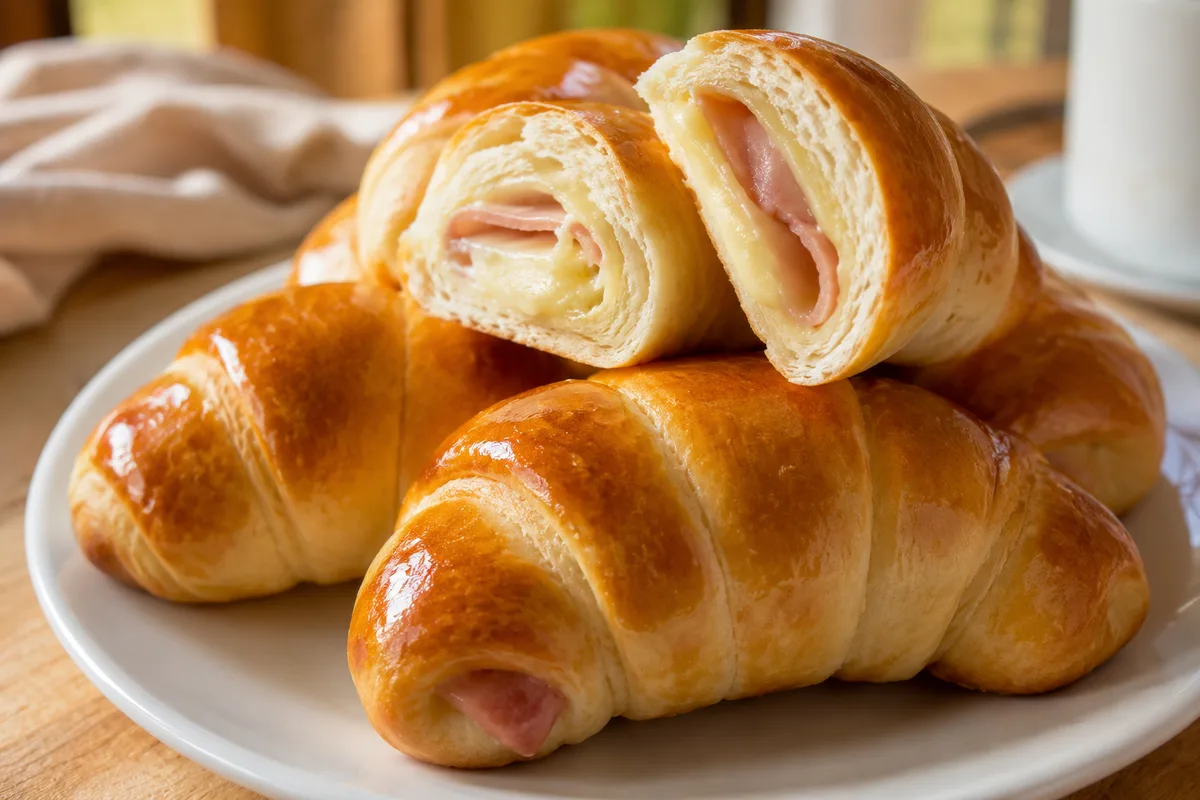
Cachitos take their crescent shape loosely from the French croissant, but the dough is a different animal entirely — softer, slightly sweeter, closer to a Peruvian bread dough than laminated butter pastry. Filled with ham and cheese and rolled tight before baking, cachitos are a bakery-case staple across Peru, sitting alongside pan de anís and pan francés — the plain everyday roll that has nothing French about it — as one of the standard breakfast breads.
They're sold both plain and filled, but the ham-and-cheese version is what most people picture when the word comes up — a complete, portable breakfast in one roll. They also do a second shift: cachitos are standard at lonche, the light evening meal Peruvians eat around six or seven instead of a heavy dinner, when bread and something hot to drink is the whole menu.
School mornings in Junín ran on these. You bought one on the way and ate it walking, still warm, which is the only way to find out whether the panadería had been generous with the cheese that day. The name is nothing more than the shape: cachito is a little horn, and that is what a rolled crescent looks like to anyone who grew up around cattle. Ask for uno calientito and the woman behind the counter will dig toward the back of the tray for you, where the ones that came out last are still steaming.
Roll from the wide end, keeping the filling centered
Starting the roll from the triangle's wide base and working toward the point keeps the ham and cheese centered inside rather than squeezed out to one side — a loose or off-center roll leaves some bites empty and others overstuffed.
The crescent shape isn't just decorative. Rolling it correctly is what keeps the filling evenly distributed.
Don't overfill
A thin, even layer of ham and cheese is enough — packing in too much makes the rolls difficult to seal properly and risks filling leaking out during baking. Less filling, rolled well, beats more filling rolled poorly.
Why the dough is enriched
A cachito is not made from the same dough as the rolls that hold chicharrón. That bread is lean — flour, water, salt, yeast — and it is meant to be crusty and neutral, a container for whatever goes inside. Cachito dough is enriched: milk instead of water, an egg, and a third of a cup of butter worked in, which is what gives it the soft, faintly sweet crumb that pulls apart in strands rather than tearing.
That richness comes at a cost, and it is worth knowing before you start. Fat slows down yeast, so an enriched dough takes longer to rise than a lean one — if your kitchen is cold, give it the time it asks for rather than the time the recipe says. This is also why cachitos go stale faster than plain bread: the same butter that makes them tender on the first day makes them disappointing on the third. Peruvian bakeries solve this by baking twice a day. At home, the answer is to eat them.
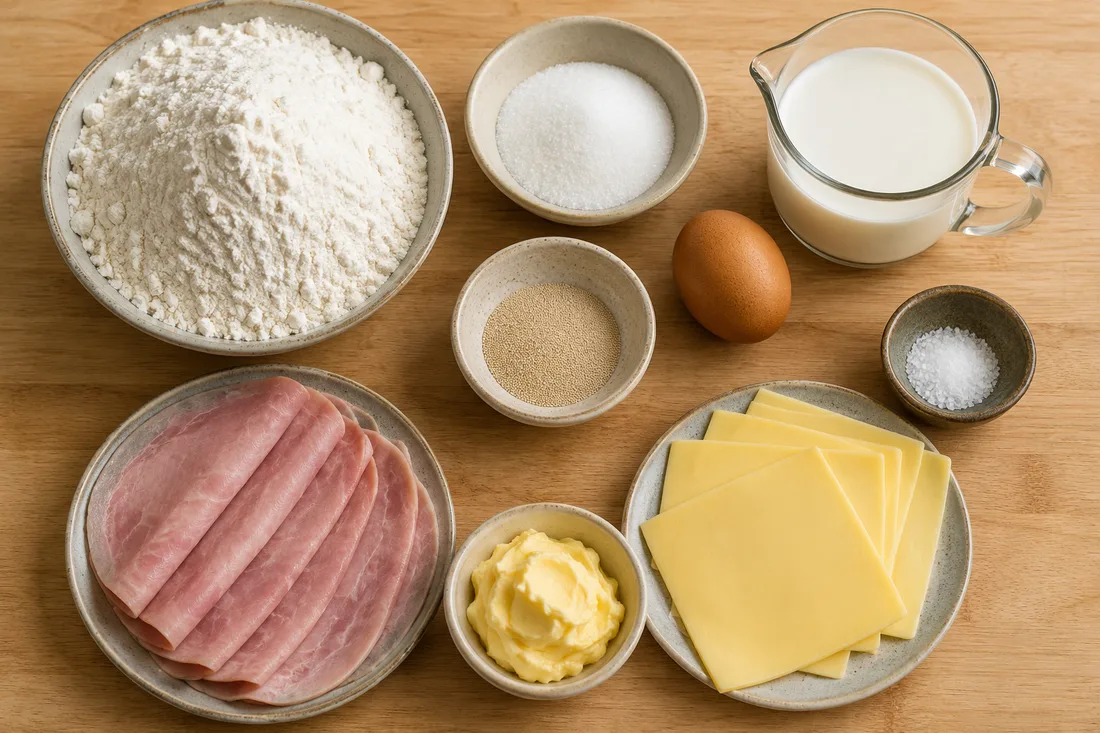
The ham and the cheese
Peruvian bakeries use jamón del país — country ham, simmered and spiced, sliced thin — and a mild melting cheese, usually Edam or a young Gouda. Neither is exotic and neither is hard to replace.
- The ham. Any thin-sliced cooked ham works. What to avoid is anything cured and dry like prosciutto — it turns leathery in the oven and fights the soft crumb.
- The cheese. Edam, Gouda, a mild cheddar or Monterey Jack. It needs to melt without releasing much oil. Fresh cheeses do not melt, and strong aged ones take over a roll that is meant to taste mostly of bread.
Slice both thin. Thick fillings are what push the roll open in the oven, and a cachito that unrolls while baking loses its cheese to the tray.
The recipe
Ingredients
- 4 cups flour
- 1/3 cup sugar
- 2 1/4 tsp active dry yeast
- 1 cup warm milk
- 1 egg
- 1/3 cup butter, softened
- 1 tsp salt
- 200g sliced ham
- 200g sliced cheese
- 1 egg, beaten, for brushing
Method
- Activate the yeast in warm milk with a spoonful of sugar. Let sit 10 minutes.
- Knead the dough from flour, sugar, salt, yeast mixture, egg and butter, 10 minutes.
- First rise until doubled, about 1 hour.
- Shape. Roll into triangles, fill with ham and cheese, roll into crescents.
- Rise, brush and bake 20 minutes, then at 190°C (375°F) for 16-18 minutes.
Troubleshooting, from experience
Filling leaked out during baking. Overfilled, or not rolled tightly enough. Use a thin layer and roll firmly.
Rolls came out dense. The rise was cut short. Give the dough its full time.
Uneven shape. The dough wasn't rolled into an even triangle before filling. Take a moment to shape it properly.
What to serve it with
Coffee or quáker con manzana, exactly as with any other Peruvian breakfast bread.
Questions people ask
Are cachitos the same as croissants? Only the shape. A croissant is laminated — layers of butter folded into the dough over hours. Cachito dough is a straightforward enriched bread dough with milk, egg and butter worked in, so the crumb pulls apart in soft strands instead of flaking. Easier to make and a different thing entirely.
Why is my dough rising so slowly? Because it is enriched. Fat slows yeast down, so this dough takes noticeably longer than a plain bread dough. If your kitchen is cold, give it the time it asks for rather than the time on the clock — a warm spot and patience beat adding more yeast.
Can I make them without the filling? Yes, and Peruvian bakeries sell them both ways. Plain cachitos are a breakfast bread on their own, eaten with butter or jam. The dough does not change; you simply roll the triangles without anything inside.
How long do they keep? Best the day they are baked, acceptable the second, disappointing the third. The butter that makes them tender on day one is what makes them go stale faster than plain bread. Peruvian bakeries solve this by baking twice a day; at home the answer is to eat them or freeze them the same day.

Junior Quintana learned to cook from his mother, Lina, in Junín, in the central Peruvian Andes — a kitchen where chicha morada simmered every Sunday and there were always native potatoes with cheese and choclo on the table. He started Andean Kitchen to share the food he grew up with, in English and without shortcuts: every recipe cooked and tested at home, where it's really made. His favorite dish is, and probably always will be, pachamanca. See how we cook, test and photograph.
Did you cook this?
Tell me how it went — including what did not work. I read every one, and with your permission I will put it on this page, with your first name, for whoever comes next.