
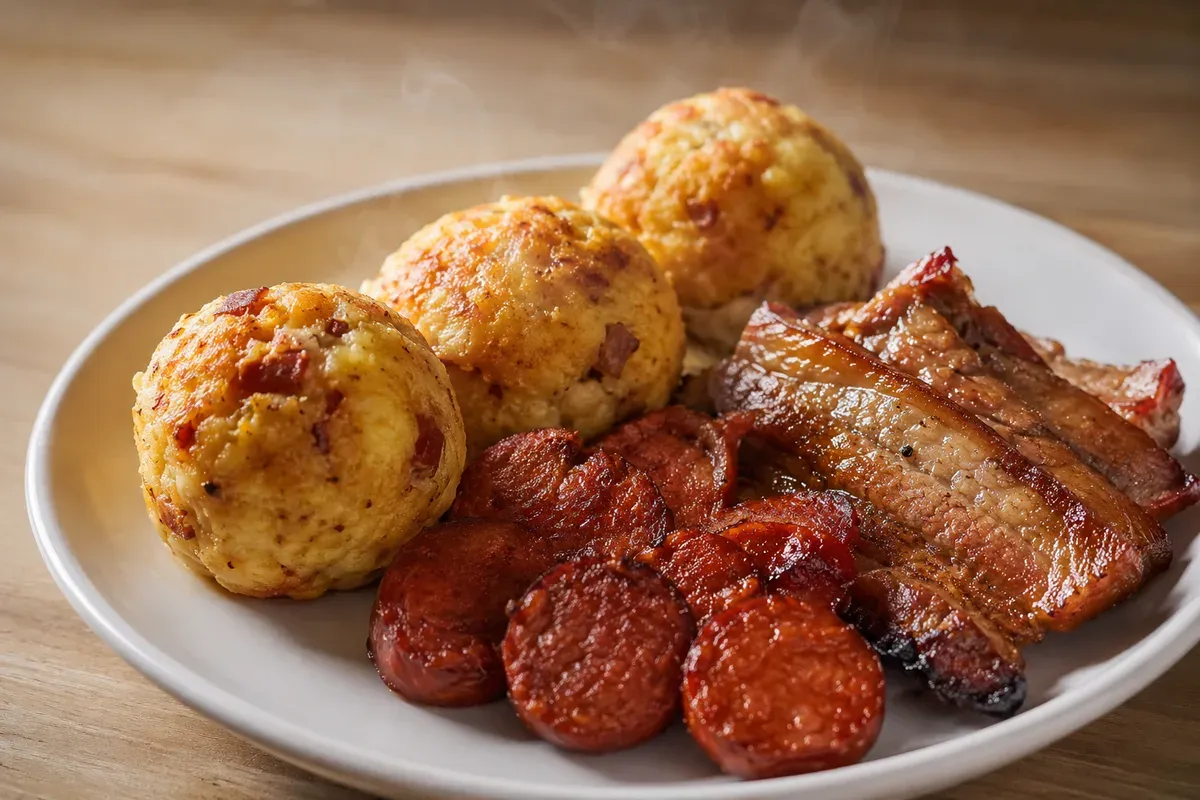
Peru is three countries pretending to be one — coast, highlands, jungle — and this site has fed you two of them for months. Time to cross the mountains east. Tacacho con cecina is the signature plate of the Peruvian Amazon: green plantains fried and then mashed, while hot, with lard and crackling pork chicharrón into rustic balls, served beside cecina — pork that's been salted and smoked over jungle hardwood until it's somewhere between ham and memory — and usually a coil of regional chorizo. In Tarapoto, Iquitos or Pucallpa it's breakfast, the kind eaten before work that involves machetes; everywhere else in Peru it's the dish people order to taste the selva without buying a flight.
If you know West African fufu, Caribbean mofongo or Ecuadorian bolones, you've met tacacho's relatives — the great plantain-mashing family that the African diaspora spread across the tropics, each branch with its own technique and loyalties. Tacacho's signatures: the plantains are fried (some jungle versions roast them over coals), the mash stays deliberately coarse, and the chicharrón goes inside the mash, not on top.
Chanchamayo is the closest the jungle gets to Junín — a few hours down from the sierra and the air turns thick and green, potato country giving way to plantain country in a single bus ride. I've eaten tacacho there more than once, always the same way: hot off the fire, the balls barely holding their shape, cecina still smoking from the grill. Coming from a region where the potato does most of the talking, watching plantain take over that job took some getting used to — but the second bite settled it.
The cecina question
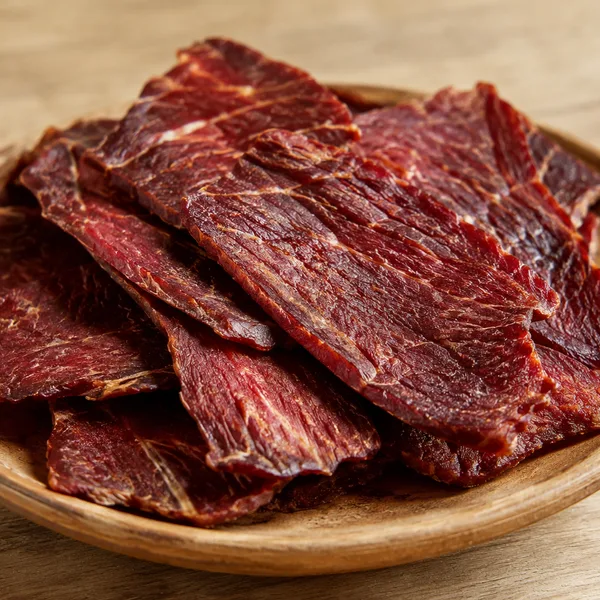
Real cecina amazónica — pork brined and smoked slowly over local woods — is the hard part outside the jungle, and even outside Peru's jungle cities. The honest substitution ladder: smoked pork loin or smoked pork chops (closest in spirit), thick-cut smoky bacon (different shape, right idea), or any well-smoked cured pork your region is proud of. What matters is genuine smoke and a good sear; sweet ham need not apply. If a Peruvian or Brazilian market near you sells carne seca or proper smoked pork, you've won.
The plantain must be green and the mash must stay coarse. Tacacho with ripe plantains is dessert; tacacho mashed smooth is baby food with ambitions.
Green means green
The plantains for tacacho are fully green — starchy, firm, savory, closer to potato than to banana. Yellow or spotted plantains turn the dish sweet and the balls slumpy. Peeling green plantains is its own small skill: cut the ends, score the skin lengthwise along the ridges, and pry it off in panels with your thumb (a spoon helps). Frying in chunks, rather than boiling, is what gives tacacho its toasty edges and jungle credentials.
Where the name comes from
The word is usually traced to Quechua takay, to pound or to beat — which describes exactly what happens to the plantains. It is the explanation you will hear most often and it is a reasonable one, but it is not settled, and anyone stating it as fact is going further than the evidence does. The Peruvian Amazon is home to dozens of languages of its own, and a word that arrived there could have come from more directions than one.
What is not in doubt is where the dish belongs. Tacacho is selva food — from the jungle regions east of the Andes — and it is eaten as breakfast in Tarapoto and Pucallpa the way bread is eaten everywhere else.
Buying and handling green plantains
Look for plantains that are hard, matte and fully green, with no yellow at the tips. They should feel like a piece of wood, not like fruit. Most Latin American and Caribbean groceries carry them year round, and many large supermarkets now stock them beside the bananas — where, confusingly, they are often the only thing in the display nobody wants ripe.
If yours have started to yellow, cook something else with them. There is no rescuing a sweet plantain into a savory tacacho; the sugar caramelizes in the pan and the balls will not hold. Green plantains keep for a week or more in a cool spot, and unlike bananas they do not need to be kept apart from other fruit.
Peeling is the part nobody warns you about. The skin does not slip off — cut both ends, run a knife down the ridges just through the skin, and lever the panels away with your thumb or the back of a spoon. Under cold water it goes faster, and it keeps the sap off your hands.
The recipe
Ingredients
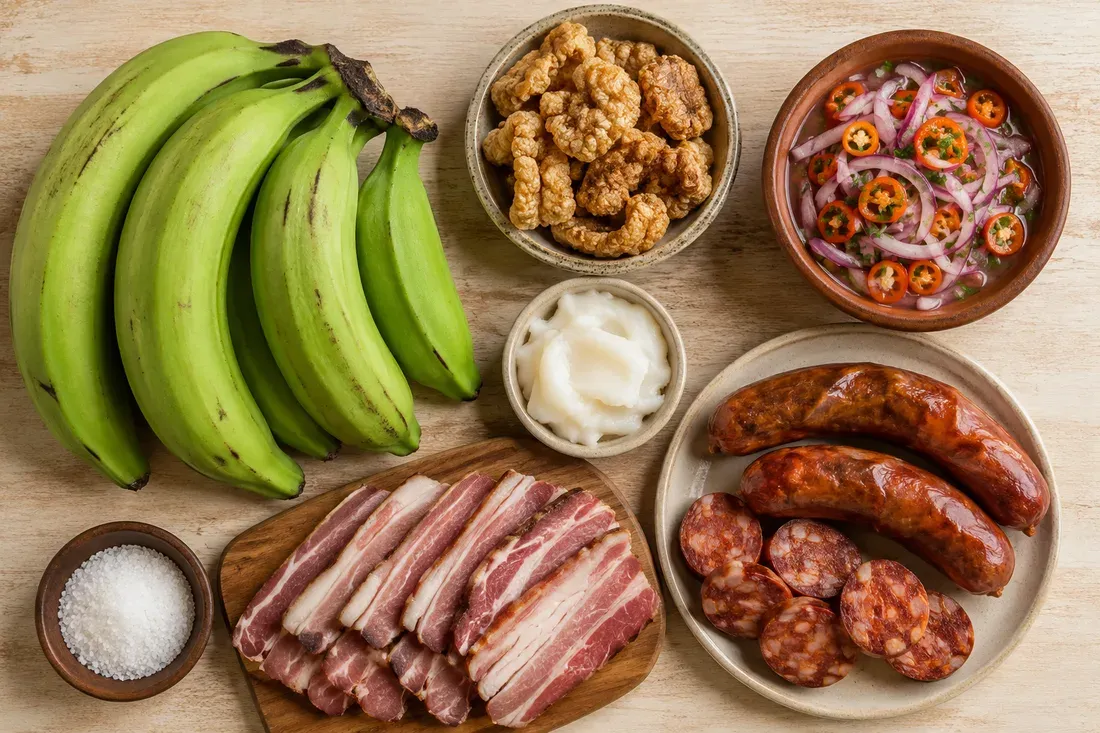
- 6 fully green plantains
- 150 g chicharrón (pork cracklings), roughly chopped — store-bought pork rinds work in a pinch, added at the last fold
- 3 tbsp lard (traditional) or oil, plus oil for frying
- 400 g cecina — or smoked pork loin / thick smoky bacon
- 4 chorizos (optional but customary)
- Salt
- To serve: salsa criolla — with ají charapita, the jungle's tiny fierce chile, if you ever find it
Method
- Peel and chunk the plantains; cut each into 4–5 thick pieces.
- Fry in medium-hot oil (170 °C), turning, until golden outside and tender inside — 8–10 minutes. Drain.
- Mash hot. In a sturdy bowl: plantains, lard, salt. Mash coarsely — a pestle, a heavy fork, tradition says a wooden mazo. Fold in the chicharrón so it studs the mash.
- Form the balls with greased hands: orange-sized, pressed just enough to hold.
- The meats. Hot pan, no extra fat needed: cecina seared 2–3 minutes per side, chorizos until done.
- Plate jungle-style: two tacachos, the meats draped beside, criolla on top, coffee strong. Breakfast is served; the day can now demand things of you.
Troubleshooting, from experience
The balls fall apart. Plantains too cool when mashed, or not enough fat. Mash hot, be honest with the lard.
It tastes sweet. The plantains were turning. Green means green — uniformly, unapologetically.
Dense as ammunition. Over-mashed or over-pressed. Coarse mash, gentle hands; the inside should be tender between the toasty bits.
What to serve it with
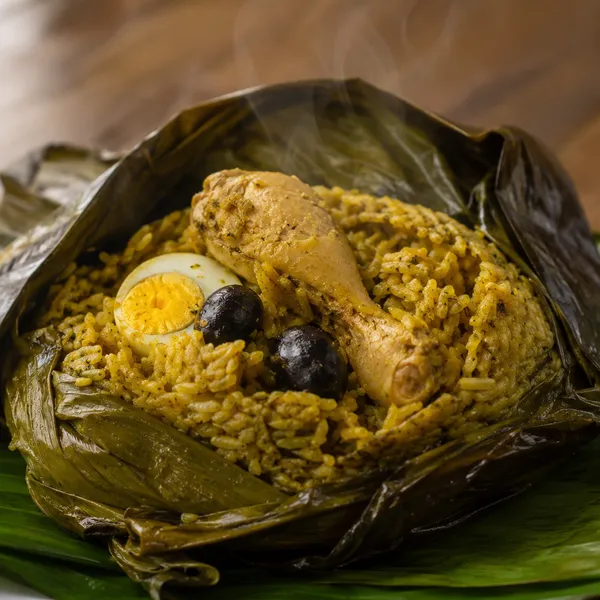
Strong coffee at breakfast, or for the full regional lunch, alongside juane — the selva's other flagship. A cold glass of chicha morada bridges the regions, and the leftover mash, flattened and pan-fried next morning, makes tacacho cakes that might be better than the original. We'll deny saying that.
Questions people ask
What can I use instead of cecina? Smoked pork loin or smoked pork chops come closest in spirit. Thick-cut smoky bacon is the wrong shape but the right idea. What matters is real smoke and a hard sear — sweet or honey-glazed ham pulls the plate in exactly the wrong direction.
Can I bake the plantains instead of frying them? Some jungle versions roast them over coals, so yes in principle. What you lose is the toasted edge that frying gives, and with it a good part of what makes the mash taste like tacacho rather than like mashed plantain.
Why did my tacacho balls fall apart? Either the plantains were not green enough, or the mash cooled before you shaped it. Mash and shape while everything is genuinely hot — the fat and the starch bind as they cool, and once they have cooled apart they will not come back together.
Is tacacho related to mofongo or fufu? They belong to the same family — the plantain-mashing tradition the African diaspora carried across the tropics. Tacacho is the version that fries the plantain rather than boiling it, keeps the mash deliberately coarse, and works the pork crackling into the middle instead of laying it on top.

Junior Quintana learned to cook from his mother, Lina, in Junín, in the central Peruvian Andes — a kitchen where chicha morada simmered every Sunday and there were always native potatoes with cheese and choclo on the table. He started Andean Kitchen to share the food he grew up with, in English and without shortcuts: every recipe cooked and tested at home, where it's really made. His favorite dish is, and probably always will be, pachamanca. See how we cook, test and photograph.
Did you cook this?
Tell me how it went — including what did not work. I read every one, and with your permission I will put it on this page, with your first name, for whoever comes next.