
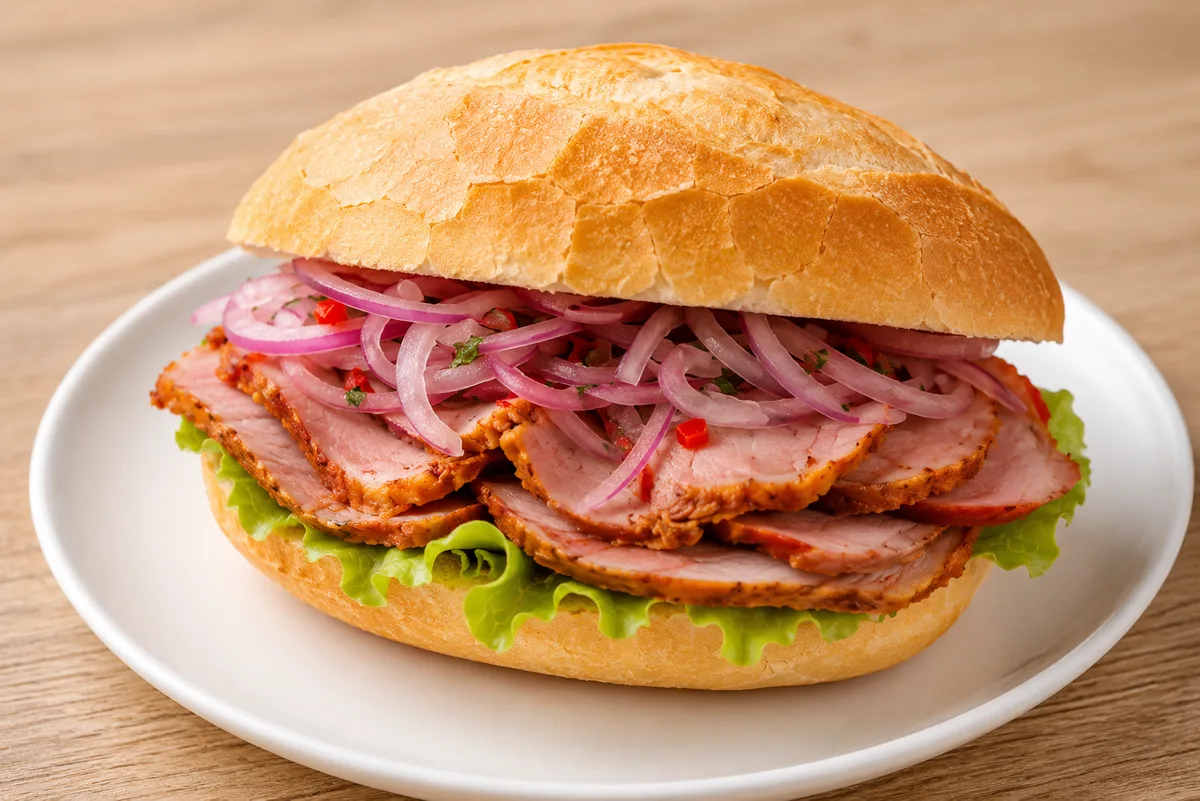
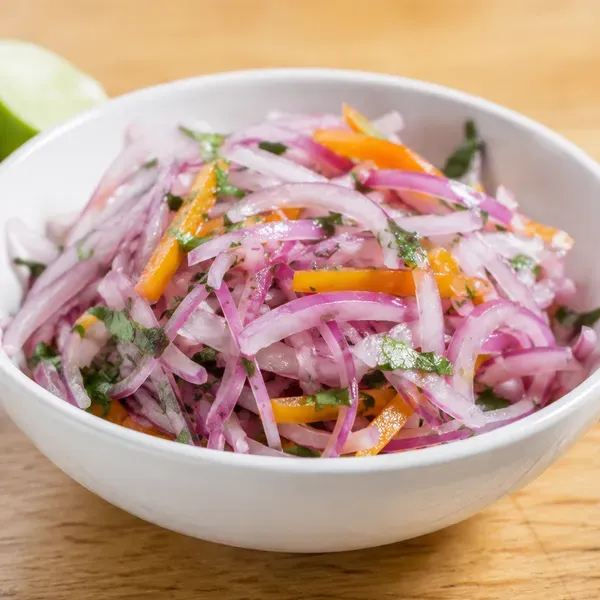
Butifarra sits right alongside pan con chicharrón as one of Peru's essential sandwiches, but where that one is rich and requires real cooking, butifarra is almost defiantly simple: sliced Peruvian country ham, a crusty pan francés roll — the plain everyday bread, nothing French about it — and a generous pile of salsa criolla on top. No lettuce, no tomato, no elaborate sauce — just three components, each one done properly. Nobody in Peru calls it a sandwich, by the way: it's a sánguche, and the word does a lot of work.
It's the one sold from the carretilla — the push-cart parked outside schools and offices across Lima — quick enough to eat standing up on the way somewhere, and reliable enough that it never needs reinventing.
The butifarra is a Lima sandwich and we are from the sierra, so ours came from bus terminals and from the trays women carry through the aisles before a long trip. That is not a complaint. A butifarra eaten somewhere between Junín and the coast, with the onion still crunching, is a better sandwich than most things served on a plate. The rule I learned from watching those women work: the criolla goes on last, at the moment of handing it over, never before.
The ham needs to be sliced thin, and there needs to be plenty of it
Peruvian jamón del país is a specific style of country ham, denser and saltier than a standard deli ham — sliced thin and layered generously rather than thick and sparse, it fills the roll properly without any single bite feeling like mostly bread. If jamón del país isn't available, a good quality cooked ham is a reasonable substitute, though the flavor will be milder.
Butifarra doesn't hide behind extra ingredients. Every one of the three has to actually be good.
Salsa criolla goes on last, right before eating
Because salsa criolla is built on raw onion in an acidic dressing, piling it into the sandwich too far ahead lets its liquid soak into the bread and turn it soggy — assemble the sandwich as close to eating it as possible, the same rule that applies to pan con chicharrón. A butifarra made ten minutes before serving is a different sandwich from one made an hour ahead.
What jamón del país actually is
This is the ingredient that decides whether you have made a butifarra or a ham sandwich. Jamón del país is not cured like prosciutto and not pressed like deli ham: it is a leg of pork rubbed with ají panca, garlic, cumin and pepper, then slowly roasted or boiled and left to cool completely before slicing. It comes out pink inside with a dark, spiced edge, and it is sold cold by weight, cut to order, in every market in Lima.
Outside Peru you will not find it, so here is the truth about the alternatives, best to worst: a spiced roast pork loin you cook yourself and chill overnight gets closest, and it is genuinely worth the effort if you are making this for people. Failing that, a good cooked ham — the kind carved off a bone, not the kind that arrives in a rectangle — will hold the sandwich together, though it gives you none of the ají panca. What does not work is smoked ham. The smoke fights the salsa criolla and wins, and what you get is a perfectly nice sandwich that has stopped being Peruvian.
The recipe
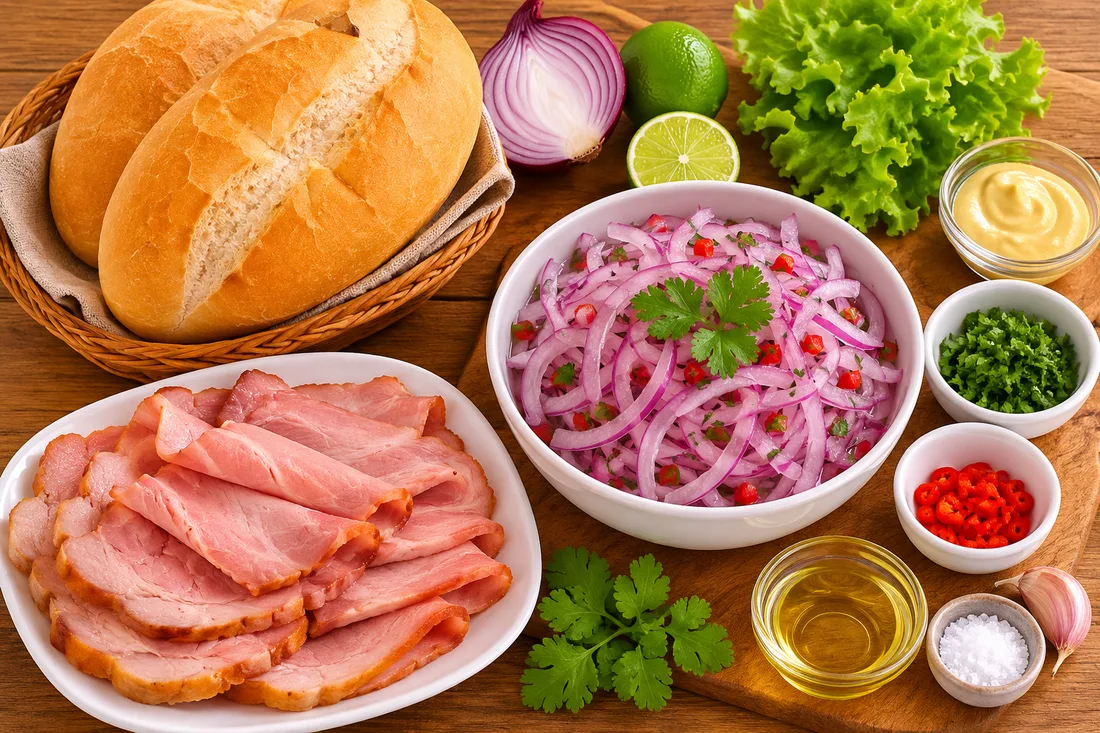
Ingredients
- 4 pan francés rolls
- 400g Peruvian country ham (jamón del país), thinly sliced
- 1 batch salsa criolla
- 4 tbsp mayonnaise
- 1 tbsp ají amarillo paste, mixed into the mayonnaise (optional)
- Salt
Method
- Split the rolls lengthwise without cutting all the way through.
- Spread a thin layer of ají mayonnaise, if using, inside each roll.
- Layer the ham generously inside.
- Top with salsa criolla and serve immediately.
Troubleshooting, from experience
Bread went soggy. Assembled too far ahead. Build it right before eating.
Sandwich tastes flat. Not enough salsa criolla, or the ham was too sparse. Both need to be generous, not sparing.
Roll fell apart. The bread wasn't crusty and sturdy enough to hold the filling. A proper pan francés with a firm crust matters more than it seems.
What to serve it with
Butifarra needs nothing on the side — it's built to be eaten on its own, quickly, standing up if that's how the day is going.
Questions people ask
What can I use instead of jamón del país? Best to worst: a spiced pork loin you roast and chill overnight yourself, which gets genuinely close; a good cooked ham carved off the bone, which holds the sandwich together but gives you none of the ají panca. What does not work is smoked ham — the smoke fights the salsa criolla and wins.
Why does the salsa criolla go on last? Because it is raw onion in lime, and it releases liquid the moment it sits. Piled in ahead of time it soaks the bread and you get a soggy sandwich. The women selling these on buses assemble each one at the moment of handing it over, and that is the correct method.
What bread should I use? A crusty roll with an open crumb — pan francés in Peru, a bolillo or a small ciabatta elsewhere. It has to hold up to the wet salsa without collapsing. Soft rolls turn to paste.
Is butifarra the same as the Spanish or Catalan butifarra? No, and the shared name causes real confusion. Catalan butifarra is a fresh pork sausage. The Peruvian one is a sandwich, and the name traveled without the meaning — the same thing that happened with bienmesabe and with cecina.

Junior Quintana learned to cook from his mother, Lina, in Junín, in the central Peruvian Andes — a kitchen where chicha morada simmered every Sunday and there were always native potatoes with cheese and choclo on the table. He started Andean Kitchen to share the food he grew up with, in English and without shortcuts: every recipe cooked and tested at home, where it's really made. His favorite dish is, and probably always will be, pachamanca. See how we cook, test and photograph.
Did you cook this?
Tell me how it went — including what did not work. I read every one, and with your permission I will put it on this page, with your first name, for whoever comes next.