
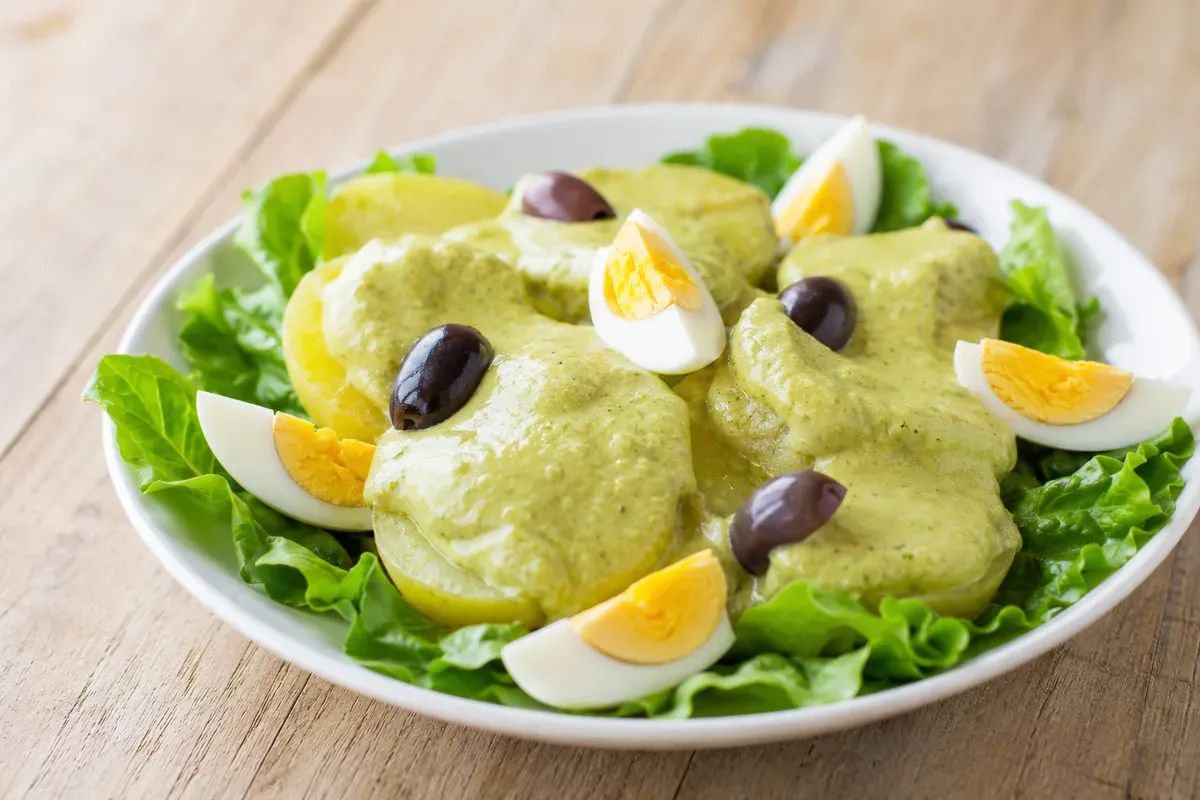
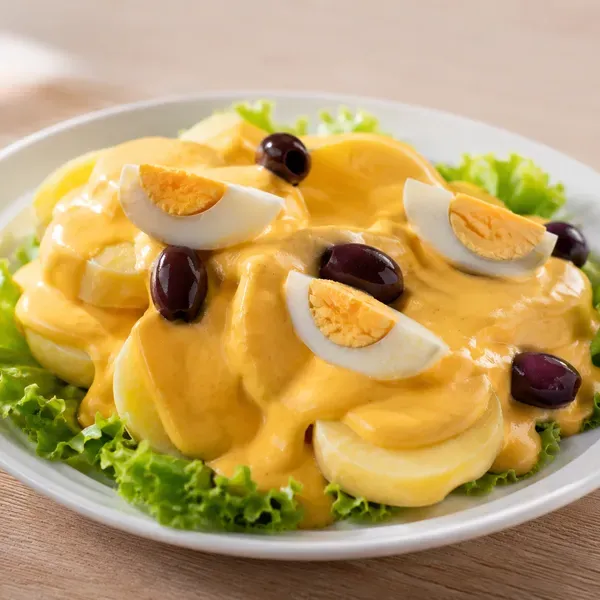
When we published our papa a la huancaína, we promised that its Arequipa cousin would arrive to argue with it properly. Here it is. Ocopa shares huancaína's entire skeleton — chile, fresh cheese, milk, crackers, blended and poured over boiled potatoes with egg and olives — and then changes the soul twice: huacatay, the Andean herb sometimes called black mint, turns the sauce olive-green and intensely aromatic; and toasted peanuts give it a nutty body and richness huancaína never claimed. Arequipa, a city that maintains a soup for every day of the week (see our chupe), naturally also maintains that ocopa is the superior potato sauce. Lima disagrees. The rest of us eat both and decline to testify.
In our house it was always huancaína first, ocopa as the occasional guest — huacatay doesn't grow as thick around Junín as it does further south, so when a caserita had a fresh atado at the market it felt like an event, not an errand.
Huacatay: the herb that doesn't translate
Huacatay (Tagetes minuta) is the flavor question every ocopa recipe abroad must answer honestly. It's a marigold relative with an aroma somewhere between mint, basil and something resinous that's entirely its own — "black mint" is the English nickname, and it undersells the strangeness. The good news: huacatay paste in jars is a staple of Latin groceries everywhere Peruvians have settled, keeps for months, and is exactly what most urban Peruvian kitchens use too. If you truly can't find it, a blend of fresh mint and basil (2:1) gestures at the profile — a gesture we'd accept at our table while noting, gently, that it isn't ocopa's voice, just a polite impression of it.
Huancaína tastes like the sun. Ocopa tastes like the garden at dusk — herbal, toasted, a little wild.
The toasting that huancaína skips
The second technical difference is heat: where huancaína's ají is briefly softened, ocopa's flavor base is seared — onion slices and garlic charred at the edges in the pan, the ají cooked alongside, the peanuts toasted until fragrant. That toasting is what gives ocopa its roasted depth and why a lazy raw-blended version tastes like herby mayonnaise. Five extra minutes at the stove; the entire personality of the sauce.
The crackers, and what they are doing there
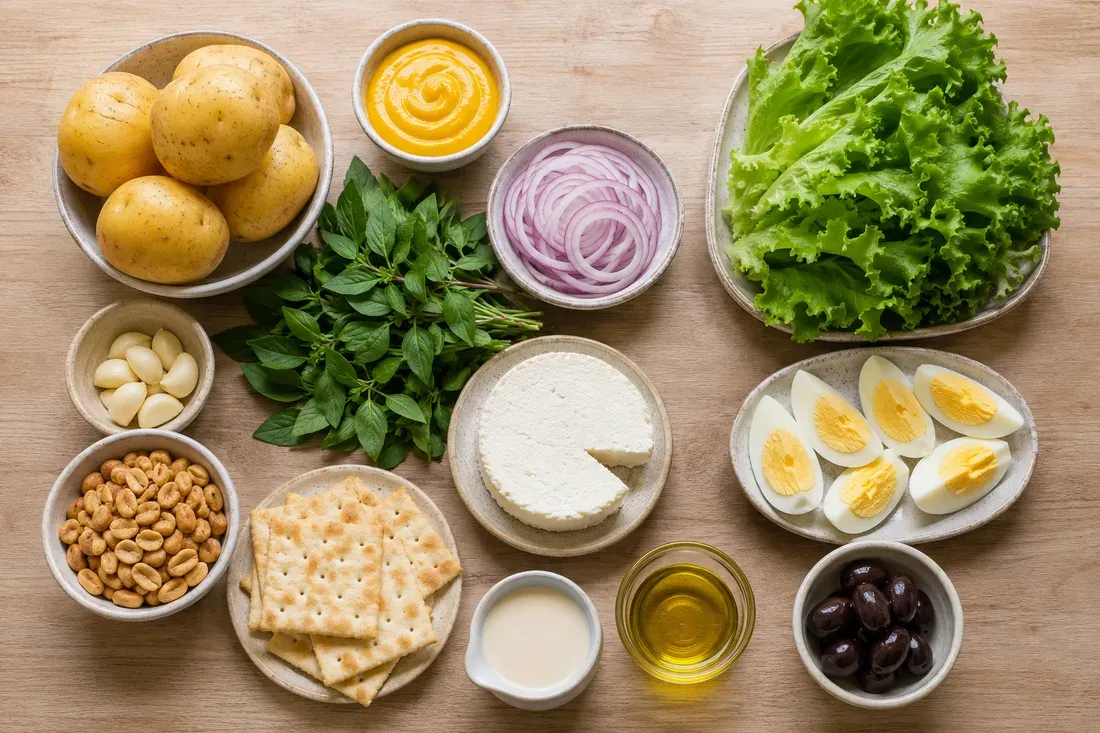
Both ocopa and huancaína are thickened with soda crackers blended into the sauce, and it is the detail that surprises people most. They are not filler. Ground into the blender they absorb liquid and give the sauce body without the flour taste a roux would bring, and they are what keeps it pourable but not runny.
Any plain unsalted soda cracker works — the Peruvian ones are galletas de soda, and saltines are the same thing under another name. Use unsalted or reduce the salt in the sauce, because the cheese is already bringing plenty. If you have none, stale white bread with the crusts off does the same job, though the texture is slightly less clean.
Making it ahead
The sauce keeps three or four days in the fridge and it thickens as it sits — loosen it with a spoonful of milk before serving. Do not freeze it: the cheese separates on thawing and comes back grainy.
What does not keep is the assembled plate. Boiled potatoes go cold and firm in the fridge and never quite recover, so make the sauce ahead and boil the potatoes the day you eat.
The recipe
Ingredients
- 1 kg yellow potatoes (the same casting as always), boiled in their skins, peeled, in thick slices
- 3 tbsp ají amarillo paste — or 3 fresh chiles, cleaned
- 4 tbsp huacatay paste, or a good handful of fresh leaves
- ½ red onion in thick slices · 2 garlic cloves, peeled
- 60 g roasted unsalted peanuts
- 150 g queso fresco
- 4 soda crackers
- Evaporated milk, ~¾ cup, to blend
- 2 tbsp vegetable oil · salt
- To plate: lettuce, 2 hard-boiled eggs in quarters, black olives
Method
- Sear the base. Oil over medium-high; onion slices and garlic until charred at the edges, 4–5 minutes. Add the ají for 2 more. Tip everything, oil included, toward the blender.
- Toast the peanuts in the same pan, 2 minutes, until they smell like the inside of a good decision.
- Blend. Seared base, peanuts, huacatay, cheese, crackers, and milk in stages until the sauce is thick, pourable and olive-green — the ribbon-off-the-spoon standard of its cousin applies. Salt at the end, tasting against the cheese.
- Plate like Arequipa: lettuce, warm potato slices, sauce generously over, egg and olives on top. Room temperature, never fridge-cold.
Troubleshooting, from experience
It tastes like grass. Raw huacatay overload or the searing was skipped. The paste is pre-cooked and forgiving; fresh leaves want the blender after the hot base joins them.
Too thick / too thin. The cracker physics of huancaína apply identically: thick means more milk, thin means one more cracker and patience.
Bitter. Burnt garlic or scorched peanuts. Charred edges, not carbonized hearts — pull the pan the moment fragrance peaks.
What to serve it with
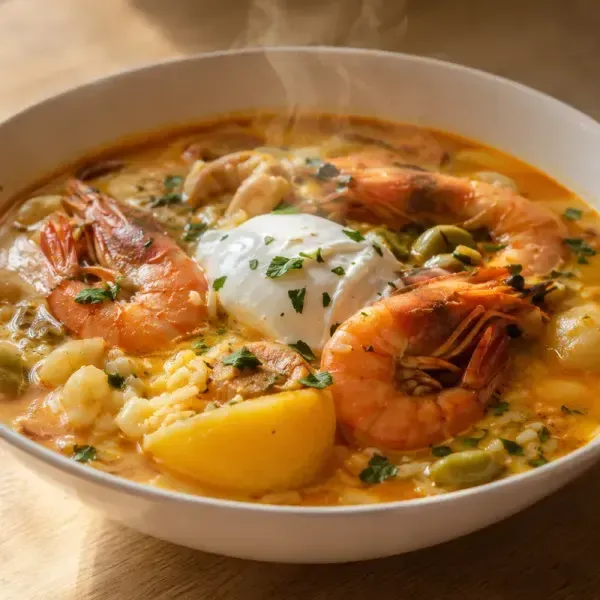
Everywhere huancaína goes, ocopa goes greener: beside pollo a la brasa, over fried yuca, and — Arequipa's own move — alongside chupe de camarones for the full picantería table. The leftover sauce on tomorrow's pasta settles the huancaína-vs-ocopa debate in the only way that matters: alternation.
Questions people ask
What is huacatay and can I skip it? It is an Andean herb related to the marigold, sometimes called black mint, with an aroma somewhere between mint, basil and something resinous of its own. Skipping it does not give you a milder ocopa — it gives you huancaína with peanuts in it. The jarred paste is a staple at Latin groceries and it is what most Peruvian kitchens use too.
What is the difference between ocopa and papa a la huancaína? The same skeleton and a different soul. Huancaína is ají amarillo, cheese and milk, and it comes out yellow. Ocopa adds huacatay and toasted peanuts, which turn it olive-green and give it a roasted, herbal depth. Arequipa says ocopa wins. Lima disagrees. Both are worth having.
Why toast the onion, garlic and peanuts? That searing is the entire personality of the sauce. Huancaína softens its ají briefly; ocopa chars the aromatics at the edges and toasts the peanuts until fragrant before anything goes in the blender. A raw-blended version tastes like herby mayonnaise, and five minutes at the stove is the difference.
Can I use peanut butter instead of peanuts? At a push, unsweetened and natural only. What you lose is the toasting, which is where most of the flavor comes from. Toasting whole peanuts in a dry pan takes four minutes and it is worth every one of them.

Junior Quintana learned to cook from his mother, Lina, in Junín, in the central Peruvian Andes — a kitchen where chicha morada simmered every Sunday and there were always native potatoes with cheese and choclo on the table. He started Andean Kitchen to share the food he grew up with, in English and without shortcuts: every recipe cooked and tested at home, where it's really made. His favorite dish is, and probably always will be, pachamanca. See how we cook, test and photograph.

Did you cook this?
Tell me how it went — including what did not work. I read every one, and with your permission I will put it on this page, with your first name, for whoever comes next.