

Genoese minestrone crossed the Atlantic more than once, and this is pesto's turn: it met the Peruvian pantry and made the trade every immigrant sauce makes here — pine nuts out, spinach, queso fresco and evaporated milk in — yielding a green sauce that's creamier, milder and more abundant than its ancestor, ladled over spaghetti and crowned, in the full criollo presentation, with a thin pan-fried steak. Ask Peruvians abroad which weekday lunch they miss and this plate polls suspiciously well.
Thursdays, in our house, more often than not — with a fried egg on top more than the steak, if I'm honest, because that's what was actually in the fridge on a Thursday. It is also a fixture of the menú, which in Peru does not mean the list of dishes but the cheap set lunch every neighborhood eatery serves at midday: soup, a main, a glass of something purple.
We're posting this the same week as Fiestas Patrias, Peru's Independence Day — not the flashiest dish for a national holiday, maybe, but exactly what ends up on the table once the flags come down and everyone just wants to eat well with family.
Pesto, the Peruvian draft
The spinach is bulk and color insurance (the same trick as arroz con pollo's green), the basil is the soul, and the dairy duo replaces both the cheese and the oil-slick of the original with something rounder. Two technique notes carry the dish: blanch the greens briefly so the sauce blends silky and stays green instead of oxidizing army-drab, and never boil the finished sauce — warmed gently with the pasta, it stays bright; boiled, it breaks and dulls, the same dairy law as every cream on this site.
Genoa sends pesto as a condiment. Peru receives it as a food group.
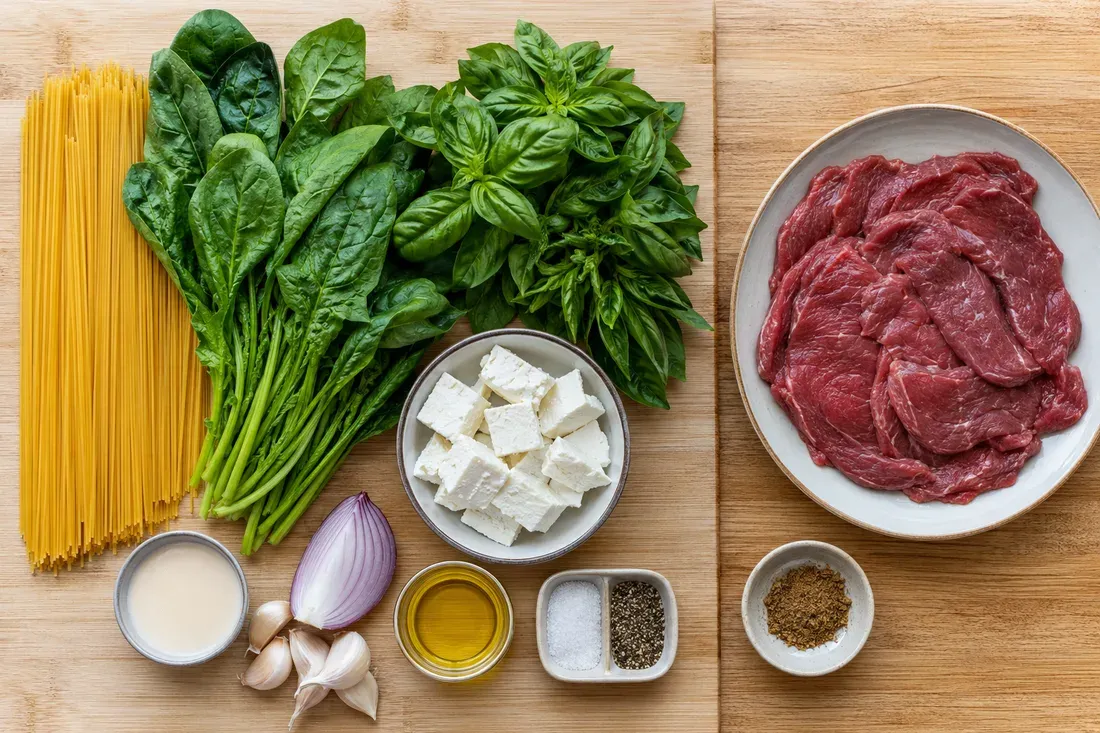
What to use instead of queso fresco and evaporated milk
These two are what make the sauce Peruvian rather than Genoese, and they are also the two things most likely to be missing from a kitchen abroad.
- Queso fresco. Mexican queso fresco is the same idea and the easiest to find. Failing that, a firm feta rinsed under cold water to pull the salt down, or a fresh farmer cheese. Do not use mozzarella — it goes stringy in the blender instead of creamy.
- Evaporated milk. Whole milk simmered down by about a third gets you close. Heavy cream works but makes the sauce richer than it should be — this is meant to be creamy, not heavy. Unsweetened condensed milk is a different product; do not substitute it.
- Both missing? Ricotta thinned with milk gets you a sauce in the right family. It will be milder and a little grainier, and it is a perfectly good dinner.
The steak on top, and what else goes there
The full criollo presentation puts a thin pan-fried steak over the pasta — bistec apanado if it is breaded, plain if it is not — and that is what a restaurant will bring you. At home the honest answer is whatever is in the fridge. A fried egg is the most common substitute and arguably the better one on a weeknight, since the yolk runs into the sauce. Grilled chicken works. So does nothing at all.
What the plate does not want is a second sauce. The green is already doing everything.
The recipe
Ingredients
- 400 g spaghetti
- 150 g spinach · 1 big bunch basil, leaves only
- 120 g queso fresco · ½ cup evaporated milk
- ¼ onion · 2 garlic cloves · 3 tbsp oil
- Salt · pepper
- The classic crown: 4 thin steaks, seasoned with salt, pepper and a little cumin, pan-fried fast — or a fried egg, the weeknight regency
Method
- Blanch spinach and basil, 30 seconds in boiling water, then drain hard.
- Sweat onion and garlic in the oil until soft, not colored.
- Blend greens, onion-garlic with its oil, cheese and milk to a completely smooth, thick green cream. Season.
- Pasta to al dente; reserve a cup of its water. Sauce into the empty pot over low heat, pasta back in, splash of pasta water, toss until glossy and coating. Never a boil.
- Crown and serve: steak over, extra cheese crumbled, and the Thursday feeling included at no charge.
Troubleshooting, from experience
The sauce turned olive-drab. Unblanched greens or a boil. Both preventable, neither reversible — tomorrow's batch will be beautiful.
Too thick. Pasta water exists for exactly this. A splash at a time.
Tastes flat. Under-salted — the dairy mutes. Season the sauce until it's almost loud alone; the pasta votes it back to balanced.
What to serve it with
The bistec is canon, the fried egg is the people's amendment, and a side of huancaína over the same plate — tallarines a lo verde con huancaína — is the gloriously excessive combination Peruvian menus call "a lo pobre" logic applied to pasta. Chicha morada, evidently.
Questions people ask
Why did my sauce turn dark green instead of bright? The greens oxidized, or the sauce boiled. Blanch the basil and spinach for a few seconds and cool them fast before blending, and warm the finished sauce gently with the pasta — never let it come to a boil. Both mistakes turn a vivid green sauce a dull army color.
Can I use ordinary Italian pesto? It will be a good plate of pasta, but a different one. Italian pesto is oil, pine nuts and hard cheese; this is dairy, spinach and a lot more volume. Peru turned a condiment into a sauce, and the whole point is how much of it ends up on the plate.
Does it have to be spaghetti? Spaghetti is what Peru uses and what the sauce clings to best. Linguine or fettuccine are fine. Short shapes work less well — the sauce is thick enough that it pools rather than coating.
Can I make the sauce ahead? A few hours, kept cold and covered. Longer than that and it starts to lose its color. If you need to prepare in advance, blanch and blend the greens ahead and stir the dairy in when you warm it.

Junior Quintana learned to cook from his mother, Lina, in Junín, in the central Peruvian Andes — a kitchen where chicha morada simmered every Sunday and there were always native potatoes with cheese and choclo on the table. He started Andean Kitchen to share the food he grew up with, in English and without shortcuts: every recipe cooked and tested at home, where it's really made. His favorite dish is, and probably always will be, pachamanca. See how we cook, test and photograph.
Did you cook this?
Tell me how it went — including what did not work. I read every one, and with your permission I will put it on this page, with your first name, for whoever comes next.