
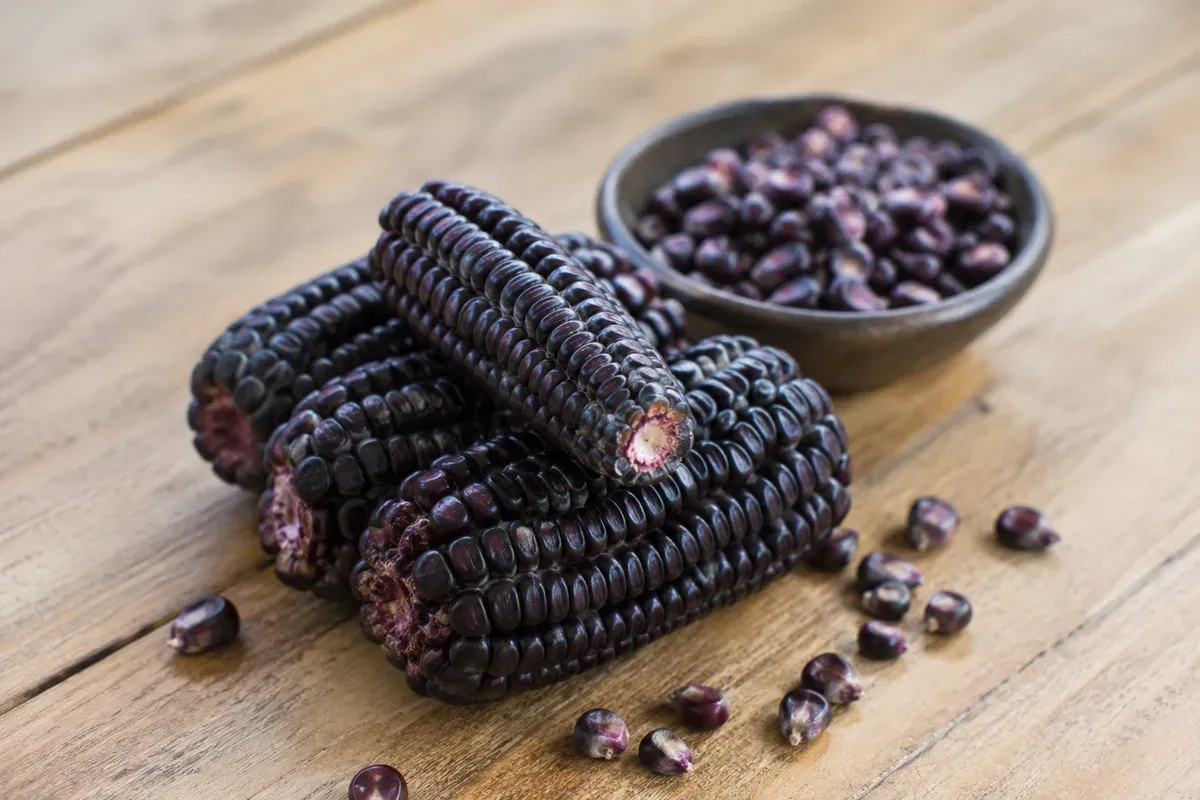
Visitors see maíz morado at a Peruvian market and assume a trick — corn that purple must be painted, or some modern novelty crop. It's neither. Purple corn has been cultivated in the Andes for thousands of years; it appears on Moche and Nazca pottery, and Peru remains its heartland, where it's grown not as a curiosity but as an ingredient with a job: to be simmered into the violet brew that becomes chicha morada, mazamorra morada, and a growing family of modern uses. This guide closes our purple-corn trilogy: the two recipes taught you to cook it; this page explains the ingredient itself, so the pantry article can do what pantry articles do — answer the questions both recipes raised.
In our market it comes by the ear, tied in bundles of four or five, and the caseras know exactly which stack has the darkest cobs — that's the one they push toward you first, because darker means stronger chicha and everyone in Junín knows it.
Why Peruvian purple corn is that color
The pigment is anthocyanin — chiefly one called cyanidin-3-glucoside — the same family that colors blueberries, black rice and red cabbage, but concentrated here at remarkable levels in both kernels and cob. Three kitchen consequences follow directly. First, brew the cob: it surrenders as much color and flavor as the kernels, which is why whole ears are sold and whole ears are simmered. Second, acid brightens, heat-plus-acid dulls: lime juice added to the finished cold brew shifts the purple vivid and red-toned; lime in the simmering pot kills the glow permanently — the rule both our recipes repeat because it's the rule everyone breaks once. Third, the color stains joyfully: wooden spoons, plastic containers and light countertops will remember your chicha. Consider it a souvenir.
The cob is half the harvest. Selling purple corn without the cob would be selling half the ingredient.
Anthocyanins are also why purple corn shows up in nutrition headlines as an antioxidant source. The compounds are real and well studied; the miracle claims attached to them are marketing. Our position is the usual one: we drink chicha because it's delicious and ours, and any antioxidants aboard are welcome passengers, not the destination.
Where to buy purple corn outside Peru
In order of preference: whole dried ears or kernels-with-cob in bags at Latin American groceries and online (the form both our recipes want); purple corn flour (harina de maíz morado), useful for baking and quick mazamorras but not for brewing; and bottled chicha concentrate, the honest shortcut we ranked in the chicha article. A 400 g bag brews a full pitcher and — thrifty Andean rule — the same corn supports a lighter second simmer. Store dried corn airtight and dark; the pigment fades with light, and faded corn brews gray-violet instead of royal purple.
The master brew, once and for all
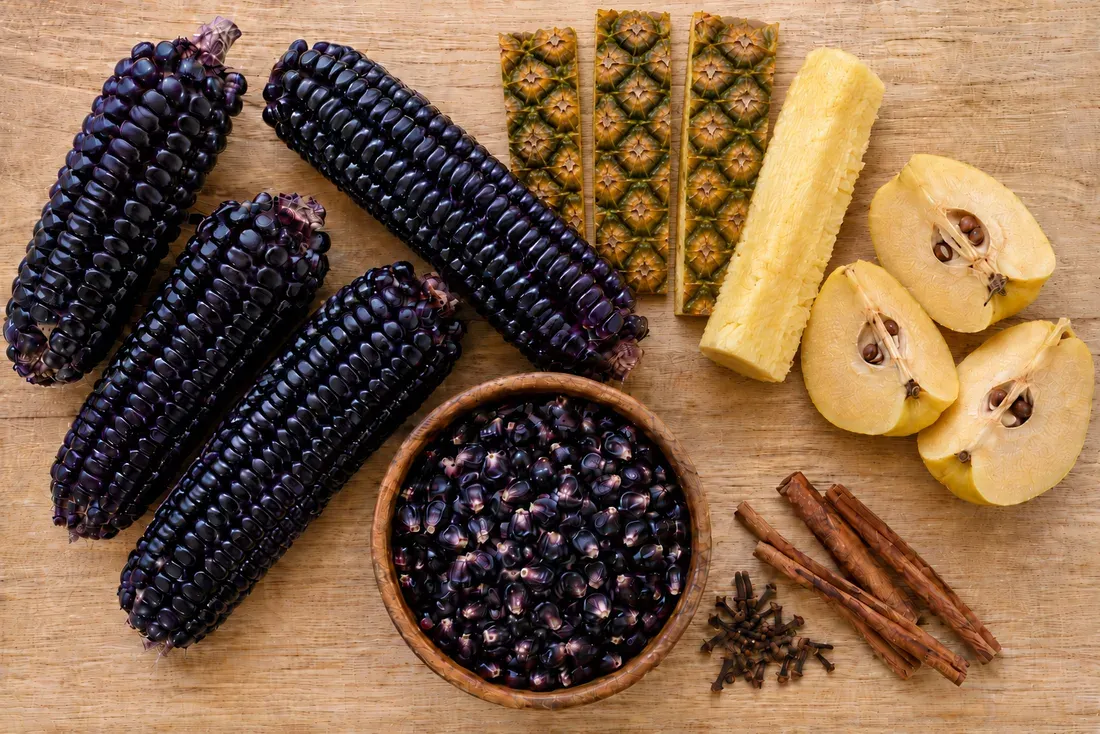
Base purple brew (for anything morado)
- 400 g dried purple corn, ears or kernels with cob pieces, rinsed
- 2.5–3 liters water (less water = stronger, for mazamorra; more, for chicha)
- Aromatics by destination: pineapple skin and quince for the classics; or brew it plain for baking and experiments
- Simmer everything, uncovered, 45 minutes, until deeply colored and the kernels split.
- Strain without pressing. That's it: you now hold the mother liquid of the entire morado family.
- Branch out: sweeten and lime it cold for chicha; concentrate and thicken it for mazamorra; reduce it to a syrup for pancakes and cocktails; or freeze it in portions, because future-you hosts lunches too.
Purple corn troubleshooting, from experience
The brew is weak and grayish. Old, light-faded corn, or kernels without cob. Buy fresh stock, whole ears, dark storage.
It turned dull after adding lime. The pot was still hot. Cold brew, then acid — the trilogy's most repeated sentence, because it's the trilogy's most repeated mistake.
Everything in my kitchen is purple. Working as intended. Baking soda paste lifts most stains; pride covers the rest.
Where the purple goes next
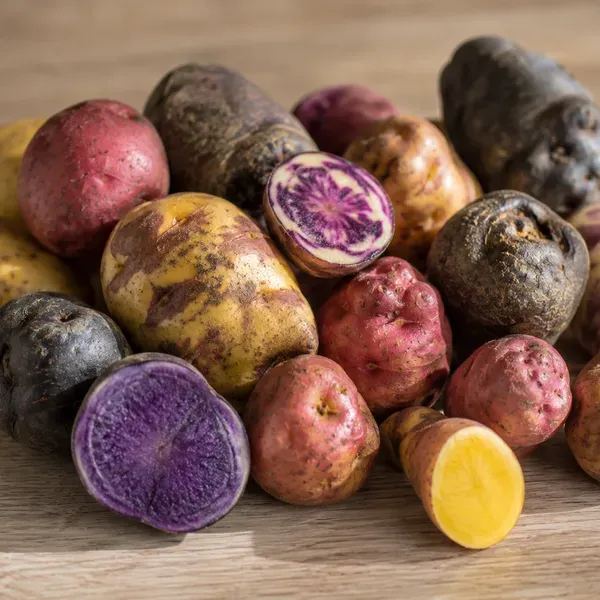
With this guide, the morado shelf of our pantry is complete: chicha morada for the pitcher, mazamorra for the spoon, and the clásico combinado to unite the purple with the white. The same anthocyanin family colors the purple native potatoes of our tuber guide — proof that in the Andes, even the color purple is a food group.
Questions people ask
Can I use the kernels without the cob? You can, and you will get a weaker brew. The cob holds as much pigment and flavor as the kernels, which is exactly why purple corn is sold as whole ears. Simmer everything — cob broken in pieces, kernels and all.
Why did my chicha turn out gray instead of purple? Either the corn was old and faded, or lime went into the pot while it was simmering. Acid added to the finished cold brew makes the color vivid; acid added to the hot pot kills it permanently. Store dried corn airtight and away from light, because the pigment fades on the shelf.
Is purple corn the same as blue corn? No. Blue corn is a Mexican variety used mostly for masa and tortillas. Peruvian maíz morado is grown to be simmered into a drink, and its pigment is concentrated at a level blue corn does not reach — which is why it can color a whole pitcher.
Can I reuse the corn for a second batch? Yes, and Andean kitchens do it as a matter of course. The second simmer gives a lighter brew, good for cooking or for a mild drink. What you cannot do is a third — by then the corn has given everything it has.

Junior Quintana learned to cook from his mother, Lina, in Junín, in the central Peruvian Andes — a kitchen where chicha morada simmered every Sunday and there were always native potatoes with cheese and choclo on the table. He started Andean Kitchen to share the food he grew up with, in English and without shortcuts: every recipe cooked and tested at home, where it's really made. His favorite dish is, and probably always will be, pachamanca. See how we cook, test and photograph.

Did you cook this?
Tell me how it went — including what did not work. I read every one, and with your permission I will put it on this page, with your first name, for whoever comes next.