
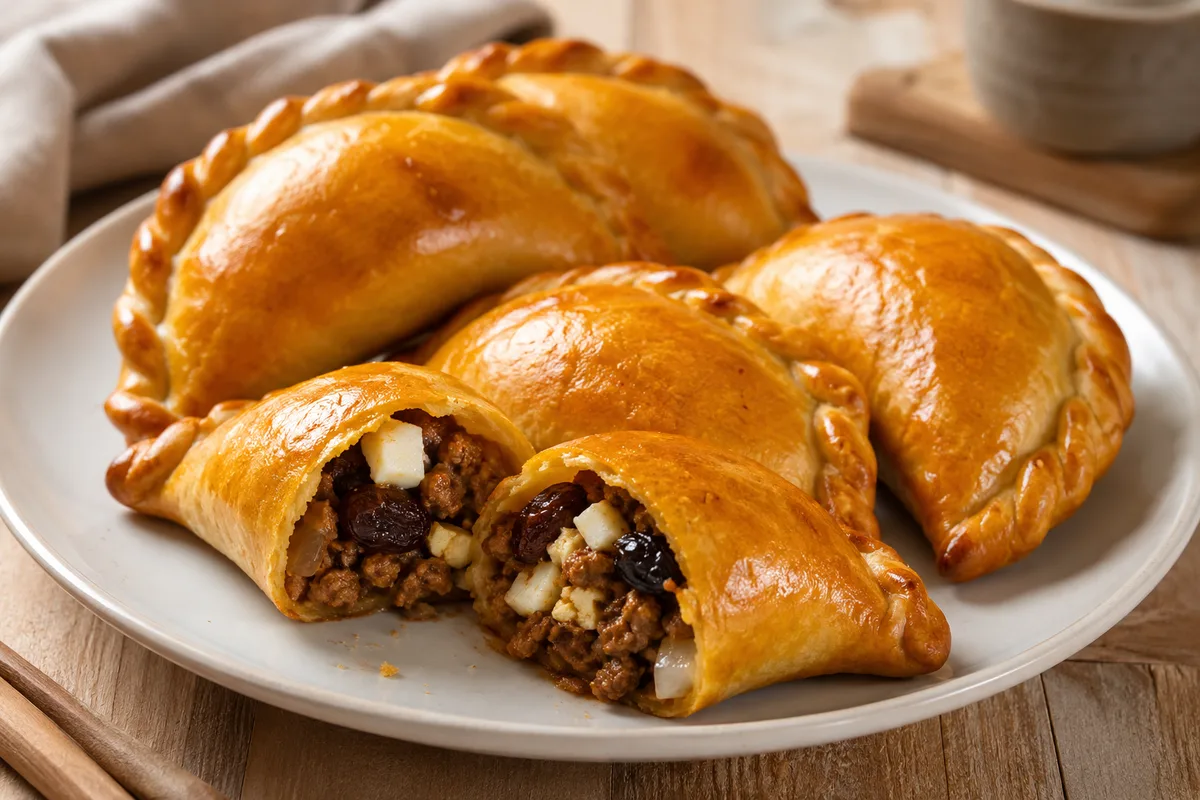
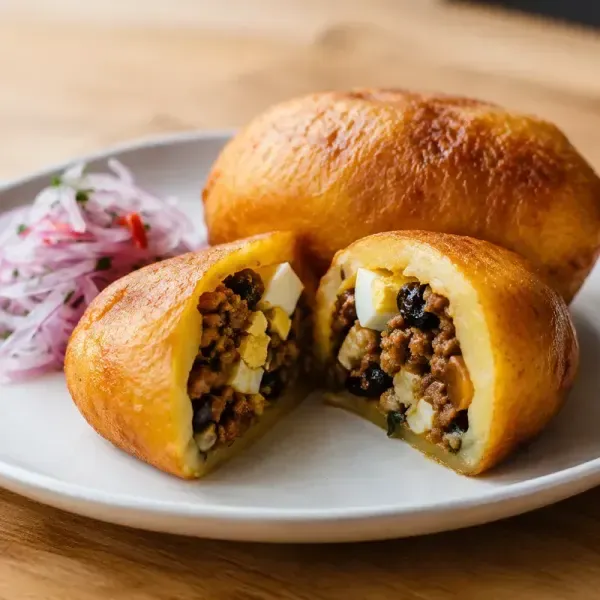
Peruvian empanadas are baked rather than fried, built around a flaky, buttery dough and a beef picadillo — meat chopped fine and cooked down with onion and chile — carrying the same signature combination found across the country's criollo cooking — raisins for sweetness, olives for brine, hard-boiled egg for richness, all built on an aderezo of onion, garlic and ají panca, cooked down slowly until it darkens. It's the same filling logic behind papa rellena and causa limeña, just wrapped in pastry instead of potato.
Every panadería — and Peru has one on almost every corner, selling bread from six in the morning — has small variations — more raisins here, a different ratio of beef to onion there — but the core combination of sweet, briny and savory stays constant across nearly all versions.
Nobody in my house made these. You bought them warm from the panadería on the corner, and the woman behind the counter asked the only question that mattered: “¿con azúcar o sin azúcar?” — with sugar or without. Answering “without” marked you as somebody who didn't know. I ate mine walking home and got powdered sugar down the front of my shirt every single time, which is how anyone could tell a Peruvian empanada had been involved.
Cold butter, cold water — the dough wants to stay cold
Flaky pastry depends on the butter staying in distinct, cold pieces through the mixing and rolling process, rather than melting into the flour — cold butter, cold water, and a chill in the fridge before rolling are what keep the final dough properly flaky rather than dense and tough.
Warm butter makes bread. Cold butter, kept cold the whole way through, is what makes pastry.
The filling needs to be fully cool before it meets the dough
Warm filling softens the cold butter in the dough on contact, undoing all the careful chilling from the previous step — let the picadillo cool completely, ideally in the fridge, before filling and sealing the empanadas.
Powdered sugar and a wedge of lime
This is the part that surprises everyone who meets a Peruvian empanada for the first time, and it is not optional here: the baked empanadas come to the table dusted with powdered sugar, with a wedge of lime alongside. You squeeze the lime over the sugar, right before you bite.
It sounds wrong written down. It is not. The filling underneath is already playing the same game — raisins against olives, sweet against brine — and the sugar and lime simply do it again on the outside, louder. Skip both and you have a perfectly good baked hand pie; you just do not have a Peruvian one.
Dust the sugar while the empanadas are warm but no longer hot, so it settles instead of dissolving. And cut the lime at the last moment: the whole point is that it is still sharp when it hits the plate.
Making them ahead, and freezing
Empanadas were built for this. Every step ahead of the oven can be done in advance, and the frozen ones bake better than you would expect — which is why Peruvian households keep a bag of them.
- The picadillo. Three days in the fridge and better on the second, once the raisins have softened into the sauce. It has to be completely cold before it meets the dough anyway, so making it the day before solves two problems at once.
- The dough. Two days wrapped in the fridge. Let it sit out for ten minutes before rolling or it will crack.
- Assembled and frozen raw. The best option. Freeze them spread apart on a tray, then bag them once solid. Bake from frozen, adding about ten minutes and starting a little cooler so the filling heats before the pastry browns.
What does not work is freezing them after baking. The pastry goes soft on thawing and never crisps back up properly — a baked empanada is meant to be eaten the day it came out.
The recipe
Ingredients
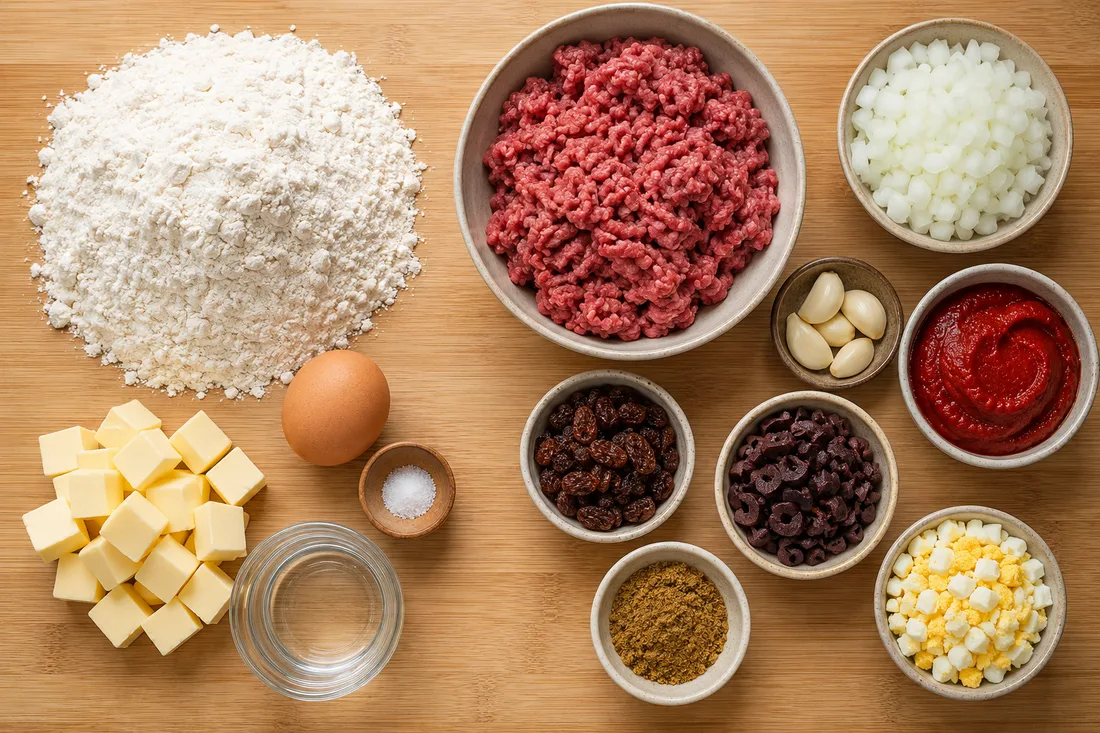
- 3 cups flour
- 1 cup cold butter, cubed
- 1 egg · 1/2 cup cold water · 1 tsp salt
- 400g ground beef
- 1 onion, diced · 3 garlic cloves, minced
- 2 tbsp ají panca paste
- 1/4 cup raisins
- 1/4 cup chopped black olives
- 2 hard-boiled eggs, chopped
- 1 egg, beaten, for brushing
- 2 tbsp oil · salt · pepper · ground cumin
Method
- Make the dough. Pulse flour, salt and cold butter until crumbly. Add egg and water, mix briefly. Chill 30 minutes.
- Make the filling. Cook onion and garlic, add ají panca and beef, browning through.
- Season and add-ins. Stir in raisins, olives and egg. Cool completely.
- Fill and seal. Roll dough, cut circles, fill and crimp.
- Bake at 200°C (400°F) for 20-25 minutes until golden.
Troubleshooting, from experience
Dough came out tough, not flaky. The butter melted into the flour before baking. Keep everything cold and don't overwork the dough.
Empanadas leaked filling. The edges weren't sealed tightly enough, or the filling was too warm. Crimp firmly and cool the filling fully first.
Bottoms came out soggy. Baked on a solid tray without airflow. Use a wire rack or perforated tray if possible.
What to serve it with
Empanadas are a starter or snack on their own, needing nothing more than a squeeze of lime if you'd like a bit of brightness.
Questions people ask
Why are Peruvian empanadas baked instead of fried? Because the dough is a butter pastry rather than a bread dough, and it is built to flake in the oven. Frying it would defeat the layering that cold butter creates. Fried empanadas exist across Latin America and they are a different thing with a different dough.
Do I really have to add powdered sugar? Yes, if you want the Peruvian version. It surprises everyone the first time and it is not decoration — the filling is already playing sweet against briny with the raisins and olives, and the sugar with a squeeze of lime does the same thing again on the outside. Skip it and you have a good baked hand pie that stopped being Peruvian.
My empanadas opened in the oven. What went wrong? Either the filling was still warm when it went in, or the seal was not properly pressed. Warm filling softens the butter in the dough and the seam gives. Cool the picadillo completely, press the edge firmly, and crimp it — a fork works if your fingers do not.
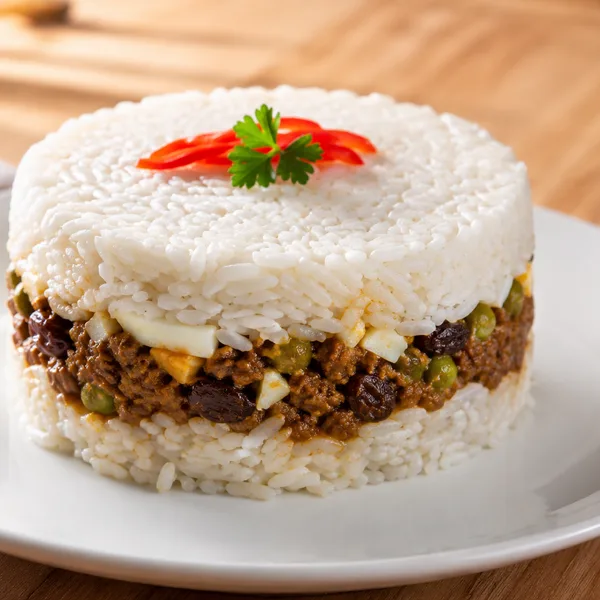
What is picadillo? The finely chopped beef filling: beef, onion, ají panca, with raisins, olives and hard-boiled egg. The same mixture fills papa rellena and arroz tapado. That sweet-and-briny combination is a signature of criollo cooking rather than a quirk of any one dish.
Junior Quintana learned to cook from his mother, Lina, in Junín, in the central Peruvian Andes — a kitchen where chicha morada simmered every Sunday and there were always native potatoes with cheese and choclo on the table. He started Andean Kitchen to share the food he grew up with, in English and without shortcuts: every recipe cooked and tested at home, where it's really made. His favorite dish is, and probably always will be, pachamanca. See how we cook, test and photograph.
Did you cook this?
Tell me how it went — including what did not work. I read every one, and with your permission I will put it on this page, with your first name, for whoever comes next.