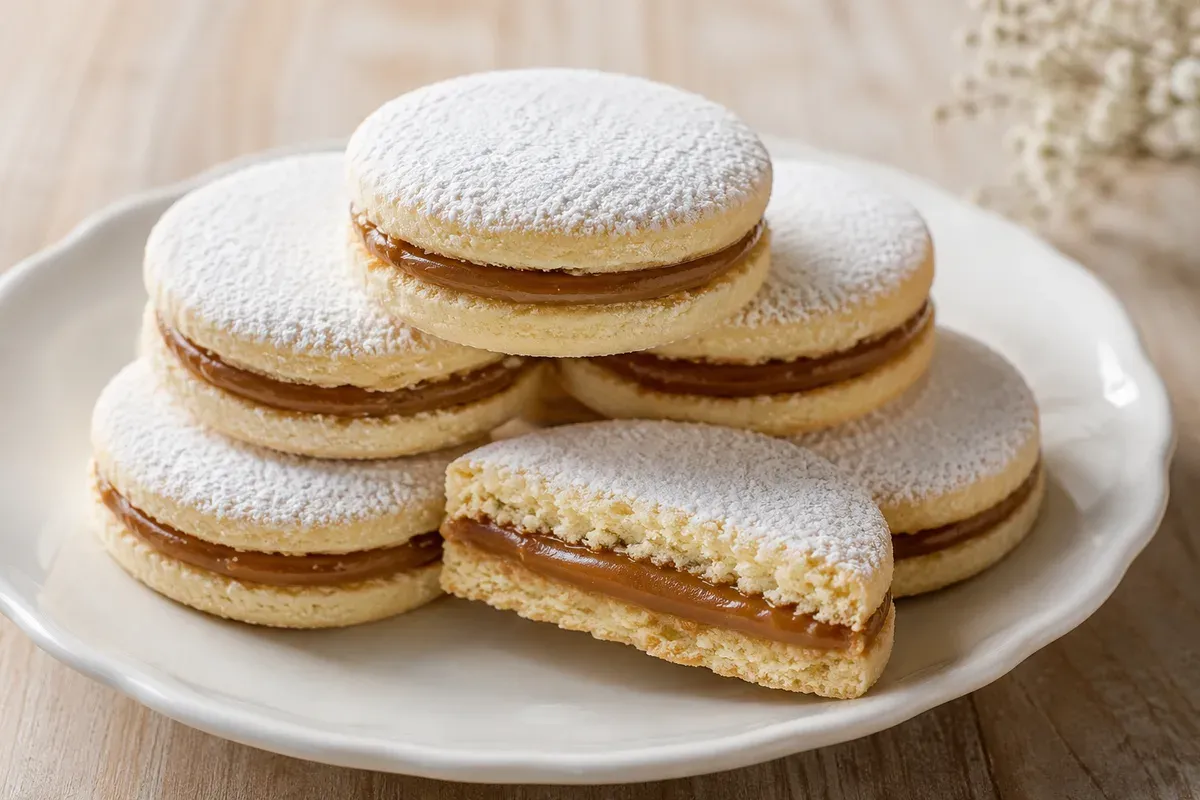
Every Peruvian celebration ends the same way: a tray of alfajores vanishing faster than dignity permits. The Peruvian build is specific within the great South American alfajor family: two cookies so high in cornstarch they dissolve rather than crunch, an unapologetic stratum of manjar blanco — Peru's name and slightly silkier take on dulce de leche, the same caramel soul that crowns suspiro — and a snowfall of powdered sugar that guarantees evidence on every eater. The recipe is short; the discipline (pale cookies, thick manjar, restraint at the tray) is the entire craft.
The alfajores I still measure every batch against came from my tía Rosa's kitchen in Junín, and later from my casera — the neighborhood shopkeeper everyone in town trusts by default — at the panadería down the block, who dusted hers so heavy you'd sneeze before the first bite. Her manjar stood thick enough to hold a spoon upright, and I've spent years chasing that exact thickness in my own pot.
Cornstarch is the architecture
Nearly half the dry mix is cornstarch, and that ratio is the melt: cornstarch carries no gluten, so the cookie sets tender and dissolves on the tongue instead of snapping. Two corollaries follow. Don't knead — bring the dough together and stop, or the flour's gluten wakes up and the clouds turn to crackers. And bake pale: the cookies are done when set and still nearly white underneath; golden-brown alfajor cookies taste toasty and wrong, like a lullaby played loud.
A proper alfajor cookie doesn't break. It surrenders.
The manjar question
Jarred manjar blanco or any thick dulce de leche works beautifully — choose the thickest you can find, since runny caramel slides the sandwich apart by teatime. The from-scratch route is a simmered patience project of milk and sugar (or the pressure-cooked condensed-milk shortcut every Latin household whispers about); we'll give manjar its own article someday, because it has earned one. For today: thick jar, generous spoon.
A Peruvian alfajor is not an Argentine one
This is the first thing worth clearing up, because the word covers a whole continent of different cookies. The Argentine alfajor most people abroad have met is often coated in chocolate or a white glaze, and its cookie is softer and cakier. The Peruvian one is bare: two pale, crumbling cornstarch discs, manjar blanco between them, and powdered sugar over the top. No coating, no glaze, nothing between you and the collapse.
The Spanish brought the idea and the Arabic-derived name, and every country that received it kept a different part. Peru kept the fragility.
Manjar blanco: what to buy, honestly ranked
- Peruvian manjar blanco from a Latin grocery. The real thing, and thicker than most dulce de leche. If the jar says manjar blanco or manjar, you are done looking.
- Argentine dulce de leche repostero. The pastry-grade version, made specifically to hold its shape in a filled cookie. Almost as thick, and far easier to find outside Peru.
- Ordinary jarred dulce de leche. It works, but many brands are loose enough to slide. Cook it down in a pan for a few minutes and let it cool completely before you fill anything.
What to avoid is caramel sauce or anything labeled caramel spread — it is a different product, it never sets, and the sandwich will be on the plate by evening.
They are better on the second day
Freshly assembled alfajores are good. Alfajores that sat overnight in a closed tin are the ones people remember. The cookie draws a little moisture from the manjar and stops being brittle, the two halves stop behaving like separate objects, and the whole thing goes from crumbly to yielding.
So make them the day before. Keep them in a tin at room temperature, not the fridge, which dries the cookie and stiffens the filling. Dust the powdered sugar just before serving rather than the night before, or it dissolves into the surface and disappears.
The recipe
Ingredients
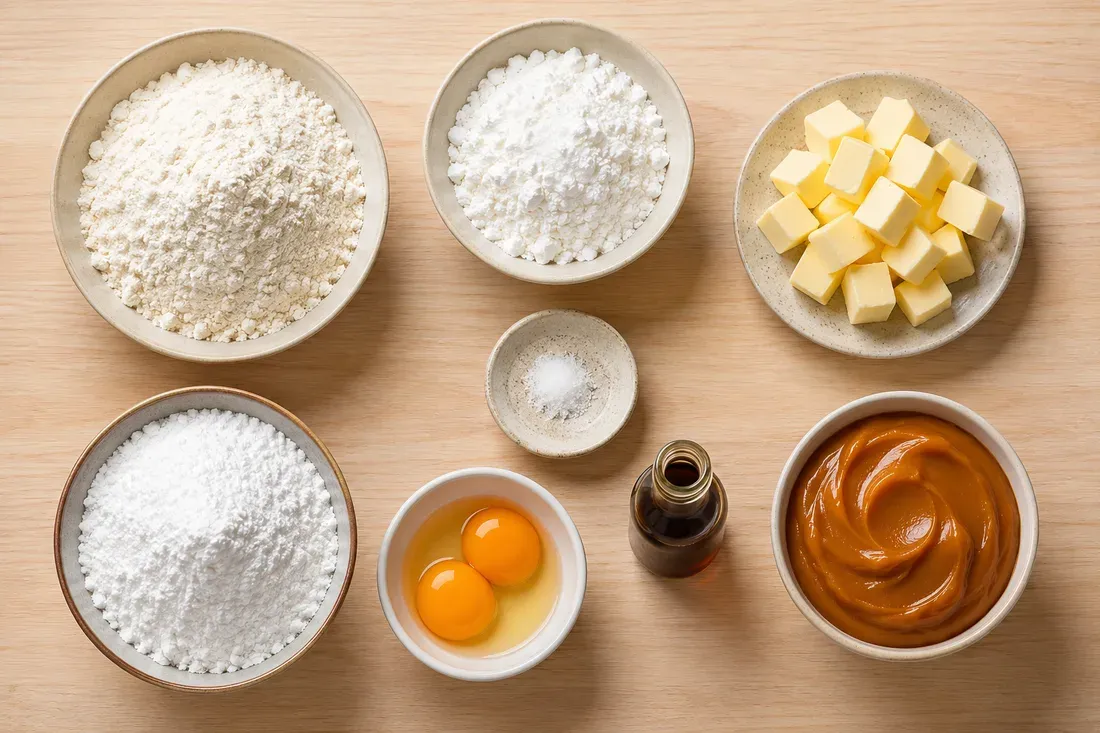
- 200 g flour · 150 g cornstarch · pinch of salt
- 200 g cold butter, cubed
- 80 g powdered sugar, plus much more for dusting
- 2 egg yolks · 1 tsp vanilla · 1–2 tbsp cold water only if the dough demands
- 400 g thick manjar blanco / dulce de leche
Method
- Crumbs, then dough. Flour, cornstarch, salt, sugar and cold butter rubbed to fine crumbs; yolks and vanilla in; press together just until it holds. No kneading. Chill 30 minutes.
- Roll and cut: 4 mm thick, 5 cm rounds, onto parchment. Re-roll scraps once, gently.
- Bake pale: 170 °C, 10–12 minutes — set, dry-looking, barely blond at the edge. Cool completely on the tray; they're too tender to argue with warm.
- Sandwich and snow. A thick disc of manjar (a piping bag keeps it civilized), the second cookie pressed with two fingers' patience, and powdered sugar over everything including, traditionally, the cook.
Troubleshooting, from experience
The cookies crumble when filling. They're supposed to be fragile — but if they're dust, the dough was overworked or overbaked. Gentle hands, pale bake.
The manjar squeezes out. Too runny or too warm. Thicker jar, cooler kitchen, lighter press.
Tough, snappy cookies. Kneading happened. The dough forgives once; the gluten never forgets.
What to serve it with
Afternoon coffee or tea is the natural habitat; a hot emoliente makes it a highland evening. On the celebration table they sit beside suspiro and picarones — the manjar family reunion — and disappear first, every time, in every household ever surveyed by us, informally, at every party we've attended.
Questions people ask
Why are my cookies hard instead of crumbly? Almost always kneading. The dough needs to be brought together and then left alone — worked any further, the flour develops gluten and the cookie snaps instead of dissolving. Overbaking does the same thing, so pull them while they are still pale underneath.
Can I use only flour instead of cornstarch? You can, but you will have made a different cookie. The cornstarch is close to half the dry mix and it is the entire reason a Peruvian alfajor melts. With flour alone you get something closer to shortbread — pleasant, and not this.
How long do they keep? Four or five days in a closed tin at room temperature, and they are at their best on days two and three. Do not refrigerate them: the cold dries the cookie out and firms the manjar past the point where the two work together.
What is manjar blanco exactly? The Peruvian version of dulce de leche — milk and sugar cooked down slowly until it thickens and browns. It is a little silkier and usually thicker than the Argentine version, which is why it holds a sandwich together instead of escaping from it.

Junior Quintana learned to cook from his mother, Lina, in Junín, in the central Peruvian Andes — a kitchen where chicha morada simmered every Sunday and there were always native potatoes with cheese and choclo on the table. He started Andean Kitchen to share the food he grew up with, in English and without shortcuts: every recipe cooked and tested at home, where it's really made. His favorite dish is, and probably always will be, pachamanca. See how we cook, test and photograph.
Did you cook this?
Tell me how it went — including what did not work. I read every one, and with your permission I will put it on this page, with your first name, for whoever comes next.