
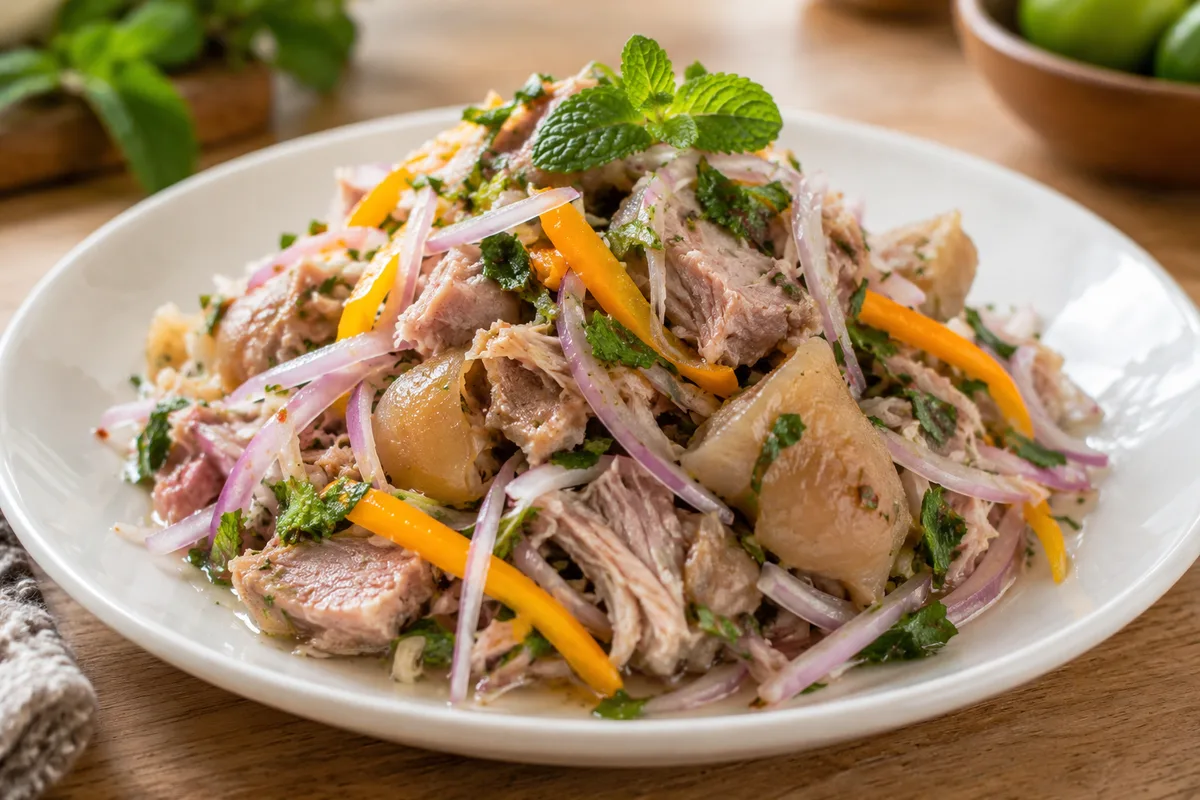
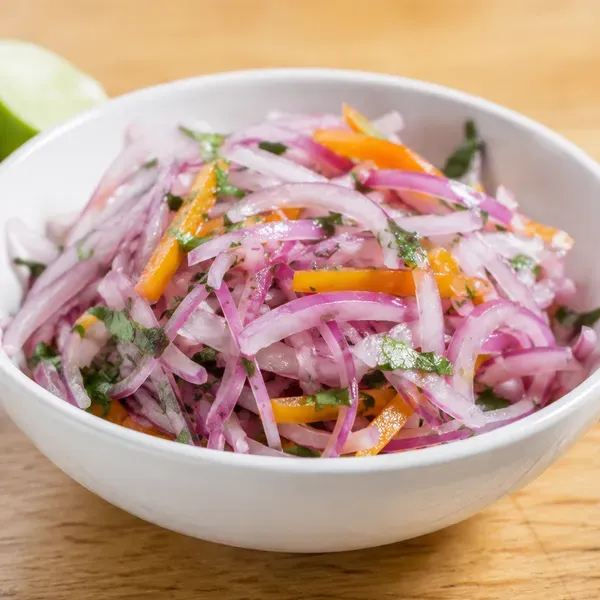
Sarsa de patitas takes pork trotters — feet, largely cartilage and collagen — and turns them, after a long, patient boil, into a genuinely appealing cold salad: sliced, boned meat and skin tossed with raw onion, lime juice and ají amarillo. It's the same instinct behind cau cau and choncholí — treating a cut most Western kitchens discard as worth real technique and its own dedicated dish.
Long-simmered trotters take on a distinctive soft, almost gelatinous texture once tender, which the sharp, acidic dressing cuts through nicely, making for a salad that's richer and more substantial than its ingredient list might suggest.
Restaurants do sell it, and it has its following — the collagen is the reason people give. I would still rather eat it at home. Nobody announces sarsa de patitas there: somebody puts the trotters on to boil in the morning, and by lunchtime it is on the table, cold, and that is the whole event.
The boil needs real patience
Pork trotters are mostly connective tissue and bone, and they need a genuine hour and a half to two hours of simmering to break down into something tender enough to bone and slice cleanly. Rushing this step leaves tough, hard-to-work-with meat that the salad's dressing can't fix afterward.
Trotters have nowhere to hide an undercooked simmer. Either they're properly tender, or they're not usable at all.
What you are actually buying, and how to ask for it
Pork trotters are the feet, and they are mostly skin, collagen and bone with very little meat on them — which is the point, not a shortcoming. The collagen is what turns into that soft, faintly sticky texture after a long simmer, and it is what makes the salad cling to the dressing instead of sliding around a plate. A trotter that has been trimmed of its skin to look tidier is a trotter that has lost the only thing you wanted from it.
Ask the butcher to split them lengthwise. They will do it with a saw in two seconds and you would need twenty minutes and a cleaver to make a worse job of it. Split trotters also cook faster and are far easier to bone afterwards. If the only ones available are whole and unsplit, buy them anyway and add half an hour to the simmer.
Outside Peru, look in Mexican, Chinese, Caribbean or Eastern European shops, where trotters are a normal thing to sell rather than a curiosity. They are cheap everywhere, because the rest of the world has largely forgotten what to do with them. Clean them properly before anything else: a scrub under cold water, and if there is any bristle left, a pass over a flame takes it off.
Bone them while still warm, if you can manage it
Removing meat and skin from trotter bones is considerably easier while the meat is still warm and pliable — once fully cooled, the collagen firms up and the job becomes noticeably more tedious. Work through this step shortly after boiling, before the trotters cool completely.
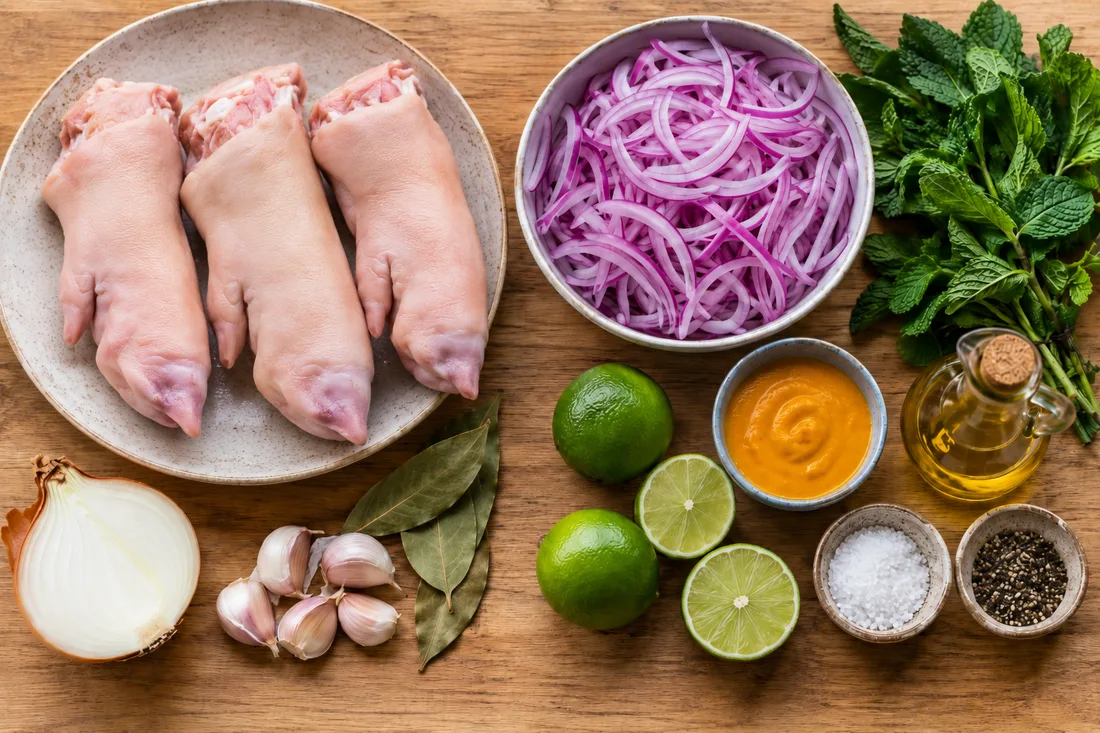
The recipe
Ingredients
- 4 pork trotters, cleaned and halved
- 1 onion, halved · 2 bay leaves · 4 garlic cloves
- 1 red onion, thinly sliced (for the salad)
- 1 tbsp ají amarillo paste
- Juice of 3 limes
- 2 tbsp chopped mint
- 3 tbsp olive oil · salt · pepper
Method
- Boil the trotters with onion, bay leaves and garlic 1.5 to 2 hours until very tender.
- Bone while still warm, slicing the meat and skin into strips.
- Toss with red onion, ají amarillo, lime juice, mint, oil, salt and pepper.
- Marinate 15 minutes, then serve cold or at room temperature.
Troubleshooting, from experience
Trotters still tough. Not simmered long enough. Give them the full 1.5 to 2 hours.
Boning was a struggle. Left to cool too long first. Work through it while the meat is still warm.
Salad tastes flat. Not enough lime or ají amarillo. This dish needs real acidity and heat to balance the richness.
What to serve it with
Boiled corn and a side of choclo round out the plate, the same way they accompany many of Peru's cold salads.
Questions people ask
Is this the same as salsa criolla? No, though the confusion is understandable — both are built on thin red onion, lime and ají. Salsa criolla is a condiment you spoon over other food; sarsa de patitas is the dish itself, a salad you eat with a fork. The onion is doing a different job in each.
How do I know the trotters are done? The meat and skin should come away from the bone with almost no effort, and the skin should be soft enough to cut with the side of a fork. If you are fighting it, it needs more time — and more time is the only fix. Underdone trotters do not improve in the dressing.
Can I boil them a day ahead? Yes, and it makes life easier. Boil, bone and slice while warm, then refrigerate the meat and dress it the day you plan to eat it. What you should not do is dress it a day ahead: the lime keeps working overnight and the onion goes limp and grey.
Is it served cold? Cold or at room temperature, never hot. Straight from the fridge the collagen is firm and the texture is at its best, which is exactly why it turns up at lunch on hot days and at parties where the food has been sitting out a while.
What if I cannot find pork trotters? Then make something else. Pig's ears work in the same style and have a similar texture, but every other substitute — shoulder, belly, hock — gives you a decent pork salad that is not this dish, because none of them have the collagen that defines it.

Junior Quintana learned to cook from his mother, Lina, in Junín, in the central Peruvian Andes — a kitchen where chicha morada simmered every Sunday and there were always native potatoes with cheese and choclo on the table. He started Andean Kitchen to share the food he grew up with, in English and without shortcuts: every recipe cooked and tested at home, where it's really made. His favorite dish is, and probably always will be, pachamanca. See how we cook, test and photograph.
Did you cook this?
Tell me how it went — including what did not work. I read every one, and with your permission I will put it on this page, with your first name, for whoever comes next.