

Choros a la chalaca takes its name from Callao — Lima's port city, whose residents are called chalacos — and it's exactly the kind of starter you'd expect from a place built around fishing boats and a constant supply of fresh shellfish. Mussels are steamed just until they open, then piled with a bright, chopped salsa of onion, tomato, corn and lime that shares real DNA with the salsa served on tiradito and ceviche — Peru's coast returning again and again to that same raw-acid-and-onion formula. The word choro is usually traced back to Quechua churu, shell — one of many words that came down to the coast from the mountains rather than across the sea.
It's a starter built for sharing, usually arriving on a platter with a dozen or two half shells arranged in a circle, meant to be picked up and eaten in one or two bites each. It is piqueo food in the strict sense — the plate of small things that comes out with drinks, before anybody has decided what they are actually eating.
I ate these for the first time in Callao itself, standing up, off a plastic table a few streets from the water, and the man who handed me the plate stood there to watch me try one. There is a joke waiting in the name that every Peruvian knows and no recipe site ever bothers to tell you: a choro is this mussel, and a choro is also what we call a thief. Order a dozen at a table in Lima and somebody will make it. It is not a good joke. It gets made anyway.
Don't overcook the mussels
Mussels need only enough heat to force their shells open — five to seven minutes of steaming is usually plenty, and pulling them the moment they open keeps the meat plump and tender rather than shrunken and rubbery. Any mussel that stays firmly shut after steaming should be discarded rather than forced open; it likely wasn't alive and fresh to begin with.
The steaming step is the only cooking this dish gets. Everything after that is assembly, not heat.
The salsa should be chopped small and dressed at the last minute
A fine, even dice on the onion and tomato lets the salsa sit properly on top of each small mussel rather than sliding off in big chunks, and tossing it with the lime juice only right before serving keeps the onion from turning limp and the tomato from going watery. Made too far ahead, the salsa loses the crisp brightness that makes this dish work.
Buying mussels, and the one safety rule
Buy them alive and cook them the same day. A live mussel is closed, or closes when you tap it; one that stays open after a tap is dead and goes in the bin before it ever reaches the pot. After steaming, the rule reverses: any mussel still closed gets thrown out. Never pry one open to see.
Pull off the beard — the tuft of fibers at the flat edge — by tugging it toward the hinge, and scrub the shells under cold water. Do the debearding just before cooking, since it kills the mussel.
You want the shells for serving, not just the meat, so keep the better half of each one. Half a shell is the plate this dish is served on.
Frozen mussels, and cooking this inland
Live mussels are best and they are not always available, which is the reality for anyone cooking this away from a coast. Frozen works, with one condition: buy them on the half shell, because the shell is the plate this dish is served on and mussel meat piled in a bowl is a different dish entirely.
- Frozen on the half shell, cooked. The most common form and the easiest. Thaw in the fridge, drain thoroughly, and skip the steaming — they are already cooked, and reheating them only makes them tough. Bring them to room temperature and top them cold.
- Frozen whole, raw. Steam them from frozen, a minute or two longer than fresh. Keep the better half of each shell.
- Vacuum-packed cooked mussels. They work if the shells came with them. If they are shelled, use small dishes or spoons instead and call it what it is — the salsa is still excellent.
Whatever you use, drain it properly. Water hiding in a shell dilutes the lime and the salsa slides off.
The recipe
Ingredients
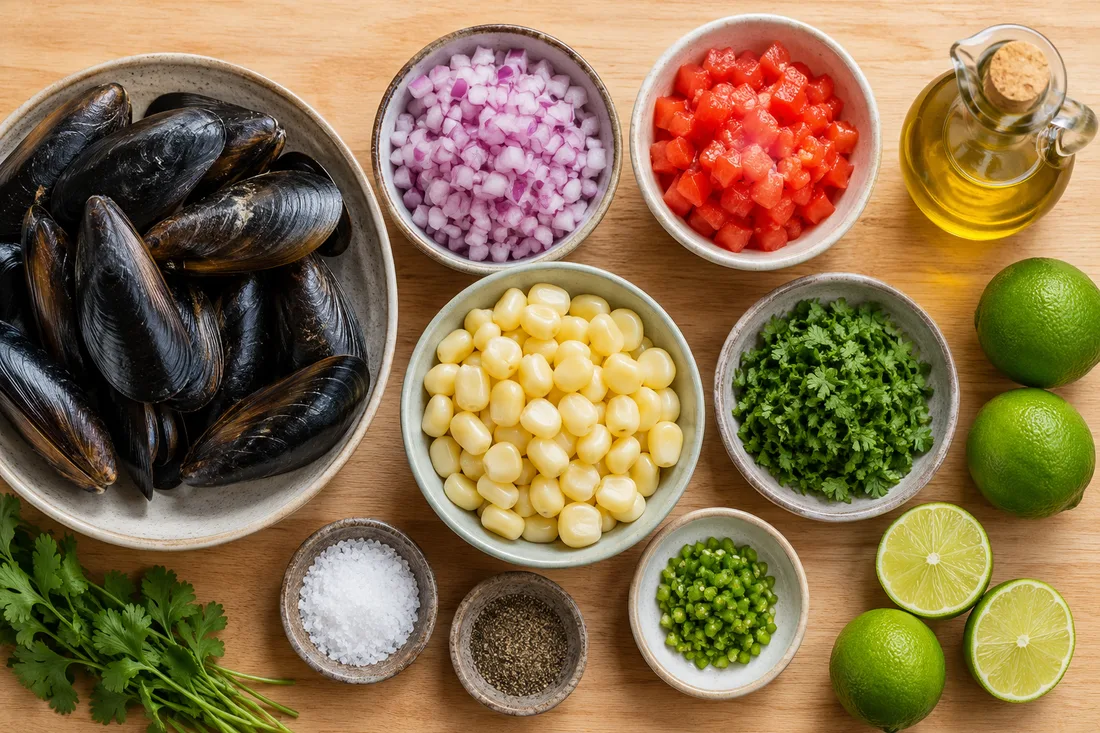
- 24 mussels, cleaned and debearded
- 1 cup water, for steaming
- 1 red onion, finely diced
- 1 tomato, seeded and finely diced
- 1/2 cup cooked corn kernels
- 1/4 cup chopped cilantro
- 1 ají limo or rocoto, seeded and minced (optional, to taste)
- Juice of 3 limes
- 2 tbsp olive oil · salt · pepper
Method
- Steam the mussels, covered, 5-7 minutes until open. Discard any that stay closed.
- Shell them, keeping half of each shell to serve on.
- Make the salsa by mixing onion, tomato, corn, cilantro, ají and lime juice with olive oil, salt and pepper.
- Assemble. Return each mussel to a half shell and top with the salsa. Serve chilled.
Troubleshooting, from experience
Mussels turned rubbery. Overcooked. Pull them the moment they open, no longer.
Salsa turned watery on the plate. It sat too long after dressing. Toss it with the lime juice right before serving, not ahead of time.
Some mussels never opened. That's normal — discard them rather than trying to force them open, since it usually means they weren't fresh.
What to serve it with
A cold beer or a glass of chilcano alongside is the classic pairing for this kind of coastal starter.
Questions people ask
How do I know if a mussel is safe to eat? Two rules that reverse. Before cooking, a live mussel is closed or closes when you tap it — one that stays open is dead and goes in the bin. After steaming, any mussel still shut gets thrown out. Never pry one open to check.
Can I make the salsa ahead? Chop it ahead, dress it at the last minute. Lime starts breaking the onion down on contact, and salsa made an hour early goes limp and watery. Keep the chopped vegetables cold and toss them with the lime as the plate goes to the table.
What can I use instead of ají limo? A fresh habanero or scotch bonnet, used sparingly — they are the same species and carry a similar fruity heat. Rocoto works too. What you want is a thin line of heat against the lime, not a burn that takes over the mussel.
Is this served hot or cold? Cool or at room temperature. The mussels are steamed and then left to come down before the salsa goes on — a hot mussel under cold lime salsa is neither one thing nor the other. It is piqueo food, meant to sit on the table while people drink.

Junior Quintana learned to cook from his mother, Lina, in Junín, in the central Peruvian Andes — a kitchen where chicha morada simmered every Sunday and there were always native potatoes with cheese and choclo on the table. He started Andean Kitchen to share the food he grew up with, in English and without shortcuts: every recipe cooked and tested at home, where it's really made. His favorite dish is, and probably always will be, pachamanca. See how we cook, test and photograph.
Did you cook this?
Tell me how it went — including what did not work. I read every one, and with your permission I will put it on this page, with your first name, for whoever comes next.