
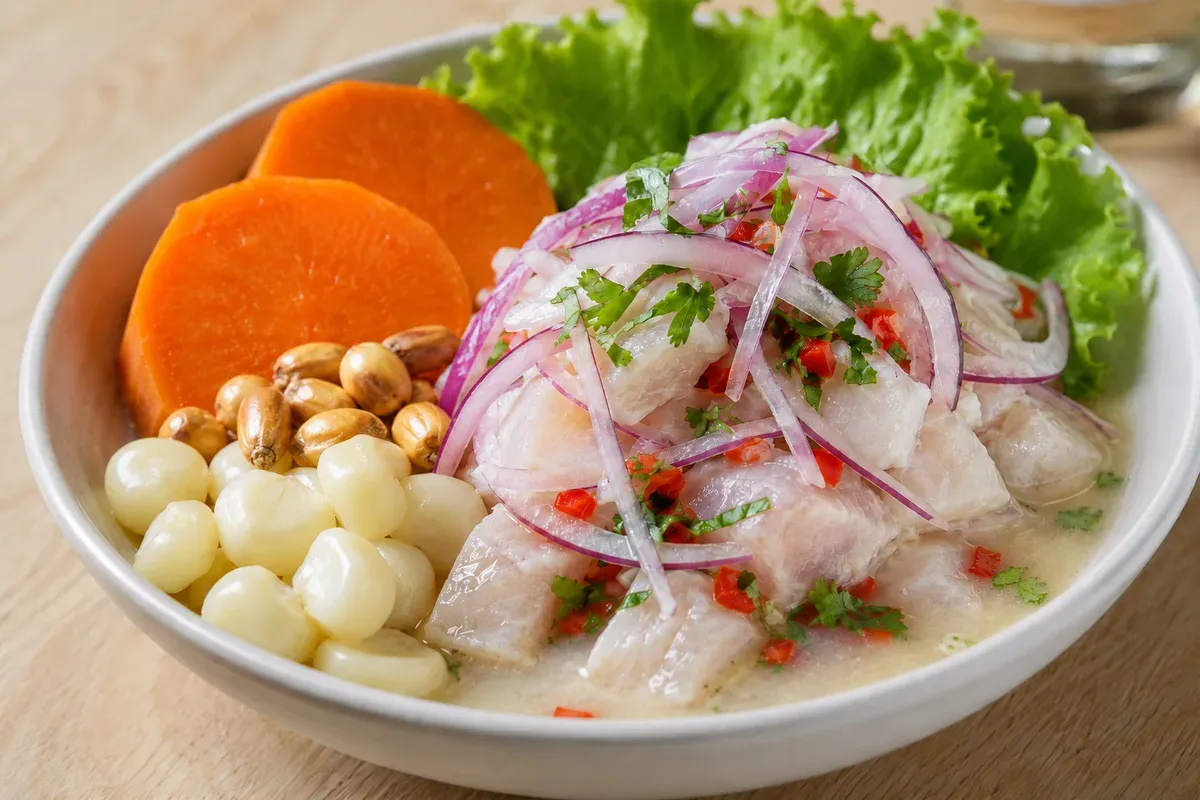
Peru's national dish has exactly five ingredients: fish, lime, red onion, ají, salt. That's the whole law. Sweet potato and choclo — the fat-kerneled Andean corn, chuqllu in Quechua — arrive as escorts on the plate, cilantro is a welcome guest, and everything beyond that — tomato, ketchup, hours of "cooking" in the fridge — belongs to other countries' very respectable but very different ceviches. The Peruvian version, declared part of the nation's cultural heritage and inscribed by UNESCO in 2023, is an exercise in restraint: the freshest fish you can find, dressed at the last possible minute, eaten before the conversation gets going.
Because there's no heat involved, ceviche is less a recipe than a sourcing problem followed by ten minutes of assembly. This guide spends its energy accordingly: most of it is about choosing fish and understanding the marinade, because once those two are right, the dish nearly makes itself — faasilmi cayan, as the grandmothers up in the sierra put it: it's easy.
We write from the sierra, not the coast, and that only sharpens the rule about freshness: the fish travels up to us, so you go to the market early, ask the casera — your trusted seller — what came up from the coast that dawn, and eat it the same midday or not at all. Here a bravazo ceviche — that's the top compliment, roughly "a knockout" — still lives or dies by that morning fish. And nobody up here eats ceviche at night: it's lunch food, full stop. The fish was bought at sunrise and the bowls are empty by three.
The fish: fresh first, species second
In Lima the classic is corvina (a South Pacific sea bass) or lenguado (flounder). Outside Peru, the species matters less than two qualities: firm white flesh that holds a cube, and absolute freshness — this is a raw preparation, full stop. Excellent candidates: sea bass, halibut, grouper, snapper, fluke, mahi-mahi. Ask your fishmonger what came in that morning and say it's for ceviche; in most coastal cities they'll know exactly what to hand you. If you're far from a trustworthy fish counter, high-quality flash-frozen fish, fully thawed in the fridge, is a safer and perfectly respectable choice — freezing to commercial standards also addresses parasite concerns, which is why even good cevicherías abroad rely on it.
Avoid oily fish (salmon, mackerel — wonderful elsewhere, muddy here) and anything flaky-soft like cod, which dissolves in the acid.
Minutes, not hours: how the marinade actually works
The old belief — fish "cooking" in lime for hours until chalk-white throughout — died decades ago in Peru. Modern Peruvian ceviche, the style codified in Lima's cevicherías, marinates for five to ten minutes: long enough for the acid to firm and opacify the outside of each cube, short enough that the center stays pearly, tender and tasting of fish rather than of lime. Acid denatures protein the way heat does, but it never stops; past the ten-minute mark you're not cooking the fish, you're mummifying it.
Lime doesn't cook fish. It starts a clock — and the dish is best in the first ten minutes of it.
Two practical notes. First, juice the limes just before using, and don't press the squeezer to the bitter end — the last drops carry the peel's bitterness. Second, a couple of ice cubes stirred in for the final minute (and fished out before serving) is a cevichería trick that keeps everything cold and slightly tempers the acid.
Leche de tigre: the point of the whole exercise
The cloudy, ferocious liquid pooling at the bottom of the bowl — lime juice transformed by fish, ají, onion and salt — is leche de tigre, "tiger's milk," and for many Peruvians it's the best part of the dish. A proper ceviche is wet: every serving should carry enough marinade to drink from the bowl when the fish is gone. (It's also a sworn hangover cure, sold by the glass at markets. We'll give it its own article, because it deserves one.)
What never goes in
Tomato. That single addition moves you out of Peruvian ceviche and into the Ecuadorian or Mexican families — both legitimate, neither this dish. The same goes for ketchup, orange juice to "soften" the lime, and olive oil. Peruvian ceviche tolerates exactly two optional upgrades: a tiny amount of garlic paste, and a few cilantro leaves. Everything else is a different recipe wearing the same name.
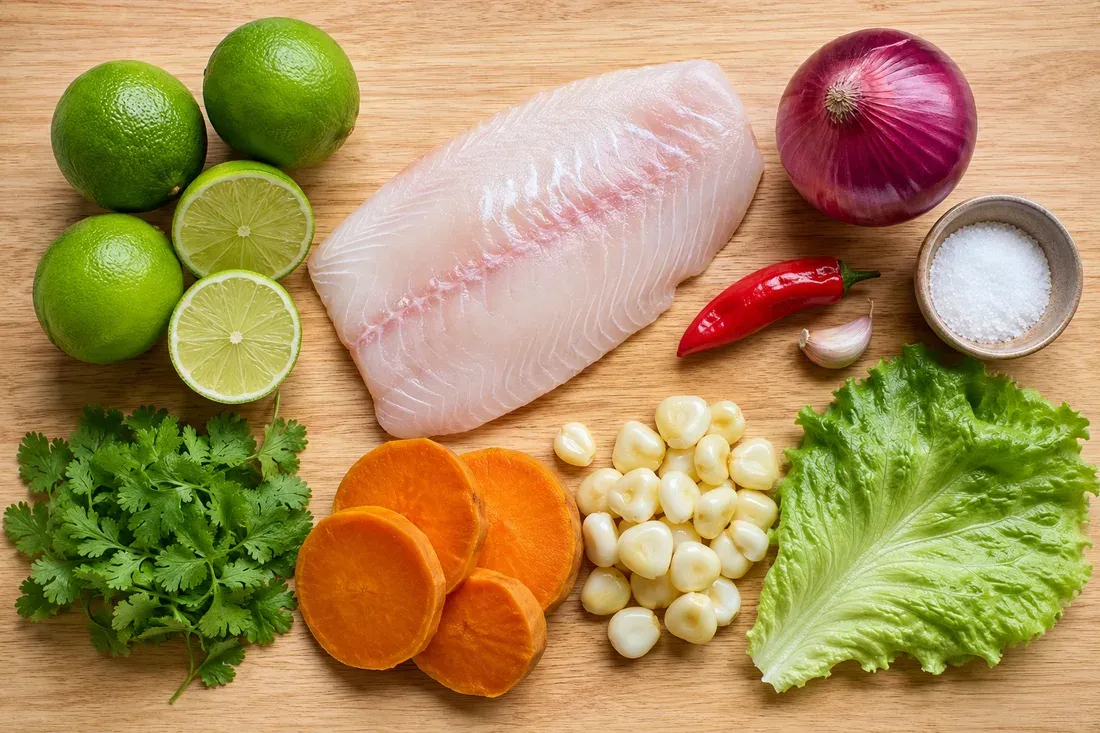
The recipe
Ingredients
- 600 g very fresh firm white fish (sea bass, corvina, halibut, grouper, snapper)
- 10–12 limes — juiced at the last minute
- 1 large red onion, in fine julienne
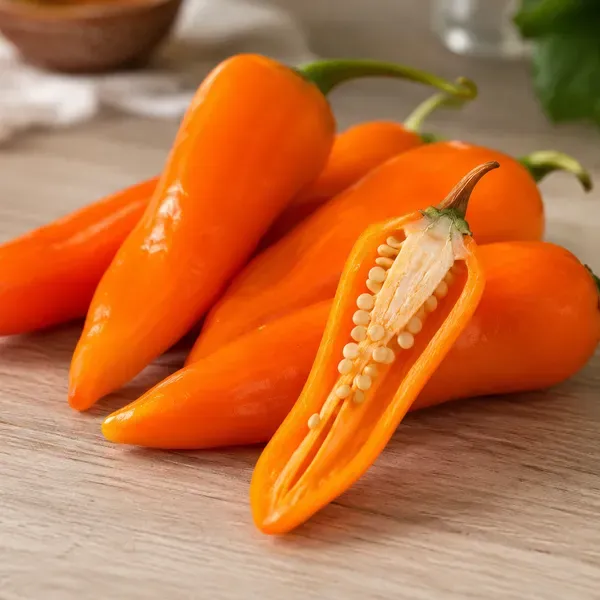
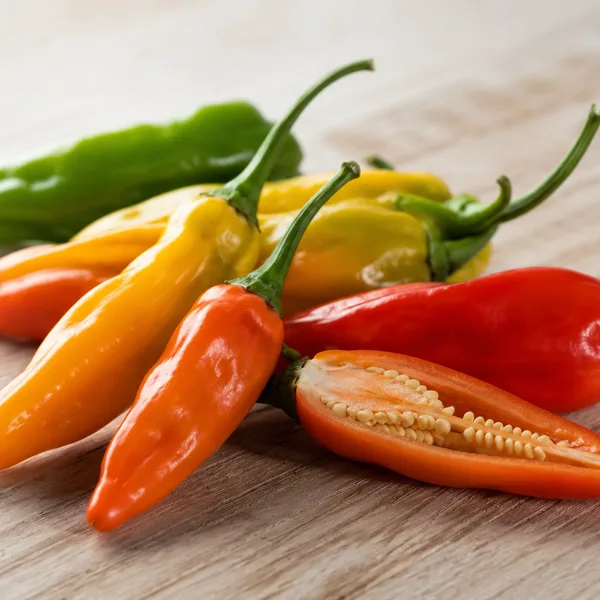
- 1 ají limo or ½ habanero, minced fine — or 1 ají amarillo for gentler heat
- Fine salt
- Optional: 1 small garlic clove ground to a paste · a small handful of cilantro leaves · 2–3 ice cubes
- To serve: boiled sweet potato in thick slices, boiled choclo or cancha (toasted corn), a lettuce leaf per bowl
Method
- Prep cold. Cut the fish into 2 cm cubes, removing every bone. Back into the fridge. Chill the serving bowls too.
- Soften the onion's bite. Soak the julienne in cold water while you do everything else; drain well before using.
- Season the fish first. In a cold bowl: fish, a confident pinch of salt, the minced ají, the garlic if using. Fold gently and let it sit 1 minute — salting before the lime seasons the fish, not just the juice.
- Lime, and start the clock. Pour the juice over until the fish is almost covered. Stir once. Five to ten minutes: outside opaque, center pearly. Drop in the ice cubes for the last minute and remove them.
- Finish. Fold in onion and cilantro. Taste the leche de tigre — it should be bracing, salty, alive — and correct.
- Serve instantly. Cold bowls, plated taipá — heaped and generous — with plenty of marinade, sweet potato and corn alongside. Eat it al toque, right away: ceviche does not wait.
Troubleshooting, from experience
It's unbearably acidic. Over-marinated, or the lime variety is harsh. Shorten the clock, and balance with the sweet potato — that's literally its job on the plate.
The fish turned mushy. Wrong species (too soft) or cubes cut too small. You want 2 cm dice from a firm fillet.
It tastes flat. Under-salted, almost always. The leche de tigre should taste nearly too intense on its own — it's seasoning fish, onion and two starches.
What to serve it with
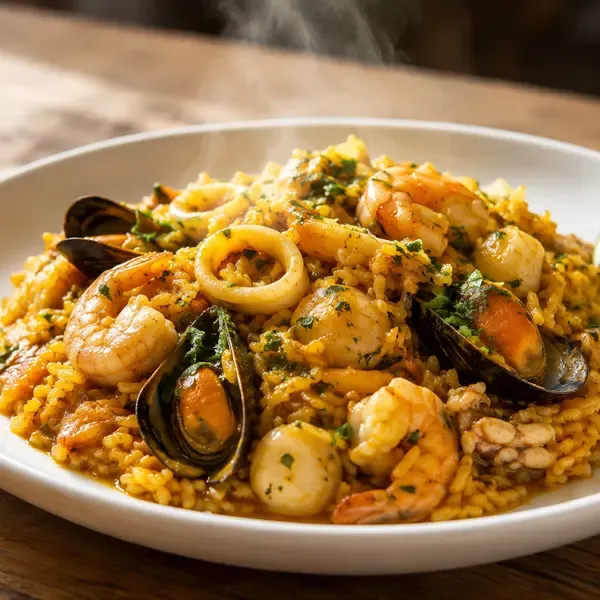
Ceviche opens the meal; in cevicherías it precedes arroz con mariscos or a fried-fish plate. The drink is non-negotiable in our house: cold chicha morada, whose sweetness is the perfect counterweight to all that lime. And the leftover leche de tigre, if any survives, is tomorrow's apology to your body.

Junior Quintana learned to cook from his mother, Lina, in Junín, in the central Peruvian Andes — a kitchen where chicha morada simmered every Sunday and there were always native potatoes with cheese and choclo on the table. He started Andean Kitchen to share the food he grew up with, in English and without shortcuts: every recipe cooked and tested at home, where it's really made. His favorite dish is, and probably always will be, pachamanca. See how we cook, test and photograph.
Did you cook this?
Tell me how it went — including what did not work. I read every one, and with your permission I will put it on this page, with your first name, for whoever comes next.