
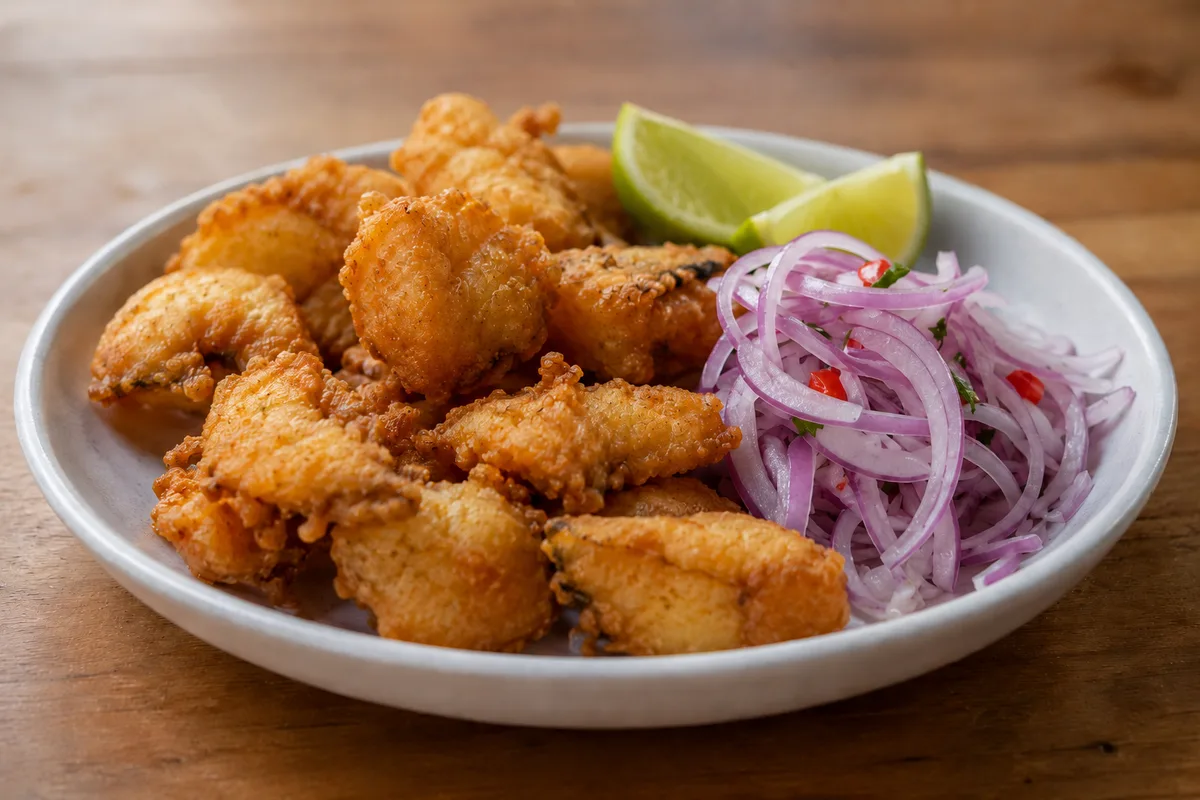
Chicharrón in Peru doesn't only mean fried pork, the way it might elsewhere — it is really a technique. Chicharrón means anything cut small and fried until crisp, and the coast applies it just as readily to fish and calamari as the sandwich version does to pork in pan con chicharrón. This is the simplest of the fried seafood dishes on this site — no platter of mixed proteins like jalea, no salsa to build, just fish or calamari, a light dredge, hot oil, and lime.
It shows up everywhere along the coast: cevicherías — the lunchtime places that live and die on how fresh their fish is — serve it as a starter before the ceviche arrives, beachside stalls sell paper cones of it to people walking by, and home cooks make a quick version whenever fresh fish needs using without much fuss.
The only fish I knew growing up was trucha, trout, pulled out of a cold river and fried whole within the hour. Sea fish came to us frozen, in a box, and it was never quite the same animal. So the first time I ate chicharrón de pescado on the coast — hot, salty, squeaking against the crust — I understood that I had been eating a different dish all my life and calling it by a nearby name.
A lime bath before the flour, not instead of it
A short soak in lime juice before dredging does two things: it seasons the fish through rather than just on the surface, and it firms the flesh slightly, which helps thin pieces hold together in hot oil instead of falling apart into the fryer. Ten minutes is enough — much longer and the acid starts to actually "cook" the fish the way it does in ceviche, which changes the texture before it ever reaches the pan.
The lime isn't a garnish for the end. Its real job happens ten minutes before the fish ever sees the oil.
A light dredge, not a heavy batter
Where jalea leans on a flour-and-cornstarch coating built for a thicker crunch, chicharrón de pescado usually stays with a simple, thin flour dredge — just enough to crisp up and let the fish or calamari underneath stay the actual point of the dish, rather than being buried under batter.
Which fish, and how to cut it
Firm white fish in bite-sized cubes is the whole requirement — around three centimeters, so each piece has enough body to stay juicy while the outside crisps. Cod, hake, pollock, haddock and monkfish all work; so does calamari, cut into rings, and most cevicherías fry both together on the same plate.
Avoid very thin fillets and anything oily. Thin pieces overcook before the crust sets, and oily fish turns heavy under frying in a way white fish does not.
Cut everything to the same size before you start. It sounds obvious and it is the single most common reason a plate of chicharrón comes out with some pieces dry and some underdone — the oil cannot compensate for a cube twice the size of the one beside it.
Getting the oil right, which is most of the job
Everything else here is preparation. The frying is where it goes wrong, and it goes wrong in three predictable ways.
- Too cool and the fish drinks the oil. You want it hot enough that a piece sizzles hard the moment it goes in — around 350°F. Below that the coating softens instead of setting and the fish comes out heavy.
- Too crowded and the temperature collapses. Four or five pieces at a time in a home pan, no more. Every piece you add drops the oil further, and a crowded pan is the same problem as a cool one.
- Drained on paper and it steams itself soft. A rack, always. The crust you spent the whole recipe building lasts about ninety seconds sitting in its own steam.
Fry in batches and serve in batches. In a cevichería the plate leaves the kitchen the instant it comes out of the oil, and nobody waits for the rest of the table.
The recipe
Ingredients
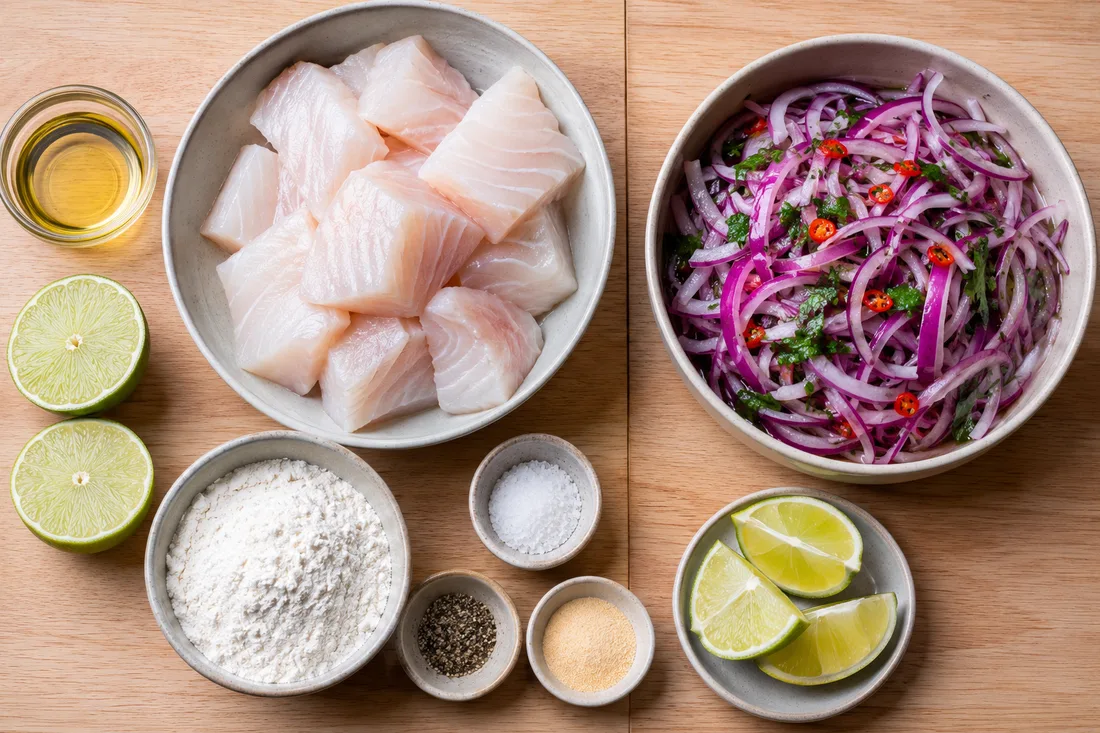
- 500g firm white fish or calamari rings, cut into bite-sized pieces
- Juice of 1 lime, plus wedges to serve
- 1 cup flour
- 1 tsp salt · 1/2 tsp pepper · 1/2 tsp garlic powder
- Oil, for deep frying
- 1 batch salsa criolla, to serve
Method
- Marinate briefly. Toss the fish or calamari with lime juice and a pinch of salt. Let sit 10 minutes.
- Dredge. Mix the flour with salt, pepper and garlic powder. Pat the seafood dry and coat lightly.
- Fry in oil at about 180°C (350°F), in batches, for 2-3 minutes until golden and crisp. Don't crowd the pan.
- Serve immediately with lime wedges and salsa criolla.
Troubleshooting, from experience
Fish fell apart in the oil. It sat in the lime bath too long, or the pieces were cut too thin and delicate. Keep pieces a reasonable bite size and the soak to about 10 minutes.
Coating turned soggy fast. Serve it the moment it comes out of the oil — chicharrón de pescado doesn't hold well and isn't meant to sit around.
Calamari came out tough. Overcooked. It needs barely a minute or two — pull it as soon as the color turns golden.
What to serve it with
Salsa criolla and a wedge of lime are the non-negotiable pair. A side of fried yuca or a simple green salad rounds it into more of a full meal.
Questions people ask
Which fish should I buy? Firm white fish that holds together in cubes: cod, hake, corvina, sea bass, halibut. Avoid anything thin and flaky, which falls apart in the oil, and anything oily like mackerel, which fights the lime. Frozen is fine as long as you thaw it fully and dry it properly.
How long should the fish sit in lime? Ten to fifteen minutes, no more. This is a seasoning step, not a ceviche — leave it longer and the acid starts cooking the fish, which then goes chalky when it hits the oil. Drain it and pat it dry before the flour.
Why did my coating fall off? The fish was wet when it was dredged. Lime, then dry thoroughly, then flour, then straight into the oil. Any water between the fish and the flour turns to steam in the pan and lifts the crust away in sheets.
What is the difference between this and fried fish anywhere else? The lime and garlic seasoning before the flour, and the fact that it is cut into pieces rather than served as a fillet. It is also never battered — a thin dredge of flour or cornstarch is the whole coating, which is why it stays light.
Junior Quintana learned to cook from his mother, Lina, in Junín, in the central Peruvian Andes — a kitchen where chicha morada simmered every Sunday and there were always native potatoes with cheese and choclo on the table. He started Andean Kitchen to share the food he grew up with, in English and without shortcuts: every recipe cooked and tested at home, where it's really made. His favorite dish is, and probably always will be, pachamanca. See how we cook, test and photograph.
Did you cook this?
Tell me how it went — including what did not work. I read every one, and with your permission I will put it on this page, with your first name, for whoever comes next.