
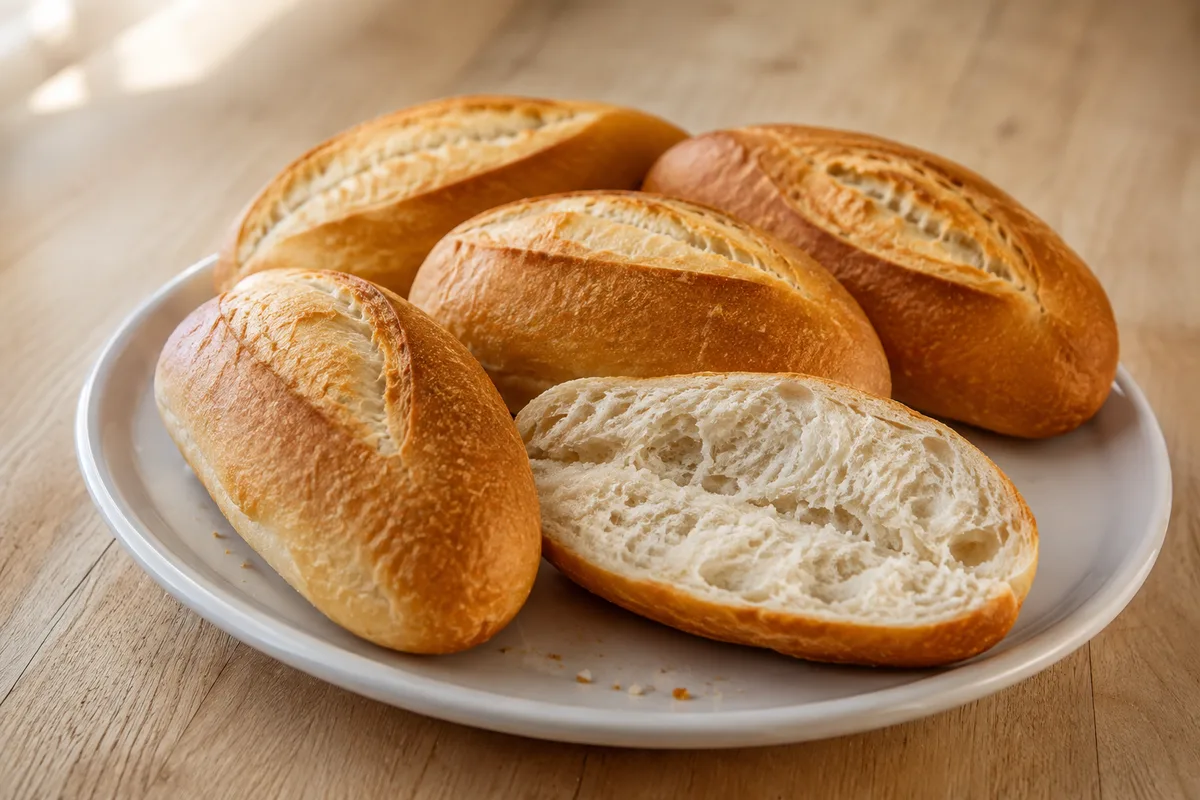
Despite the name, pan francés owes very little to France — it's simply what Peru calls its everyday bread roll, the one bought fresh every single morning from a neighborhood panadería rather than kept in a bag on a shelf. The name is a hand-me-down from an era when anything considered refined got labeled "francés" regardless of its actual origin, and it stuck to this particular roll the way "quáker" stuck to oatmeal. What matters far more than the name is the ritual around it: someone in nearly every household walks to the corner bakery each morning, buys however many rolls the day needs, still warm, and the bread on the table is never more than a few hours old.
The roll itself is built for that ritual — a shatteringly crisp crust from a hot, steam-injected oven, and a soft, slightly torn-looking interior from the way it's shaped, with a distinctive split seam across the top that opens as it bakes. It's engineered to be eaten the same day, which is exactly the point of buying it fresh every morning instead of once a week.
The bakery near us baked before dawn, for the whole day, and again at night for dinner — though that second batch was always the small one, and everybody knew the hours. You do not ask for a number of rolls either. You ask for two soles of bread, or five soles, and they count out however many that comes to. Get there when the first batch is out and the crust still crackles when you press the bag. Get there an hour later and it is the same bread, technically, and not the same bread at all.
The panadería as a daily appointment
A Peruvian corner bakery isn't a destination shop — it's closer to a daily appointment, open before most people are awake and often visited twice, once for breakfast bread and again in the evening for whatever the dinner table needs. The bread basket at any given meal is rarely just pan francés alone; it shares space with pan de yema (a softer, egg-enriched roll) and whatever the bakery happens to be known for locally, but pan francés is the one that shows up daily, without exception, everywhere in the country.
A loaf that lasts a week isn't a failure of the recipe — it's a sign nobody's walking to the panadería anymore, and that's the actual loss.
It is not a baguette, and it is not trying to be
The name invites the comparison and then the bread refuses it. A baguette is long, lean and made of four things — flour, water, salt, yeast. Pan francés is a short, plump roll, and there is almost always a spoonful of lard or shortening worked into the dough, which is what keeps the crumb soft and a little fluffy instead of open and chewy. The crust cracks when you press it; it does not shatter into splinters down your shirt.
The real difference shows up on day two. A baguette goes properly stale and is then good for very little. Pan francés dries out more gently, which is why no Peruvian kitchen throws out yesterday's rolls: they get split and toasted for breakfast, or torn into a soup, or soaked for the milky bread pudding that shows up when there are too many left over.
Baking it at home, without a bakery oven
Home ovens can't match a bakery's deck oven and steam injection, but a pan of hot water on the bottom rack during baking gets remarkably close, producing enough steam in those first crucial minutes to let the crust develop properly before it sets. The classic torn-top seam comes from shaping the dough into a tight ball and then, just before the final rise, pressing a rolling pin or the side of your hand firmly across the top — the dough splits open there as it proofs and bakes, rather than anywhere random.
The recipe
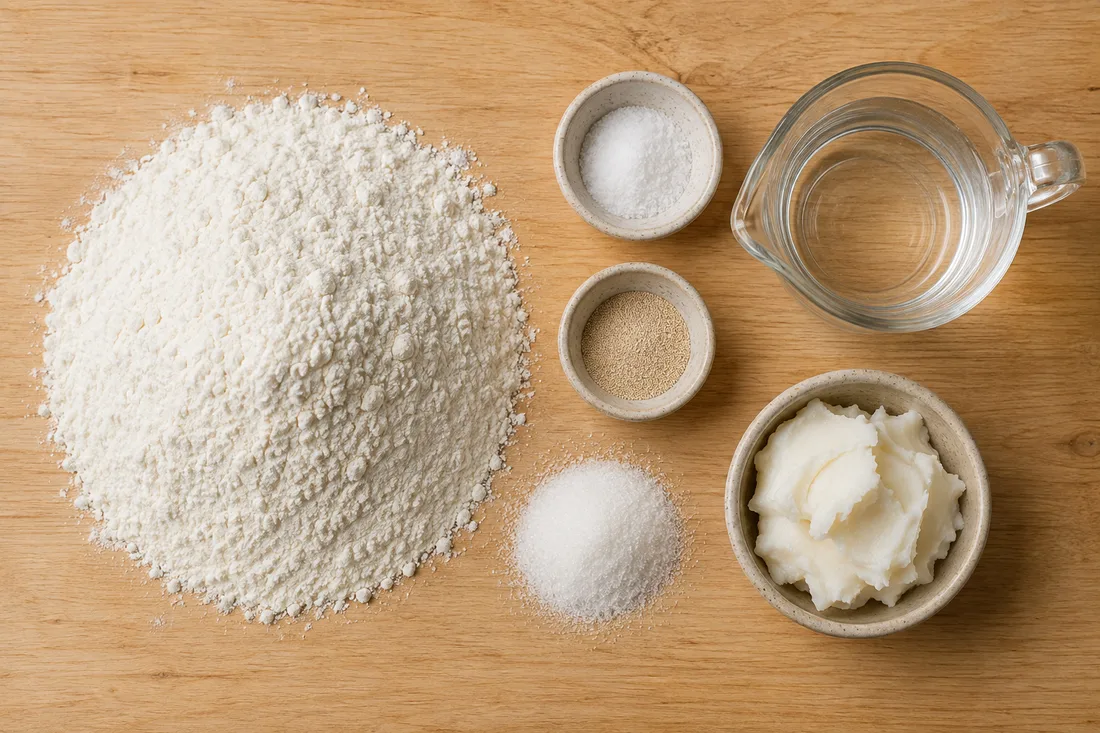
Ingredients
- 500 g bread flour, plus extra for dusting
- 10 g salt
- 7 g instant yeast
- 1 tbsp sugar
- 1 tbsp lard or neutral oil
- 300 ml warm water
Method
- Mix and knead. Combine flour, salt, yeast and sugar. Add lard and warm water, then knead about 10 minutes until smooth and elastic.
- First rise. Cover and let rise until doubled, roughly 1 hour.
- Shape. Divide into 12 pieces. Shape each into a tight ball, then press a rolling pin firmly across the top to create the signature split seam.
- Second rise, covered, 30-40 minutes, seam-side up, until visibly puffed.
- Bake at 220°C with a pan of hot water on the bottom rack for steam, 18-20 minutes, until deep golden and hollow-sounding when tapped underneath.
Troubleshooting, from experience
Crust came out soft, not crisp. Not enough steam in the oven, or the water pan dried out too early. Refill it if baking a second batch.
The seam didn't split properly. The press wasn't firm enough, or the dough had already over-proofed by the time it went in. Press with real confidence right after shaping.
Dense, heavy rolls. Under-proofed, most likely — give the first rise the full hour, longer in a cool kitchen, until it's genuinely doubled.
What to serve it with
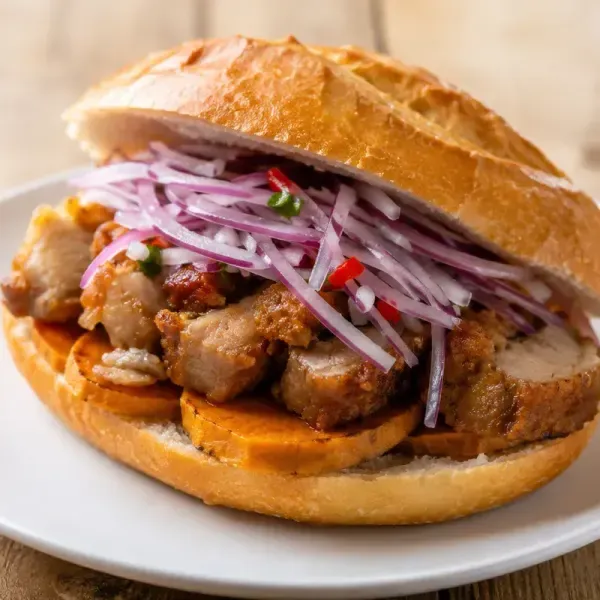
Butter and a slice of queso fresco is the everyday version; stuffed with fried pork it becomes pan con chicharrón, one of the country's most beloved breakfast sandwiches. Alongside a mug of emoliente or coffee, a basket of these rolls is most of what a Peruvian breakfast table actually needs — and if there is pan de anís in the bag too, that is a good morning.
Questions people ask
Can I leave the lard out? You can, and you will still get good bread — just a leaner, chewier roll that goes stale faster. Butter or a neutral oil works in the same amount if lard is not something you keep. What you should not do is add more of it thinking softer is better: past a spoonful or so the crust stops cracking and starts going pale and tender, which is a different bread entirely.
Why did mine not split open on top? Either the seam was not pressed deeply enough, or the dough was over-proofed before it went in. Press firmly — you want a real crease, not a scratch — and get the rolls into a properly hot oven while they still have a little spring left in them. Dough that has risen until it is slack has nothing left to push the split open.
Do I need a stand mixer? No. This is a stiff, low-hydration dough, so it is honestly easier by hand than many breads: ten minutes of kneading and it stops sticking and starts feeling smooth. A mixer saves your arms, nothing else.
How do I keep them? You do not, really — that is the whole point of the bread. Eaten the same day is the intention. If you have leftovers, a paper bag on the counter beats plastic, which traps steam and turns the crust soft and leathery overnight. For anything longer than a day, freeze them and warm them straight from frozen in a hot oven for a few minutes; the crust comes back surprisingly well.

Junior Quintana learned to cook from his mother, Lina, in Junín, in the central Peruvian Andes — a kitchen where chicha morada simmered every Sunday and there were always native potatoes with cheese and choclo on the table. He started Andean Kitchen to share the food he grew up with, in English and without shortcuts: every recipe cooked and tested at home, where it's really made. His favorite dish is, and probably always will be, pachamanca. See how we cook, test and photograph.
Did you cook this?
Tell me how it went — including what did not work. I read every one, and with your permission I will put it on this page, with your first name, for whoever comes next.