
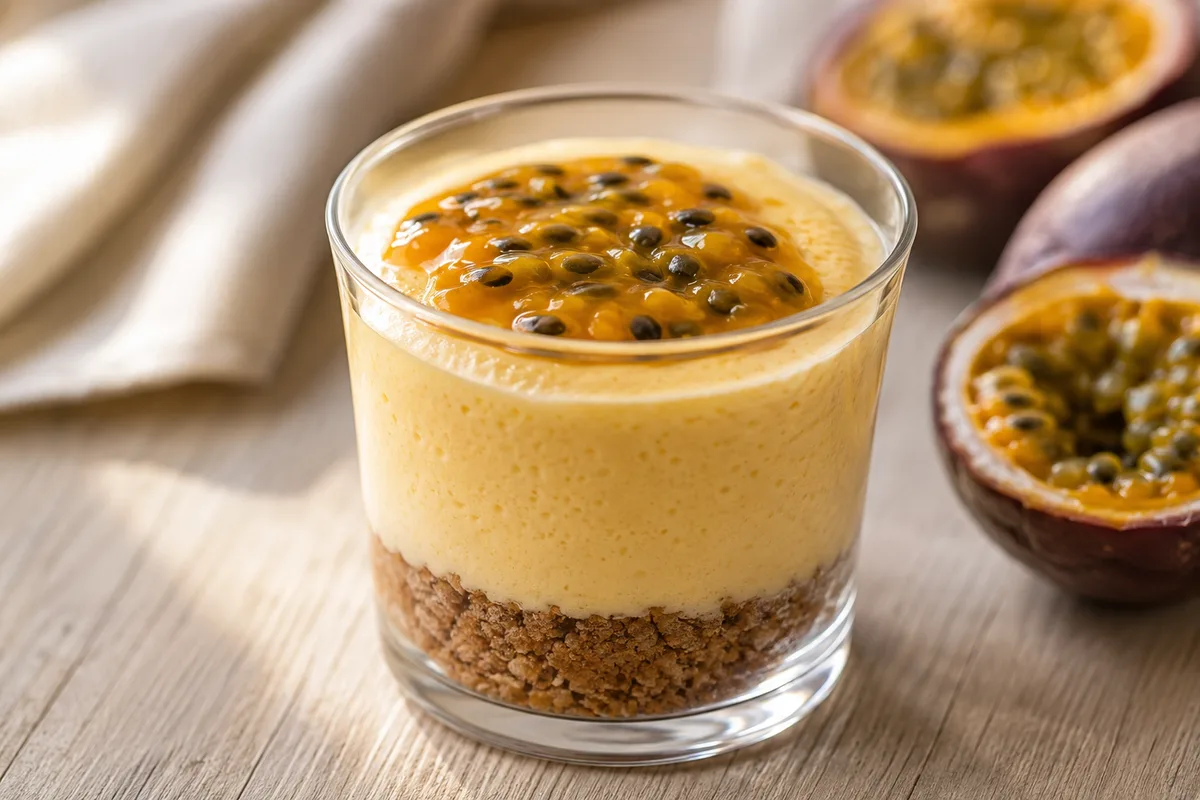
Delicia de maracuyá is newer and more modern than most of the desserts on this site — a no-bake mousse layered over a crumbled cookie crust, the kind of dessert that shows up at contemporary Peruvian family gatherings rather than tracing back centuries. It belongs to the family we call postres de vaso — desserts served in a glass, eaten with a spoon, never sliced — and it's built on the same passion fruit behind refresco de maracuyá, whisked into condensed milk and folded with whipped cream into something bright, tart and genuinely refreshing.
Its appeal is largely practical: no oven, minimal active cooking, and a tropical tang that cuts through richness the way passion fruit reliably does across Peruvian desserts and drinks alike.
This is the dessert that shows up when somebody has to bring something and has no intention of turning on an oven. In our family the phrase is no puede faltar — it cannot be missing — at any birthday where the cake is already handled and someone still wants a second sweet on the table. My aunt makes hers in whatever glasses are clean and measures everything al ojo — by eye, no scale involved — which is the correct approach: nobody has ever complained that a delicia de maracuyá was served in the wrong cup. It goes out of the fridge bien heladito, properly cold, because at room temperature the tartness flattens and the whole point of the dessert goes with it.
Strain the passion fruit pulp thoroughly
Passion fruit seeds add an unwanted crunch to what's supposed to be a smooth, silky mousse — strain the pulp through a fine sieve, pressing to extract the juice, and discard the seeds entirely before mixing with the condensed milk.
A single stray seed in a bite of mousse breaks the whole texture. Strain it properly the first time.
Fold the whipped cream, don't stir it
Vigorously stirring whipped cream into the passion fruit mixture knocks out the air that gives the mousse its light texture — fold it in gently with a spatula, working in broad strokes, to keep as much volume as possible.
Getting the passion fruit right
The fruit's name is not Spanish and not Quechua: maracuyá reached Spanish through Portuguese, from Tupi–Guaraní, the languages of the lowlands east of the Andes. Most Peruvian ingredients on this site carry a highland name; this one arrived from the other direction.
Everything here depends on the maracuyá, and there is no hiding a weak one behind condensed milk. In Peru you buy the fruit itself: heavy for its size, with skin that has started to wrinkle rather than gleam, because a smooth passion fruit is an underripe one. Cut, scoop, strain, and you are done — four fruits give you roughly the cup this recipe asks for, though it varies enough that you should buy one or two more than the arithmetic suggests.
Outside Peru, frozen passion fruit pulp is the practical answer and a genuinely good one. It is sold in blocks or pouches at Latin American groceries, it is usually unsweetened, and it has already been strained for you. Read the label: if sugar appears before the fruit, cut back the condensed milk or the dessert will land somewhere closer to candy. What does not work is bottled passion fruit juice, which is mostly water and apple concentrate and will leave you with a mousse that never sets and never tastes of anything in particular.
The recipe
Ingredients
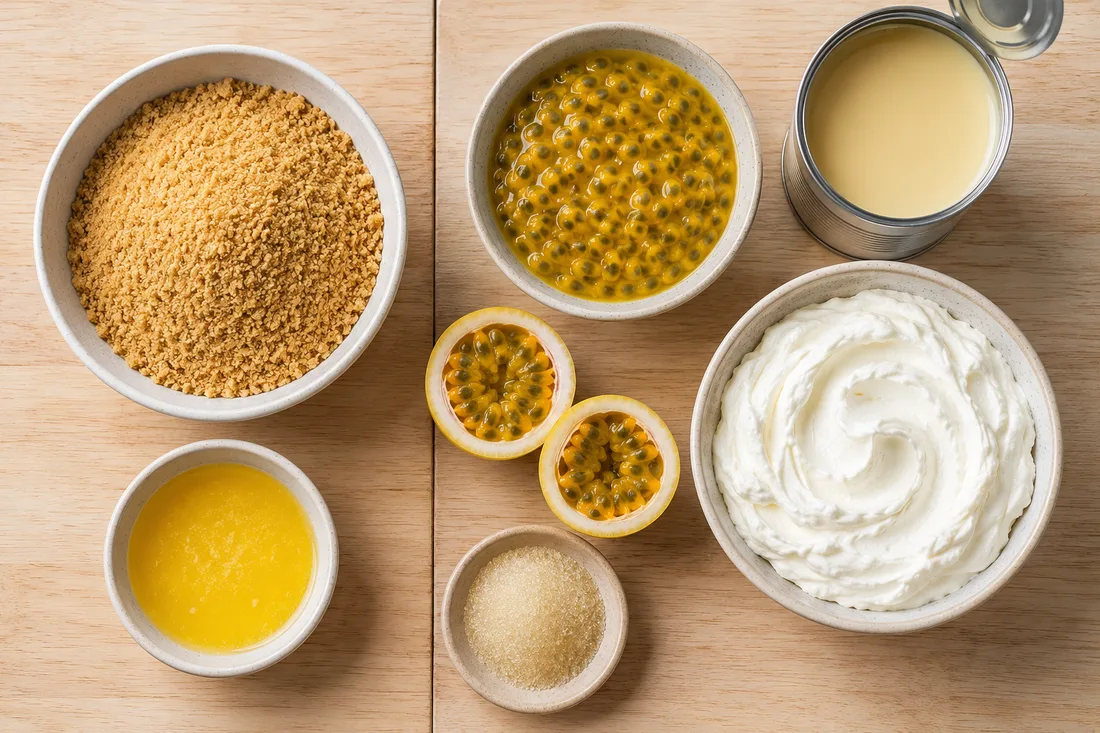
- 2 cups crushed plain cookies (like maria biscuits)
- 1/3 cup melted butter
- 1 cup passion fruit pulp, strained of seeds
- 1 can (14 oz) sweetened condensed milk
- 2 cups heavy cream, whipped to soft peaks
- 1 tbsp unflavored gelatin, dissolved in 3 tbsp warm water
Method
- Press the crust from cookies and butter into a dish. Chill.
- Whisk passion fruit pulp with condensed milk until smooth.
- Stir in gelatin, then fold in whipped cream gently.
- Chill at least 3 hours until set.
Troubleshooting, from experience
Mousse tastes gritty. The seeds weren't fully strained out. Press firmly through a fine sieve.
Mousse didn't set. Not enough gelatin, or it wasn't fully dissolved before mixing in. Make sure it's completely dissolved first.
Texture came out dense, not light. The cream was stirred rather than folded. Use a gentle folding motion.
What to serve it with
Delicia de maracuyá is a complete, self-contained dessert — no accompaniment needed.
Questions people ask
Can I use bottled passion fruit juice? No, and this is the one shortcut that ruins it. Bottled juice is mostly water and apple concentrate — the mousse never sets properly and never tastes of much. Frozen passion fruit pulp is the honest answer outside Peru: unsweetened, already strained, and genuinely good.
Why is my mousse runny? Either the pulp was watery or the cream was folded in too hard. Whipped cream needs to be at soft peaks and folded with broad strokes, not stirred — stirring knocks the air out and the mousse loses the structure holding it up.
How far ahead can I make it? A day, and it is better for the wait — the crust softens slightly against the mousse and the whole thing settles. Assemble it in the glasses, cover, and keep it cold. Serve it bien heladito; at room temperature the tartness flattens and the point of the dessert goes with it.
How many passion fruits do I need? Roughly four for the cup this recipe wants, but it varies enough that you should buy one or two extra. Pick fruit that is heavy for its size with skin that has started to wrinkle — a smooth, gleaming passion fruit is an underripe one.

Junior Quintana learned to cook from his mother, Lina, in Junín, in the central Peruvian Andes — a kitchen where chicha morada simmered every Sunday and there were always native potatoes with cheese and choclo on the table. He started Andean Kitchen to share the food he grew up with, in English and without shortcuts: every recipe cooked and tested at home, where it's really made. His favorite dish is, and probably always will be, pachamanca. See how we cook, test and photograph.

Did you cook this?
Tell me how it went — including what did not work. I read every one, and with your permission I will put it on this page, with your first name, for whoever comes next.