
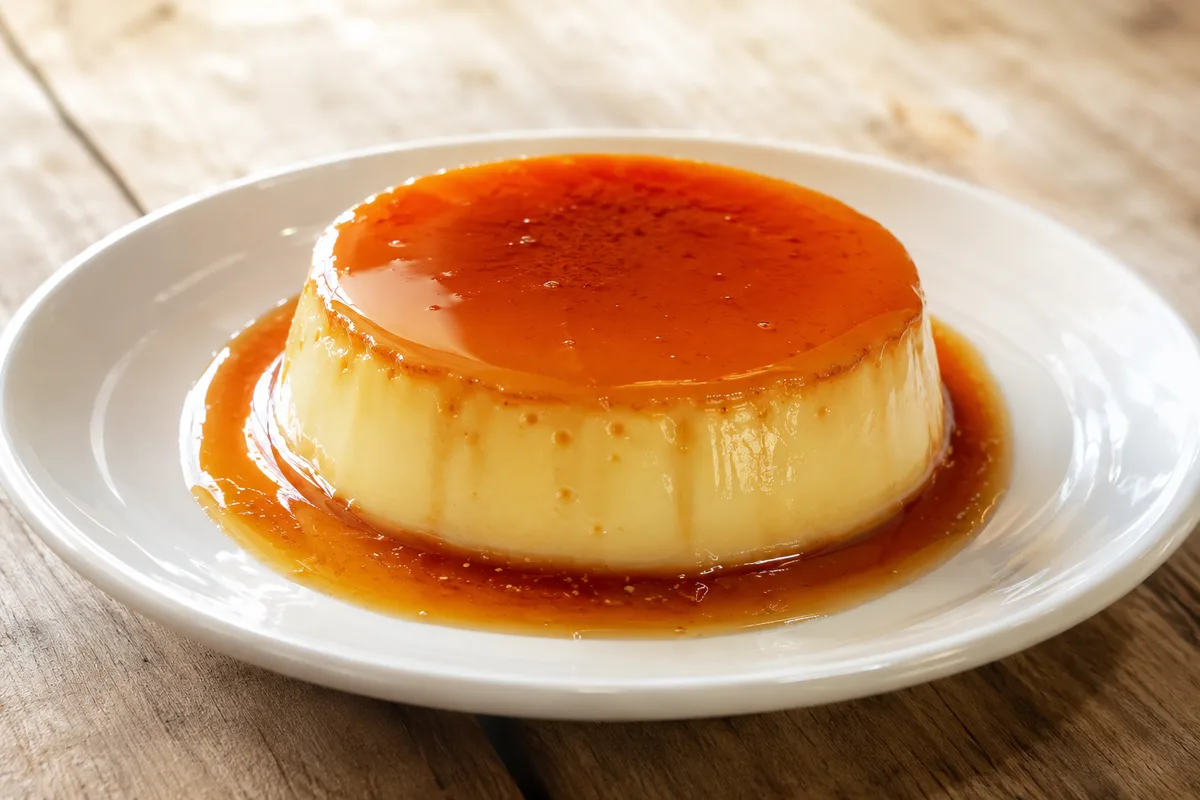
Flan exists across most of Latin America and much of the Spanish-speaking world, but Peru's version, crema volteada, tends to be noticeably denser and eggier than the versions found elsewhere — closer to a firm custard than the wobblier flans common in Mexico or Spain. The extra eggs are not an accident: they are what keeps it from being empalagoso — sweet past the point of pleasure, the one thing a Peruvian dessert is never allowed to be. The name literally means "flipped cream," describing the one dramatic moment every version of this dessert shares: baked upside down with caramel on the bottom, then inverted onto a plate right before serving so the caramel becomes a sauce running down the sides.
It's a dessert nearly every Peruvian household has a version of, usually a family recipe passed down with small variations in ratio — more condensed milk here, an extra egg there — but the basic technique of caramel, custard, water bath and flip stays constant. It belongs to the everyday category of dulces — the sweets that come out of a pot or a mold rather than a bakery box, made at home for no particular reason.
Every family is convinced theirs is the good one. Ours had an extra yolk and a mold that had been in the house longer than I had. The part nobody writes down is the fight over the quemadito — the dark, almost-burnt caramel welded to the bottom of the mold after you flip it, bitter and chewy and the best bite in the whole dessert. My grandmother scraped it out with a spoon and gave it to whoever had helped her. That was the payment.
The caramel needs to move fast
Once sugar starts to caramelize, it goes from pale gold to burnt in the space of under a minute, so the mold needs to be within reach and ready before the sugar even hits the heat. Caramel has a point — a punto, as it gets called in any Peruvian kitchen — and it lasts a few seconds. Pour the caramel the instant it reaches a deep amber color and tilt the mold immediately to coat the bottom — hesitating even briefly risks the sugar hardening in the pan before it ever makes it into the mold.
There's no fixing burnt caramel partway through. If it goes dark and bitter, start the sugar over rather than trying to rescue it.
The water bath is what keeps the custard smooth
Baking the custard directly in a dry oven, without the surrounding hot water, cooks the outside far faster than the center, leading to a custard riddled with small air holes and a rubbery texture instead of silky. The water bath insulates the mold, letting the custard set gently and evenly all the way through — don't skip it even if it feels like an extra step.
The flip, and how not to lose it
This is the moment the dessert is named for and the moment people lose it, usually by moving too early. The custard has to be genuinely cold — four hours minimum, overnight is better. Warm, it has not set enough to hold its shape and it will slump onto the plate in pieces.
- Loosen the edge first. Run a thin knife all the way around, right down to the bottom of the mold. Skipping this is the single most common cause of a torn top.
- Warm the base for a few seconds. Sit the mold in hot water for ten or fifteen seconds — just enough to melt the caramel that welded itself to the metal. Longer than that and you start cooking the custard again.
- One decisive motion. Plate on top, hold both together, turn over in a single move. Hesitating halfway is how it cracks.
If some caramel stays behind in the mold, it has not gone wrong — that is the quemadito, and in most Peruvian kitchens somebody is already waiting with a spoon.
The recipe
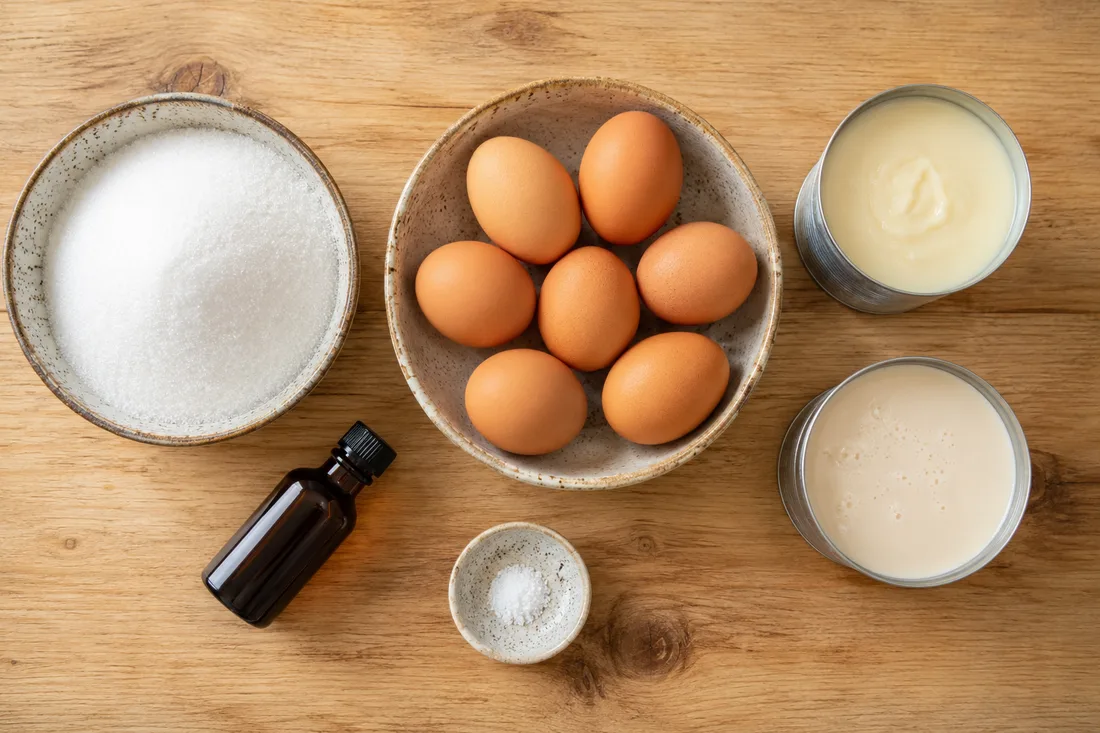
Ingredients
- 1 cup sugar, for the caramel
- 6 eggs
- 1 can (14 oz) sweetened condensed milk
- 1 can (12 oz) evaporated milk
- 1 tsp vanilla extract
- Pinch of salt
Method
- Make the caramel. Melt sugar over medium heat, swirling, until deep amber. Pour immediately into the mold, tilting to coat the bottom.
- Blend the custard. Blend eggs, condensed milk, evaporated milk, vanilla and salt until smooth. Pour over the caramel.
- Bake in a water bath. Set the mold in a larger pan with hot water halfway up the sides. Bake at 160°C (325°F) for 50-60 minutes until set but slightly jiggly in the center.
- Chill and unmold. Cool completely, then refrigerate at least 4 hours. Run a knife around the edge and invert onto a plate.
Troubleshooting, from experience
Custard has air holes or a rubbery texture. It baked without a proper water bath, or the oven ran too hot. Keep the water bath topped up and the oven at the stated temperature.
Caramel seized or hardened in clumps. The sugar was stirred too much while melting. Let it melt mostly undisturbed, swirling the pan gently instead of stirring with a spoon.
Custard wouldn't unmold cleanly. It wasn't chilled long enough. A full 4 hours, ideally overnight, lets it firm up enough to hold its shape when flipped.
What to serve it with
Crema volteada needs nothing beyond its own caramel sauce, though a few fresh berries on the side add a nice contrast to the richness.
Questions people ask
Why does my custard have little holes in it? It baked too hot, or without the water bath. Both cook the outside faster than the center and the trapped steam leaves bubbles behind. The water bath insulates the mold so the custard sets gently and evenly — it is not an optional refinement.
How do I know when it is done? The edges are set and the center still wobbles slightly when you nudge the mold — like gelatin, not like liquid. It firms up considerably as it chills, so pulling it while the middle still moves is correct.
My caramel hardened before I could pour it. What now? Start over with fresh sugar. Caramel goes from pale gold to burnt in under a minute and there is no rescuing it partway. Have the mold within reach before the sugar ever hits the heat — that is the whole preparation.
Can I make it in individual molds? Yes, and they unmold more reliably than one large one. Reduce the baking time by roughly a third and start checking early — small molds set much faster than the recipe time suggests.

Junior Quintana learned to cook from his mother, Lina, in Junín, in the central Peruvian Andes — a kitchen where chicha morada simmered every Sunday and there were always native potatoes with cheese and choclo on the table. He started Andean Kitchen to share the food he grew up with, in English and without shortcuts: every recipe cooked and tested at home, where it's really made. His favorite dish is, and probably always will be, pachamanca. See how we cook, test and photograph.
Did you cook this?
Tell me how it went — including what did not work. I read every one, and with your permission I will put it on this page, with your first name, for whoever comes next.