
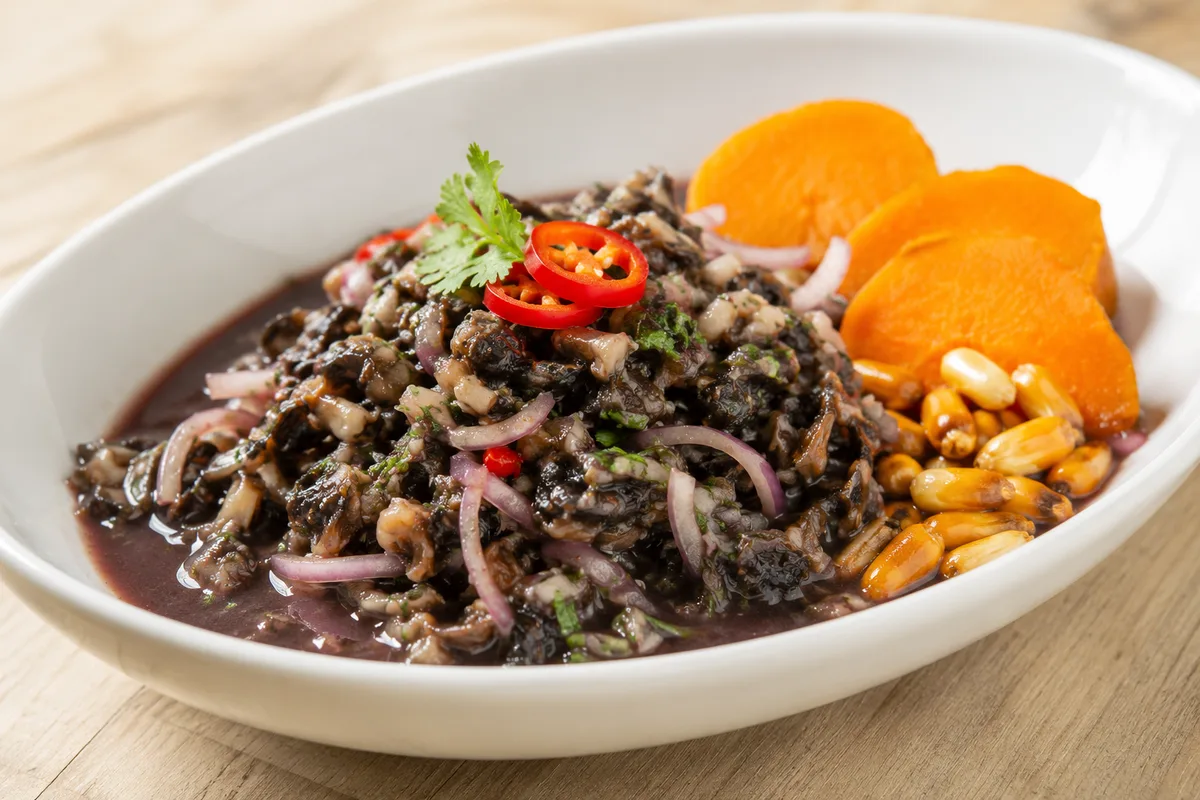
Black clams — conchas negras — live only in the mangrove forests of Tumbes, in Peru's extreme north, and they carry a mineral, almost metallic depth that fresh whitefish ceviche simply doesn't have. Cebiche de conchas negras follows the same basic method as ceviche — raw seafood cured in fresh lime juice with onion and ají — but the clam itself, along with a traditional splash of chicha de jora, makes this version taste distinctly of its specific corner of the coast.
Conchas negras are also harvested by hand from the mangrove mud, a labor-intensive process tied closely to Tumbes' local economy, which is part of why this dish carries real regional pride beyond just its flavor.
These come out of the mangrove mud in Tumbes, pulled up one at a time by concheros who go in to the waist and feel for them by hand. I have never done that and I am not going to pretend I have. What I can tell you is what happens the first time you eat one: the black liquid and the iron in it either win you over on the spot or they do not, and there is no gradual version of that decision.
The clam's own liquid is part of the dish
Unlike fish ceviche, where the seafood alone provides all the flavor, conchas negras release their own briny liquid when shucked, and that liquid gets folded back into the ceviche rather than discarded — it's a genuine part of the dish's character, contributing a depth that lime juice alone doesn't provide.
This isn't ceviche with clams standing in for fish. The clam brings its own liquid, and that liquid is half the point.
Chicha de jora is traditional, not decorative
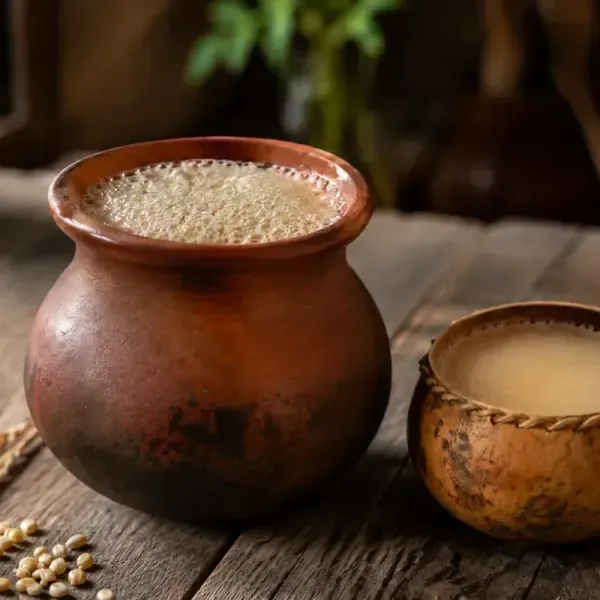
A small splash of chicha de jora stirred into the lime juice is the traditional finishing touch in Tumbes, adding a faint fermented sweetness that rounds out the acidity. It's optional if chicha de jora isn't available, but it's what separates an authentic version from a generic ceviche using clams.
The closed season, and why it matters here
Black clams are under real pressure. They grow only in mangrove, they are gathered by hand from the mud one at a time, and Peru sets a legal veda — a closed season — during which taking or selling them is prohibited so the population can spawn. There are also minimum-size rules, because a clam taken too small never reproduces at all.
An honest kitchen respects both. If a vendor is selling conchas negras during the veda, or selling them noticeably undersized, that is not a bargain — it is the reason the species keeps getting scarcer, and the reason the concheros of Tumbes have to dig longer every year for less.
Outside Peru you will almost certainly not find them at all, and no substitute really works: the mineral, mangrove flavor is the entire dish. Cockles or small clams make a decent ceviche, but call it what it is rather than pretending.
Opening them, and keeping what comes out
Recipes say "cleaned and shucked" and move on, which is unhelpful, because this is the one step that decides whether you end up with the dish or with a bowl of clam in lime.
- Scrub the shells first. They come out of mud and they arrive with it. Cold water and a stiff brush, until the outside is genuinely clean, because whatever is on the shell ends up in the bowl.
- Open them over a container, never over a sink. A short blunt knife into the hinge, twist, run it along the top shell. The liquid that pours out is not waste — it is the dark, briny, faintly metallic thing that makes this a cebiche de conchas negras and not a cebiche with clams in it.
- Strain it and put it back. Pour the collected liquid through a fine sieve to catch grit, then fold it into the ceviche at the end.
They are opened raw, not steamed. Heat cooks the clam and drives off exactly the flavor you are trying to keep.
The recipe
Ingredients
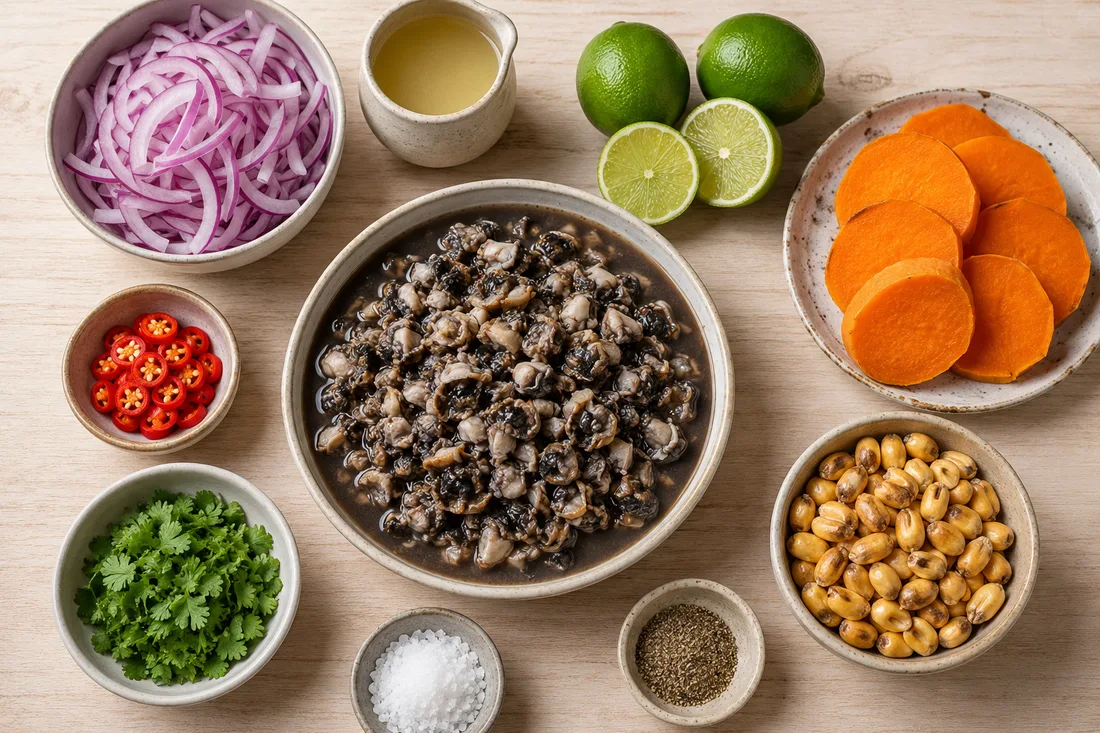
- 500g black clams (conchas negras), cleaned and shucked, with their liquid reserved
- 1 red onion, thinly sliced
- Juice of 8 limes
- 2 tbsp chicha de jora (optional, traditional)
- 1-2 ají limo, thinly sliced
- 1/4 cup chopped cilantro
- Salt · pepper
- Boiled sweet potato and toasted corn (cancha), to serve
Method
- Clean the shucked clams thoroughly, keeping their liquid.
- Combine clams with onion, ají limo, cilantro, salt and pepper.
- Add lime juice, reserved clam liquid and chicha de jora if using.
- Cure 5-10 minutes and serve immediately with sweet potato and toasted corn.
Troubleshooting, from experience
Can't find black clams. Regular clams are the closest substitute available outside Peru, though the flavor will be milder and less mineral.
Taste too intense. Conchas negras have a stronger flavor than most seafood — cut it with a bit more onion and lime if it's overwhelming the first time.
Ceviche sat too long and turned rubbery. As with any ceviche, serve it soon after curing rather than making it ahead.
What to serve it with
Boiled sweet potato and toasted corn (cancha) are the standard pairing, exactly as with classic ceviche.
Questions people ask
How do I know if they are alive? A live black clam is shut, or closes when you tap it. One that stays open and does not react goes in the bin, no exceptions. They should also smell of the sea and of mud, which is correct here, and never of ammonia.
Why is chicha de jora in a ceviche? Because in Tumbes and Piura it belongs there. A splash of fermented corn beer rounds off the lime and gives the ceviche a sour depth that citrus alone does not reach. It is traditional in the north and it is not decoration. Dark beer is the nearest substitute if you cannot find it.
What is the veda, and does it affect me? A closed season, imposed while the clams reproduce so the mangroves are not stripped bare. In Peru it makes them unavailable for months at a stretch. Outside Peru it matters less directly, but it is the reason a supplier may simply have none — and it is worth respecting rather than working around.
What can I use instead? Honestly, nothing quite works: the mineral mangrove flavor is the whole dish. Regular clams or cockles make a good ceviche that is simply a different one, milder and lighter. If you make that version, keep their liquid too — the technique still pays off.

Junior Quintana learned to cook from his mother, Lina, in Junín, in the central Peruvian Andes — a kitchen where chicha morada simmered every Sunday and there were always native potatoes with cheese and choclo on the table. He started Andean Kitchen to share the food he grew up with, in English and without shortcuts: every recipe cooked and tested at home, where it's really made. His favorite dish is, and probably always will be, pachamanca. See how we cook, test and photograph.
Did you cook this?
Tell me how it went — including what did not work. I read every one, and with your permission I will put it on this page, with your first name, for whoever comes next.