
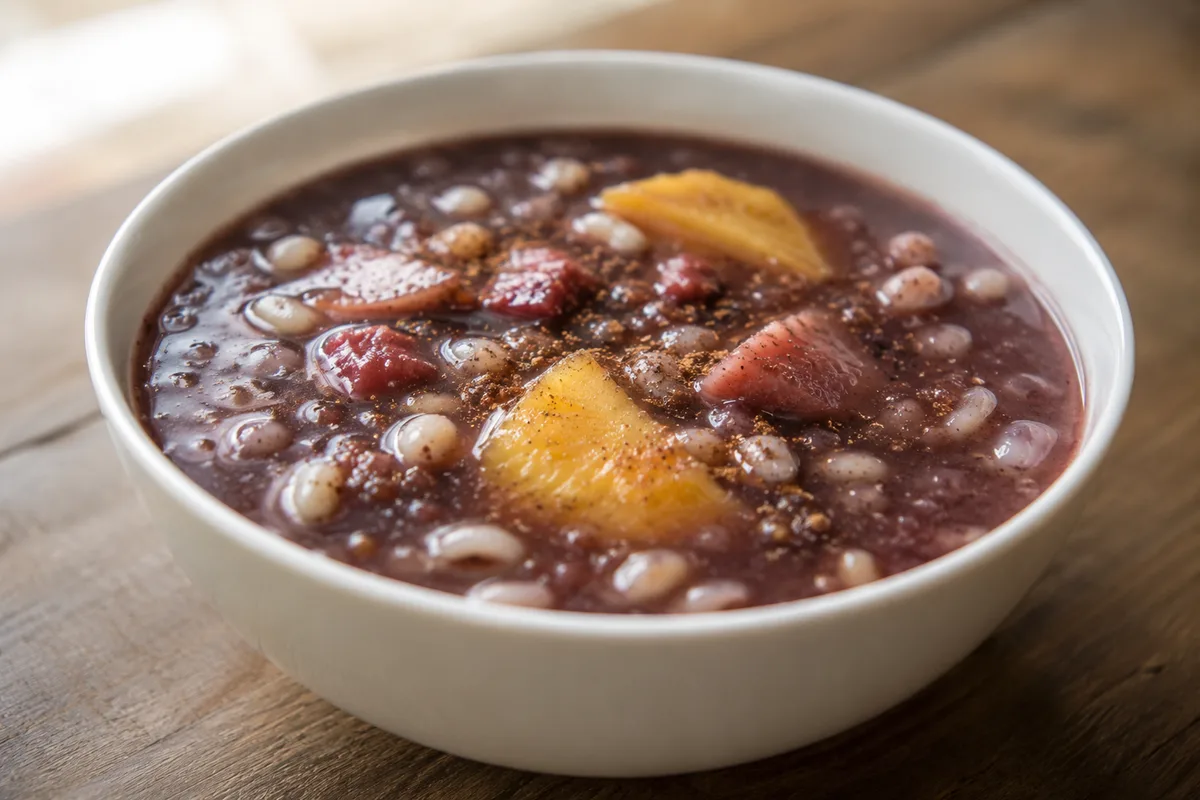
Champús belongs to the same purple corn family as mazamorra morada, but it takes the concept somewhere heartier: whole kernels of white hominy corn — mote — simmered until tender, then folded into a purple corn, quince and pineapple broth thickened until it sits somewhere between a drink and a pudding. It's served warm, almost always, which sets it apart from the room-temperature or chilled way mazamorra usually reaches the table.
This is a highland dish through and through, more closely tied to sierra towns than to the coast, and it shows up around religious festivals and cold-weather gatherings, where it is sold hot by the glass and counts as a dulce and a drink at the same time, where something warm and substantial matters as much as something sweet.
Champús is a cold-morning food, and I grew up where the mornings are cold. My grandmother used to buy me one on the way to school, in a glass I had to hold with both hands, and I remember being annoyed the first time — I had been expecting something to drink and I got something to chew. I have not been annoyed about it since. In the sierra they sell it before the sun is properly up, and buying one is less a decision than a reflex.
Two separate cooks, joined at the end
Champús is really two preparations run in parallel and combined only near the finish: the hominy corn, which needs a long, patient boil on its own until fully tender, and the purple corn and fruit broth, simmered separately until it's deeply colored and fragrant. Rushing either half, or trying to cook them together from the start, tends to leave one component undercooked while the other overcooks.
The hominy and the purple corn broth don't need each other to develop — they only need each other at the very end, once both are already right.
Quince and pineapple, not just spice, build the flavor
Where mazamorra leans mostly on dried fruit and spice for its flavor, champús keeps whole pieces of quince and pineapple simmering in the broth long enough to soften and release their flavor directly into the liquid, and often keeps some of those pieces in the final pudding rather than straining everything out. That fruit is what gives champús its rounder, less purely spiced flavor compared to mazamorra.
Champús and mazamorra morada, side by side
They start from the same purple corn and get confused constantly, so it is worth being clear about what actually separates them:
- Temperature. Mazamorra is served cool or at room temperature. Champús is served warm, and that is most of the point of it.
- Body. Mazamorra is thickened with sweet potato starch into something smooth you eat with a spoon. Champús has whole mote kernels in it, so it is chewy rather than smooth.
- Fruit. Mazamorra leans on dried fruit and spice. Champús keeps whole quince and pineapple in the pot, and often in the bowl.
- Where. Mazamorra is coastal and everywhere. Champús is a highland dish, tied to cold mornings and festival days.
If you have made mazamorra, you already understand the broth. Champús is that broth given something to chew on and served hot.
Why it is served warm, and when people eat it
Almost everything else made with purple corn in Peru is served cold, which is what makes champús confusing to anyone meeting it after mazamorra morada or chicha morada. The warmth is not a variation. It is the whole reason the dish exists.
It belongs to early mornings and to cold months, sold from a pot on a cart along with other warm things at an hour when nobody wants a chilled drink. In much of the sierra it turns up around the November holidays and through the rainy season, and in some towns it is tied to particular feast days. It also has enough body to work as breakfast on its own, which is exactly how a lot of people treat it.
Where the name comes from is not settled, and versions of champús exist in Colombia and Ecuador with different fruit and the same warm sweetness. Anyone who tells you flatly which came first is guessing.
The recipe
Ingredients
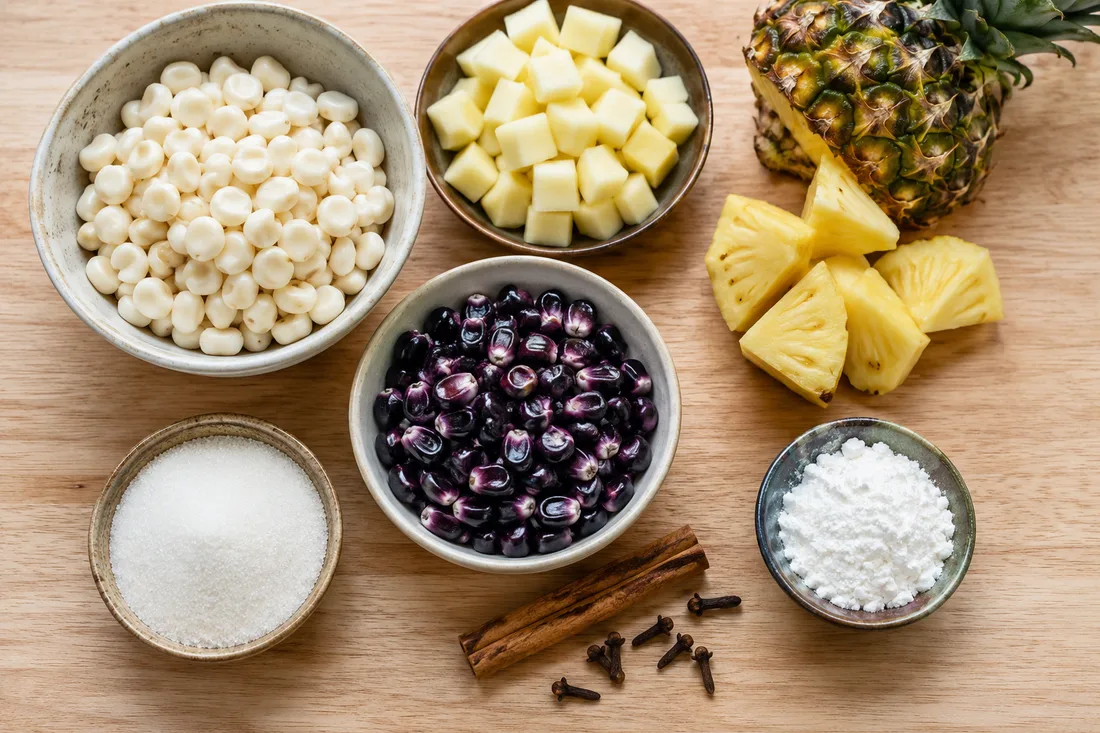
- 1 cup dried white hominy corn (mote), soaked overnight
- 8 cups water
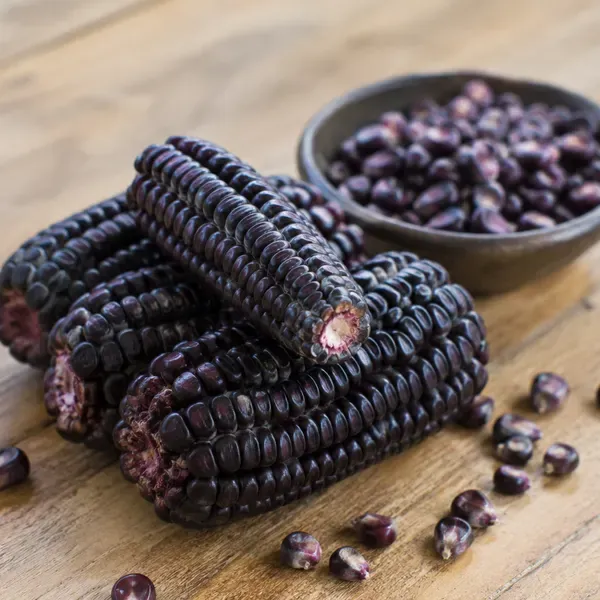
- 1 cob purple corn (maíz morado), or 1/4 cup dried purple corn kernels
- 1 quince, peeled and diced
- 1 cup diced pineapple, plus the peel
- 1 cinnamon stick · 4 cloves
- 3/4 cup sugar, or to taste
- 3 tbsp cornstarch, dissolved in 1/4 cup cold water
Method
- Cook the hominy in half the water until very tender, 45 minutes to 1 hour. Drain and set aside.
- Make the purple corn broth. Simmer purple corn, quince, pineapple and peel, cinnamon and cloves in the remaining water 30-40 minutes. Strain, keeping any fruit pieces you'd like in the final pudding.
- Combine the broth with the cooked hominy, add sugar, and bring to a simmer.
- Thicken with the dissolved cornstarch, stirring until it reaches a pudding-like consistency. Serve warm.
Troubleshooting, from experience
Hominy stayed tough. It wasn't soaked long enough beforehand, or the boil was rushed. Give it the full overnight soak and a patient hour of simmering.
Pudding turned lumpy when thickening. The cornstarch slurry was poured in all at once without stirring. Add it gradually while stirring constantly.
Flavor tastes flat. The purple corn broth wasn't reduced enough before combining. Let it simmer the full time to concentrate before straining.
What to serve it with
Champús is a complete dessert or warm snack on its own, best eaten hot, straight from the pot on a cold sierra evening.
Questions people ask
What is mote doing in a fruit pudding? Giving it body and something to chew. Mote is boiled hominy corn, and without it champús is a thick fruit drink rather than the spoonable thing it is meant to be. It goes in whole and stays whole.
Can I skip the quince? You can, and it will be noticeably flatter. Quince gives champús its perfume and a tartness that stops the whole thing from being just sweet. If you genuinely cannot find it, a tart apple plus a little extra pineapple gets you partway there.
How is this different from mazamorra morada? Both start with purple corn. Mazamorra is thickened with sweet potato starch, served cold, and set firm enough to hold a shape. Champús is looser, served warm, and carries whole mote and pieces of fruit. They are cousins, not versions of each other.
Why did mine turn out watery? Not enough starch, or the fruit released more liquid than the recipe expected. It should coat a spoon thickly, not pour. Add a little more dissolved starch and give it a few minutes of gentle heat — but stop before it sets, because champús is meant to be spoonable, not sliceable.

Junior Quintana learned to cook from his mother, Lina, in Junín, in the central Peruvian Andes — a kitchen where chicha morada simmered every Sunday and there were always native potatoes with cheese and choclo on the table. He started Andean Kitchen to share the food he grew up with, in English and without shortcuts: every recipe cooked and tested at home, where it's really made. His favorite dish is, and probably always will be, pachamanca. See how we cook, test and photograph.

Did you cook this?
Tell me how it went — including what did not work. I read every one, and with your permission I will put it on this page, with your first name, for whoever comes next.