
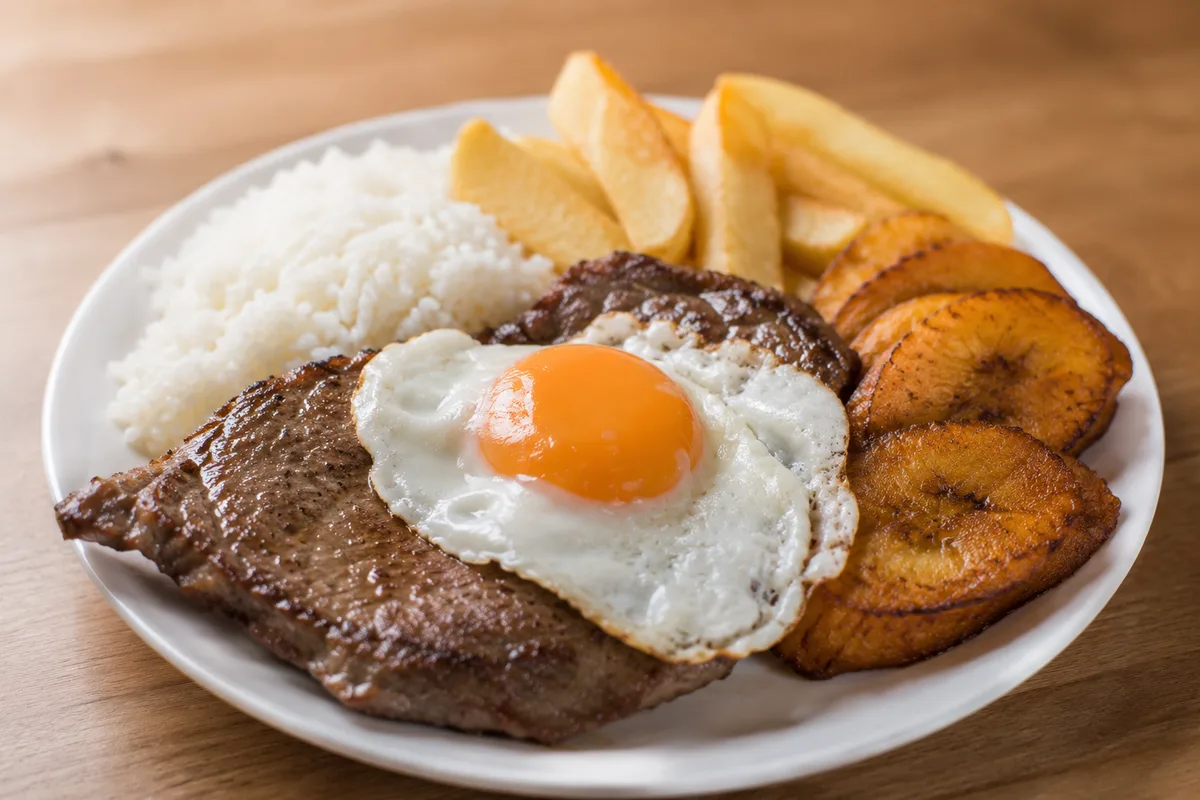
The name "a lo pobre" — "poor man's style" — is a genuine irony once the plate arrives: steak, a fried egg on top, white rice, a full portion of fries, and fried sweet plátano, all on one plate. The egg has its own name in this construction — the steak is served a caballo, on horseback, which is what any Peruvian menu means when it puts those two words after a dish. The theory behind the name is that it originated as a way to stretch a smaller cut of steak into a filling, satisfying meal by surrounding it with cheaper starches — the poverty is in the cut of meat, not in the size of the plate.
Whatever its origin, it's become one of Peru's most reliably ordered home-style mains, the segundo a restaurant serves without needing to explain, and a favorite for anyone who genuinely can't decide between rice, fries or plantain as their side.
This was my order as a kid, every single time, and I never once pretended otherwise. My mother would ask what I wanted and I would say a lo pobre before she finished the question, because it was the only plate where you did not have to choose. Rice and fries and plantain and an egg, all of it at once. She used to say I ordered it because I could not make up my mind. She was right.
Everything gets cooked separately, timed to finish together
Fries, rice, plantain and steak all cook by different methods and at different speeds — start the rice and get the fries going first, since they take longest, and sear the steak and fry the egg last so both arrive at the table hot. Planning the order matters more than any individual technique here.
This isn't a complicated dish. It's several simple things, timed so none of them go cold waiting on the others.
The egg yolk is meant to run into everything
Fry the egg sunny-side up with a soft yolk, not hard — that yolk is meant to break and run over the steak and rice once the plate is cut into, becoming an unofficial sauce for the whole dish. A fully cooked, hard yolk misses the point.
"A lo pobre" is a style, not a dish
The words attach to whatever protein is underneath them. Bistec a lo pobre is the steak version, but a Peruvian menu will just as readily offer pollo a lo pobre, chuleta a lo pobre or milanesa a lo pobre, and every one of them arrives the same way: the meat, the fried egg on top, rice, fries and fried plantain.
So if you see those three words on a menu anywhere in Peru, you already know what is coming and roughly how much of it. What you are choosing is only the thing in the middle.
The plantain is the part people abroad most often leave out, and it is the part that makes the plate make sense. Use one that is properly ripe — the skin should be more black than yellow — and fry the slices until the edges go dark. Its sweetness is what stops the plate from being three kinds of salt and starch in a row.

Why it is called "poor man's" when it has the most on it
The name confuses everyone who meets the dish, and it should. The most loaded plate on the menu is the one named after poverty.
The likeliest explanation is the plainest one: the steak is small and the cheap things around it are doing the work. Rice, potato and plantain are what a household always has. Pile enough of them beside a modest cut of beef and one steak feeds a family. The egg is the last touch that makes it feel like a proper meal instead of a stretched one.
Chile and Bolivia both have their own a lo pobre, built on the same idea, which suggests the style traveled rather than being invented in any one kitchen. Nobody has ever settled which country got there first, and anyone who tells you flatly is guessing.
The recipe
Ingredients
- 4 beef steaks (sirloin or similar, about 200g each)
- 4 eggs
- 2 ripe plantains, sliced and fried
- 4 cups cooked white rice
- 4 potatoes, cut into thick fries and fried
- 3 garlic cloves, minced
- 3 tbsp oil · salt · pepper · ground cumin
Method
- Season the steaks with garlic, salt, pepper and cumin. Rest 15 minutes.
- Sear to your preferred doneness. Rest.
- Fry the eggs sunny-side up in the same pan.
- Plate the steak topped with egg, alongside rice, fries and fried plantain.
Troubleshooting, from experience
Some components went cold. Poor timing. Start the longest-cooking items first and finish the quick ones last.
Steak came out tough. Overcooked, or the wrong cut for a quick sear. Choose a tender cut and don't overcook it.
Egg yolk broke too early or cooked hard. Handled roughly, or left in the pan too long. Cook gently and pull it while the yolk is still soft.
What to serve it with
Bistec a lo pobre is already a complete meal — everything you'd want on the side is already on the plate.
Questions people ask
What cut of beef should I use? Something thin and quick: sirloin, rump, or skirt. It goes into a hot pan for a couple of minutes a side and comes out. A thick cut is the wrong choice — this is not a steak you rest and slice, it is a steak that shares a plate with four other things and has to be ready when they are.
What kind of plantain do I need? Ripe, with skin that has gone yellow and blotched with black. Green plantain is a different ingredient and fries up starchy rather than sweet, and the sweetness is exactly the point here — it is what plays against the salt of the beef and the runny yolk.
How do I get everything hot at the same time? Work backward from the egg, which takes two minutes and cannot wait. Rice first and covered, then plantain, then fries, then beef, then egg. Anything already done sits in a low oven. Peruvian home cooks tend to keep a plate warming over the rice pot, which works just as well.
Is bistec a lo pobre the same as lomo a lo pobre? Same idea, different cut and price. Lomo is tenderloin and it is what a restaurant charges more for; bistec is the everyday version and what most households make. The rice, fries, plantain and egg are identical. The style is the dish, not the meat.

Junior Quintana learned to cook from his mother, Lina, in Junín, in the central Peruvian Andes — a kitchen where chicha morada simmered every Sunday and there were always native potatoes with cheese and choclo on the table. He started Andean Kitchen to share the food he grew up with, in English and without shortcuts: every recipe cooked and tested at home, where it's really made. His favorite dish is, and probably always will be, pachamanca. See how we cook, test and photograph.
Did you cook this?
Tell me how it went — including what did not work. I read every one, and with your permission I will put it on this page, with your first name, for whoever comes next.